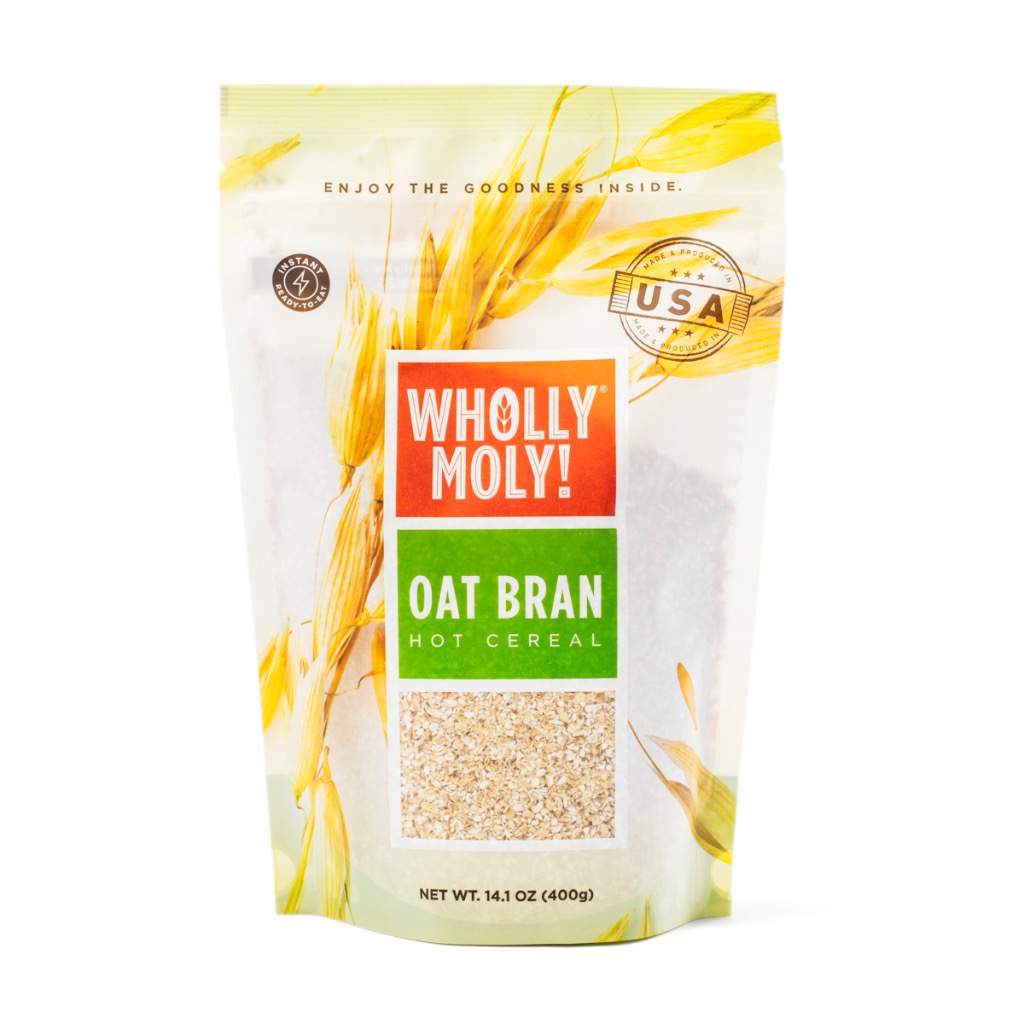
The health-food brand turning the part of the oat everyone throws away into a mission - and a business.
Here is a thing about oats that turns out to matter a great deal: when you mill them, the fibrous outer casing - the bran - is the part most processes treat as leftover. Wholly Moly! looked at that leftover and decided it was the product.
This is a slightly stubborn premise, which is usually where the interesting companies live. Oat bran is rich in fiber and low in calories, which are two attributes that sound great in a nutrition seminar and terrible in a marketing meeting, because fiber is possibly the least glamorous word in food. You cannot make fiber aspirational the way you can make, say, a matcha latte aspirational. What you can do is bet that a category nobody wants to be seen in is also a category nobody else is competing in. That is the Wholly Moly! bet.
The company was founded around 2015 and went to market in 2017, sourcing oats from the US and Canada and turning them into instant porridge and powdered oat drinks aimed squarely at China. The pitch to consumers is a diet swap: less refined white rice, more whole grain. This is not a small ask - white rice is not a snack in China, it is infrastructure - which is exactly why, if it works, it is hard to undo. Habits, once changed, are expensive to change back. That durability is the moat.
The founder, Claire Cao Fang, did not arrive from the food world. She previously held leadership roles under Rocket Internet, including running Groupon's China operation. So the resume reads less like a chef and more like an operator who understands distribution, unit economics, and the unglamorous machinery of getting a physical product from a warehouse to a doorstep. For a consumer brand, that is arguably the more useful background.
The corporate structure is its own small curiosity. Wholly Moly! is a US-owned brand - a subsidiary of USA-based Yum Delight - with an address in San Mateo and its commercial heart in Shanghai. So you have American and Canadian oats, sold by a US company, back into the Chinese market, marketed on Xiaohongshu and Douyin. The supply chain is not a place, it is a route. And provenance - "these oats came from North America" - is not a logistics footnote here. It is the feature.
The range fans out from a single idea - oat bran as a meal - into porridge, cereal, drinks, and snacks. The best-seller remains the plainest one.
High-fiber oat bran as instant porridge, no sugar added. The flagship, and the product the whole company argues for.
Whole Grains Council certified, ~5g fiber and 6g protein per serving, zero added sugar, positioned as a meal replacement.
Plant-based drinks packed in lightweight Ecolean pouches - lower packaging weight, lower freight, lower carbon.
Rounding it out: a 5-grain porridge, quinoa drinks, and whole-grain rice chips - all extensions of the same fiber-forward logic, sold direct-to-consumer and through e-commerce on both sides of the Pacific.
A roughly US$10 million Series A is not a headline-grabbing number in the abstract. What makes it interesting is who is behind it. C Ventures is not a food fund; it is a culture-and-lifestyle fund that has backed brands like Casetify. Its interest in a fiber company is a tell: the bet is less on nutrition science and more on a generation deciding that whole grains are, finally, cool.
The stated use of funds was unglamorous and correct - working capital, supply-chain expansion, and a wider user base, with room to push beyond porridge and drinks into other formats and health concerns.
Claire Cao Fang begins shaping a concept: more whole-grain, high-fiber food in the Chinese diet.
Oat-bran porridge and powdered oat drinks, made from North American oats, hit the market.
Annual sales reach roughly RMB 100M (~US$15M).
Raises ~US$10M led by C Ventures to expand supply chain and product range.
Adopts lightweight Ecolean pouches for oat drinks, cutting packaging weight and carbon.
Grows US presence via an Amazon storefront and the Weee! Asian grocery marketplace.
"Oat bran - the fibrous outer casing of the oat - is rich in fibre but low in calories."
High-fiber oat products - oat-bran instant porridge, 100% oats hot cereal, oat and quinoa drinks, and whole-grain snacks - with no added sugar.
Founded by Claire Cao Fang. It operates between San Mateo, California and Shanghai, China, and is a subsidiary of USA-based Yum Delight.
About US$10 million in a Series A round led by C Ventures, the fund founded by Hong Kong entrepreneur Adrian Cheng, in 2020.
Oat bran is the fibrous outer layer of the oat - rich in dietary fiber but relatively low in calories - which the brand positions as a healthier staple than refined white rice.
Through Chinese e-commerce and retail channels and, in North America, via Amazon and the Weee! Asian grocery marketplace.
Search these for founder interviews, brand stories, and product walkthroughs: