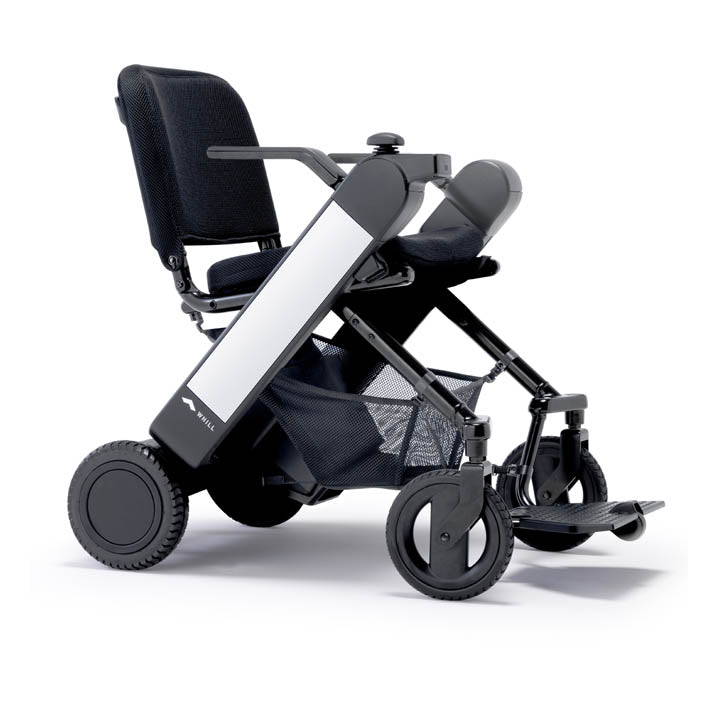
A traveler at Haneda Airport sits down in a small, white, four-wheeled machine outside Gate 142. She taps a destination on a touchscreen. The chair pulls away, threads itself between roller bags and toddlers, slows for a family in front of it, and arrives at security. Then it turns around, by itself, and drives back to the gate. Nobody pushed it. Nobody steered. Nobody called it a wheelchair.
01 Who they are now
WHILL is, on paper, a medical device company. In the cabinet of a hospital procurement officer, the Model C2 power chair sits alphabetically between three other things that look like equipment. In the wild it does not. The product is too clean. The wheels are too unusual. The brand book references a car launch.
That is the point. WHILL was assembled in 2012 by three engineers who had been making other things: Satoshi Sugie was designing cars at Nissan, Junpei Naito was at Sony's R&D division, and Muneaki Fukuoka was building medical imaging gear at Olympus. They left those jobs to build, in a small apartment in Machida, a device that none of their employers would have signed off on, in a category none of them had worked in.
Today WHILL sells two personal power chairs - the omni-wheeled Model C2 and the foldable Model F - through dealers and direct-to-consumer in 30+ countries. It also runs an autonomous mobility service that, as of the most recent count the company will confirm, has carried passengers more than 700,000 times, mostly in airports.
02 The problem they saw
The mobility scooter industry is, charitably, a backwater. The dominant aesthetic is beige. The dominant business model is reimbursement codes. The user is treated as a patient. Many people who would benefit from a powered chair, the founders learned, simply do not buy one - because the social cost of being seen in one outweighs the utility of getting to the store.
There were also engineering problems nobody had bothered to fix. Sidewalks are not smooth. Cracks throw small front casters. Curb cuts are inconsistent. A two-block trip can require navigating fifteen surfaces, and the legacy industry's response was, broadly, to suggest the user not go.
Sugie and his co-founders made a list. The list had two columns: image and terrain. They started at the top.
Four numbers that do not, on their own, mean anything. Stacked, they describe a company that has done something more interesting than it usually gets credit for.
03 The founders' bet
The founders' bet was specific, and slightly heretical. They believed the wheelchair was a consumer electronics product that had been mis-shelved in a medical catalog. If it were treated as consumer hardware - styled, app-connected, branded - the people who refused to buy one would buy one.
To make the point unmistakable, they did something a little theatrical. WHILL's first prototype, the Type-A, did not debut at a medical trade show. It debuted at the Tokyo Motor Show. Among the concept cars. Where the press took pictures of it as if it were a vehicle.
This is the kind of decision that sounds clever in a deck and tends, in practice, to be expensive. It also worked. The prototype was reported on as design news, not as accessibility news. The company started raising money from venture investors rather than hospital systems.
04 The product, briefly
The hardware does two unusual things. First, the wheels. WHILL's signature omni-wheel has 24 small rollers around its perimeter. The big wheel rolls forward; the little rollers handle sideways slip. A WHILL chair can crab into a tight turn. It can climb up a 2-inch curb. It can handle gravel, hills, light snow, and the kind of pavement crack that would launch a conventional caster.
Second, the form. The Model C2 looks like an industrial design student's thesis project, which is a compliment. The Model F folds in under three seconds, weighs less than 53 pounds with the battery out, and fits in the trunk of a Toyota Corolla. It also unlocks from your phone, like a car. The Model F won the CES 2022 Best of Innovation Award in Accessibility, which is a category that does not usually involve CES.
What you can actually do with one
Go to the grocery store two blocks away. Take a flight without arranging gate-side assistance you may or may not actually get. Visit a friend who lives at the top of a gravel driveway. Sit at a normal-height table instead of one cut for a hospital-issue chair. Look like a person, not like a diagnosis.
WHILL · A short, opinionated timeline
05 The proof
The proof is in the deployments. WHILL's autonomous chairs operate at Haneda in Tokyo as permanent infrastructure. They have run trials, some now permanent, at Winnipeg Richardson International, San Jose International, and at airports in Atlanta, Dallas, Houston, New York, Grand Rapids and Toronto. Airports are the natural first market: they are the place where the gap between where you can walk and where you need to be is widest, the customer is captive, and the operator is paying labor to push wheelchairs by hand.
The proof is also in the partnerships. Toyota's growth fund, Woven Capital, led a strategic round in April 2022 specifically to scale the service side of the business. Autodesk has worked with WHILL on generative design of the Model F's chassis. Daiwa Securities, INCJ, Eight Roads and SBI Investment have all written checks.
Where the money has gone
Funding by round · approximate, in USD millions
A capital stack that gets less heroic and more strategic as it goes. Series C and D paid for the factory; the Toyota round paid for the service.
06 The mission, in plain words
WHILL describes its mission as delivering mobility, confidence, and joy. Most companies use three abstract nouns the way they use placeholder text - to fill the space until a real sentence shows up. WHILL's three are unusually traceable to the product.
Mobility is the omni-wheel. Confidence is the design language that lets a user roll into a restaurant without scanning the room. Joy is, embarrassingly enough, what people say in the testimonials - that the chair feels less like a piece of equipment and more like a thing they own.
It is fashionable to be cynical about mission statements. It is also possible to be wrong about it.
07 Why it matters tomorrow
The number of people over 65 in OECD countries is going up. The number of airports willing to staff manual wheelchair pushers is going down. The number of mobility-impaired travelers willing to surrender their independence to a stranger has always been low and is dropping further as the affected population ages into a generation that grew up assuming software solves things.
WHILL is one of a small number of companies positioned at the intersection of those three trend lines. The hardware is regulated, expensive to develop, and design-led. The service is sticky, contract-based, and scales per airport rather than per user. Neither piece is easy to copy.
The harder question is the one WHILL has not fully answered yet: whether the autonomous service generalizes beyond airports - to hospitals, theme parks, conference centers, retirement communities, and eventually the kind of last-200-meter problem that exists on every campus in every city. The bet is that it does. The capital structure says Toyota agrees.
08 Back at Gate 142
The traveler from the opening paragraph - the one who tapped a destination on a touchscreen and was driven, by a chair, to security - did not say anything memorable on her way there. She didn't have to. She made a phone call. She read part of a magazine. She arrived at her gate on time, which is the highest praise a piece of airport infrastructure can receive.
That is what WHILL has built, more or less: a quiet machine for the part of the trip nobody used to be able to make on their own. The wheelchair, reclassified as something you do not have to think about.
Which is, if you squint, what the founders said they were going to do in 2012. They were just polite enough not to put it in the deck.