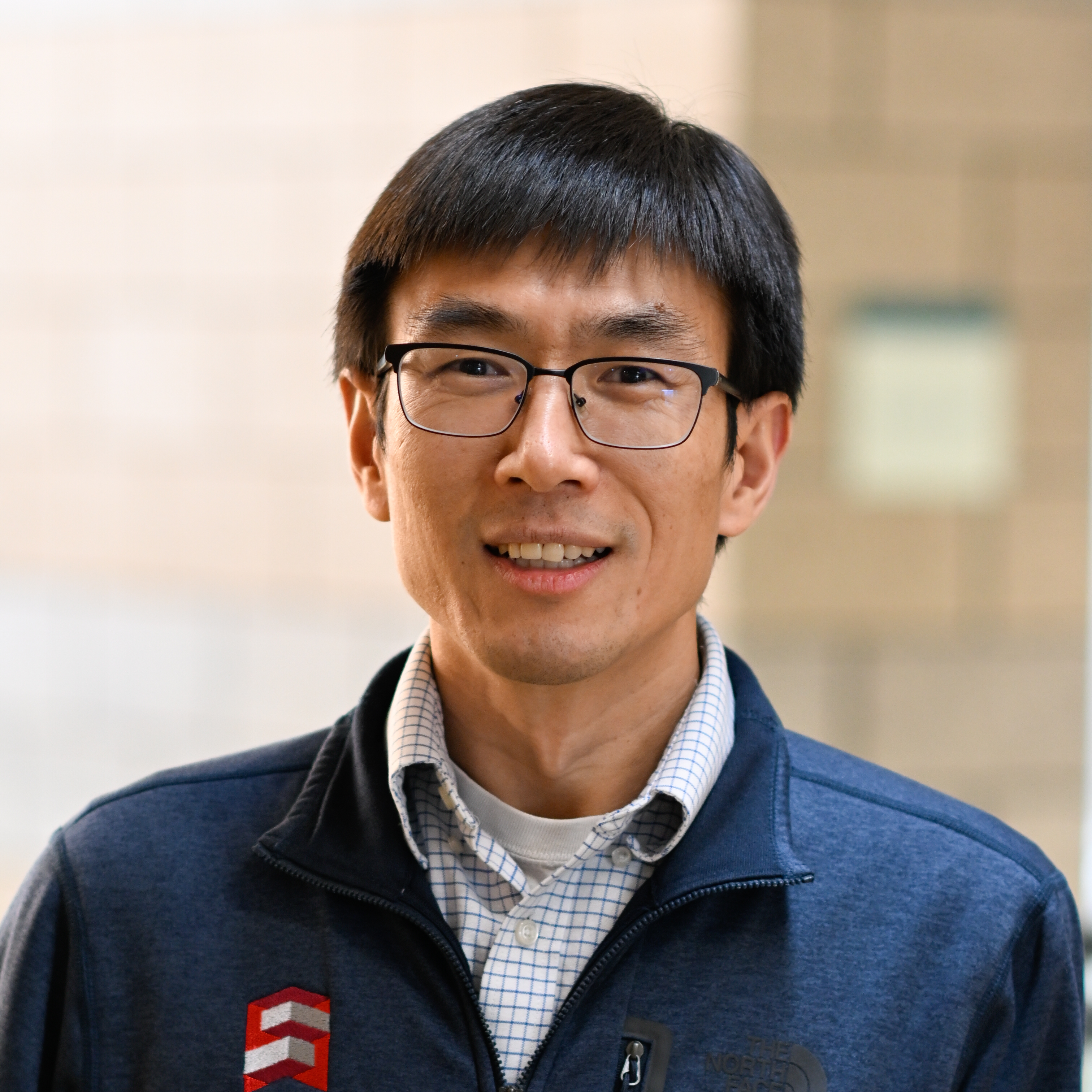
Most people who help launch five FDA-approved medicines call it a career. Wenqing Yao called it a warm-up.
In January 2024, a quiet company in Wilmington, Delaware stepped into the open with $102 million and a name that reads like a chemist's private joke - Synnovation, synthesis plus innovation. At the front of it is Wenqing Yao, Ph.D., founder and CEO, and a man whose idea of a fresh start involves reassembling the exact team that already changed how a generation of cancer and inflammatory diseases gets treated.
Synnovation is built on a deceptively simple thesis: do not chase the newest, riskiest target. Take the ones biology has already validated - the targets everyone agrees matter - and build a molecule that does the job better. Cleaner. More selective. Easier on the patient. In an industry that fetishizes being first, Yao is comfortable being unmistakably best.
The lead program, SNV1521, is the clearest expression of that philosophy. PARP inhibitors already exist and already work, but the first generation came with a hematologic tax - toxicity that limited how hard and how long patients could be dosed. Synnovation's reading of the problem is specific: the damage traces largely to inhibiting the PARP2 isoform. So the company engineered a molecule that selectively hits PARP1 and largely leaves PARP2 alone, and made it CNS-penetrant on top - meaning it is designed to reach tumors that have spread to the brain, territory many drugs simply cannot enter.
The second program, SNV4818, applies the same discipline to PI3K-alpha, going after the oncogenic mutant form of the protein with selectivity tuned to specific mutations. The pattern repeats: a validated, important target, attacked with a better-behaved molecule.
How the resume got this long
Yao did not arrive at this from a business school. He arrived from the bench. He earned a bachelor's in chemistry from Xuzhou Normal College and a master's in organometallic chemistry from Nankai University, then crossed into pharma as a Principal Research Scientist in medicinal chemistry at DuPont Pharmaceuticals, which became part of Bristol Myers Squibb.
In 2002 he joined a then-small company called Incyte as, by his own account, the second chemist on staff. He stayed for roughly nineteen years and rose to Executive Vice President and Head of Discovery Chemistry. During that run, the discovery engine he helped build produced an unusually long list of approved drugs: Jakafi, for myelofibrosis and polycythemia vera; Olumiant, for rheumatoid arthritis, alopecia, and COVID-19; Pemazyre, for treatment-resistant bile duct cancer; Tabrecta, for non-small-cell lung cancer; and Opzelura, for eczema and vitiligo.
Five molecules that became medicines. That is not luck. That is a system - a way of running chemistry that turns ideas into compounds and compounds into drugs - and Yao spent two decades building it.
Why leave to start over
When Yao left Incyte in 2021, he did not leave alone in spirit. Synnovation's founding bench reads like an Incyte alumni reunion: co-founder Liangxing Wu, a former Executive Director of Medicinal Chemistry; Phillip Liu on biology; Kevin O'Hayer, a physician-scientist, leading clinical development; David Butera on business development. The press called them one of the most accomplished medicinal chemistry teams in biopharma, and for once the press was being literal.
What they wanted was control of the whole arc again - from the first sketch of a molecule to the first patient dosed - aimed at problems where the biology is settled but the chemistry still has room to improve. By launch, the lead PARP1 program was already on the doorstep of Phase 1, with first-patient dosing expected in short order. Companies usually need years to reach that line. Synnovation arrived at it nearly out of the gate, because the people building it had done every step before.
The quiet operator
Yao is not a founder who trades in slogans. His public statements are short and almost stubbornly plain. "Our goal is to develop best-in-class therapies, ultimately aiming to enhance the lives of patients," he has said - a sentence with no swagger and no hedging, which is roughly how the man himself reads. The ambition lives in the molecules, not the adjectives.
There is something instructive in that restraint. The biotech world rewards bold narratives about untested targets and platform revolutions. Yao's bet runs the other way: pick the fights you already know you can win, and win them more elegantly than anyone has before. It is the worldview of someone who has shipped real drugs to real patients and knows exactly how many ways the process can break.
Backers seem to find it persuasive. Synnovation's $102 million Series A was led by Third Rock Ventures, with Nextech, Lilly Asia Ventures, Sirona Capital, and Cormorant Asset Management joining - investors who tend to write checks for execution, not for promises.
For now, the work is the same work it has always been for Yao: a target, a molecule, and the long patient grind of making the second one fit the first a little better than anyone managed last time. He has done it five times already. The sixth is the whole point.