Who they are now
Look up. That glass didn't hang itself.
Walk through Silicon Valley and you are walking past their work. The mirrored tower. The glassy tech campus. The crisp gray panel that reads as stone but weighs a fraction of it. Most people never think about the skin of a building. Walters & Wolf thinks about almost nothing else.
From a plant in Fremont, California, this is a company of roughly 600 people who design, engineer, fabricate, and install building envelopes - the curtain wall, glass, metal, GFRC and precast concrete that separate the inside of a building from the weather, the noise, and the street. They are one of the largest building-envelope manufacturers in North America. And, in a detail that explains a lot about how they behave, they are owned by their own employees.
"Building solutions from concept to completion."- The line that runs the company
It is an unglamorous sentence for a deeply consequential job. The envelope is the single most expensive thing you can get wrong on a tall building. It is also the thing everyone sees. Walters & Wolf lives in that gap.
The problem they saw
A building's skin is a one-off, every time.
Here is the tension that defines the business. A curtain wall is not a product you pull off a shelf. Every facade is custom - a different height, a different wind load, a different architect with a different idea about how light should land. It has to be engineered like a structure, manufactured like a product, and installed like a stunt, often hundreds of feet in the air. Get the engineering right and the fabrication sloppy, or the fabrication right and the field crew wrong, and the whole thing leaks, rattles, or fails inspection.
Most of the construction industry solves this by splitting the work apart: one firm designs, another fabricates, a third installs, and the seams between them are where projects go to die. The problem Walters & Wolf set out to solve was the seam itself.
The envelope is the most expensive mistake you can make on a tower. Their entire reason to exist is so you don't make it.- The thesis, stated plainly
The founders' bet
Two names on the door, 1977.
John Walters and Randy Wolf started the company in 1977 with a modest, almost suspiciously simple idea: build a better glass company - one that was good for its customers and good for its employees. The construction trade is not historically famous for either. That was rather the point.
Their bet was vertical. Instead of being a glazing subcontractor that waited for someone else's drawings, they pulled design, engineering, fabrication, and installation under one roof and one contract. One company, accountable for the whole skin. If something went wrong forty stories up, there was no one to point at. That was the feature, not the bug.
The second bet took longer to play out. In 2000, the founders sold the company to the people who worked there, through an Employee Stock Ownership Plan. The crews installing the curtain wall now own the firm installing it. It is an arrangement that tends to change how carefully a person tightens a bolt.
In 1977 they wanted a glass company that was good to its people. In 2000 they handed those people the company.- On the ESOP
The build-out, in five acts
1977
Two men, one shop. John Walters and Randy Wolf launch a glass company in the Bay Area with a can-do attitude and not much else.
2000
The handoff. The company becomes employee-owned through an ESOP. The workforce becomes the ownership.
2010s
The campus era. Walters & Wolf skins marquee tech projects - Apple Park, Google Charleston East, Moffett Towers and Place.
2020
Paper, gone. The firm goes fully paperless, folding lean and kaizen thinking into a very heavy industry.
2025
~600 owners, 5 states. Field-promoted leadership, seven locations, five divisions, and a 50th birthday in sight.
The product
Five ways to wrap a building.
What they actually sell is the entire surface of a structure, broken into five overlapping crafts. Some of it is glass you can see through. Some of it is concrete pretending to be stone. All of it is engineered to keep the weather on the correct side of the wall.
Curtain Wall & Glazing
Unitized and stick-built curtain wall, storefronts, window systems and architectural glass for high-rises and campuses.
Architectural Precast
Custom precast concrete panels finished as integral color, sandblasted aggregate, brick, tile, stone or terra cotta veneer.
GFRC
Glass-fiber-reinforced concrete - the heavy look of stone at a fraction of the weight, with integral-color finishes.
Metal & Stone
Metal panel systems and natural stone cladding integrated into one complete, weather-tight envelope assembly.
Interiors
Doors, frames, hardware and specialty glazing, including ExamGlide and VersaGlide sliding systems and fire-door testing.
Their precast plant can make concrete imitate brick, tile, stone and terra cotta. Architecture in disguise.- On the GFRC shop
The proof
The tenant list reads like a keynote.
You can claim a lot in construction. The buildings either stand up or they don't. Walters & Wolf has put its envelope on work for Apple, Google, Adobe, Kaiser and Sutter Health - the kind of clients who notice a one-millimeter reveal and have lawyers who notice everything else.
The Google Charleston East project demanded a builder obsessed with zero waste; its grid-like solar canopy and rainwater systems had to align with Google's own environmental targets. The Clifford L. Allenby Building in Sacramento reached LEED Platinum and net-zero energy - a standard the envelope makes or breaks. And in 2022, Walters & Wolf served as integration partner for NEXT Energy Technologies' transparent-solar prototype window wall, an early sign that the facade is quietly becoming a power plant.
One company, five overlapping crafts
Relative breadth of the Walters & Wolf envelope portfolio (illustrative, by service line)
Illustrative comparison drawn from the company's five divisions - not audited financials.
Apple, Google, Adobe, Kaiser, Sutter. The clients who notice a one-millimeter reveal hire the firm that does too.- On the customer roster
The mission
A company that is good to the people who built it.
Strip away the panels and the mission is older than the products. Walters & Wolf set out to be good to its customers and good to its employees, and the ESOP is that promise written into the cap table. The numbers that prove it are quieter than revenue: long tenures, crews who stay for twenty years and more, and two recent chief operating officers - Rick Calhoun and Brian Mickelson - who both started in the field before running the place.
The culture borrows openly from lean manufacturing and the Toyota Production System: kaizen, value-stream mapping, continuous improvement, and a 2020 jump to fully paperless operations. It is an unusual vocabulary for a glass-and-concrete shop, and a telling one. They treat the factory floor like a system to be improved, not just a place to make panels.
"We care deeply about their professional growth and personal happiness."- Chad Hall, Business Development Manager, Interiors Division
Why it matters tomorrow
The facade is about to start working for a living.
The building envelope used to have one job: keep the weather out. That job is changing. Energy codes are tightening, net-zero is becoming a requirement rather than a press release, and the wall itself is being asked to insulate better, shade smarter, and - with transparent solar - generate power. The skin of a building is turning into one of its most active systems.
That is a problem tailor-made for a firm that already engineers, fabricates and installs the whole envelope under one roof, and improves its own process for a hobby. The integration that started as a way to avoid finger-pointing turns out to be the exact capability the next decade of buildings will demand.
Fun factBoth recent COOs climbed from field roles. The ladder here starts on the scaffold.
Fun factA glazing contractor whose Instagram handle is "waltersandwolfwellness." Wellness, from the people who make windows.
Fun factThe crew hanging the curtain wall on your building may literally own the company doing it.
Fun factTheir concrete can imitate brick, tile, stone and terra cotta - then weigh far less than any of them.
So go back to the start. Look up at the glassy tower you never thought about. That effortless skin took an engineer, a factory, a field crew, and a very specific refusal to leave a seam where the work could fall through. Walters & Wolf didn't make the building. They made the part you actually see - and they own the company that did it.
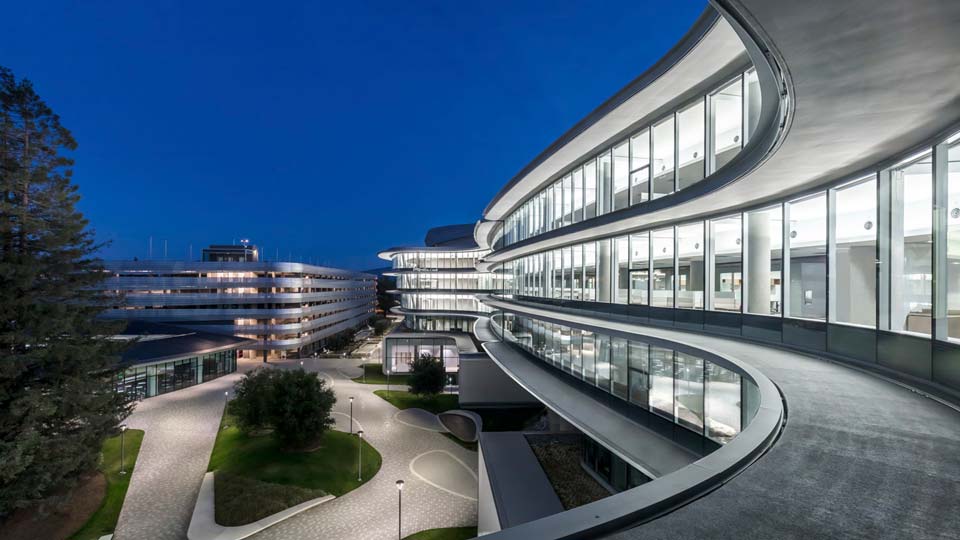 EXHIBIT A: A facade that looks effortless. It wasn't. Central & Wolfe, skinned by Walters & Wolf.