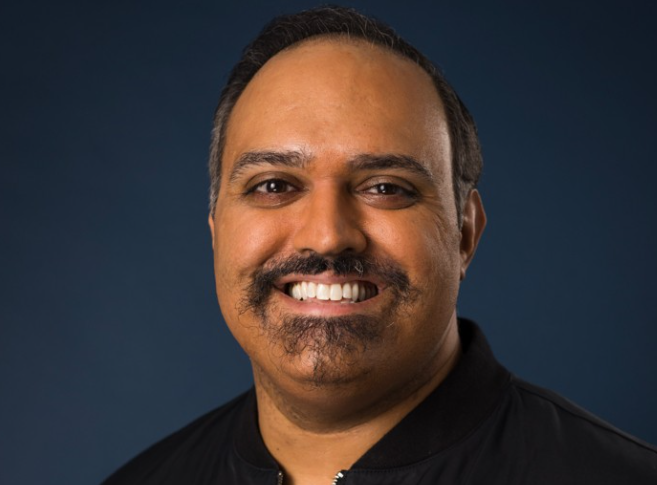
He spent a decade teaching software to read contracts. Now he is starting over.
The clearest public signal of what Vishal Sunak is doing in 2026 is a website that says almost nothing. Visit joyride.ai and you get a name and a slogan - "make waves so others catch the drift" - and not much else. His LinkedIn headline reads "Joyride," trailed by a race-car emoji. His email runs on the same domain. This is roughly the amount of information a founder shares when the interesting part has not shipped yet and he would prefer you not to have opinions about it in advance.
Which is a notable posture for someone who, until early 2025, ran a company of about 450 people. In February 2025, LinkSquares - the contract-management company Sunak co-founded in 2015 and led as CEO for a decade - announced a leadership transition. Chris Combs stepped in as interim CEO. Sunak stayed on as a founding board member and advisor, the arrangement founders reach for when they want to remain useful without remaining responsible for the standup meeting. Then he went quiet and started building again.
The through-line here is not an industry. It is a habit. Sunak has now built radio-frequency electronics for the military, sold and shipped B2B software at other people's companies, and constructed a legal-AI platform from a standing start. The domains have almost nothing to do with each other. The person keeps doing the same thing, which is to find a specific problem, get uncomfortably close to it, and build the thing that fixes it.
"You grow up a little bit differently knowing that you're the first part of your family trying this great American dream."
Sunak was born in Brazil, to Indian parents, and the family immigrated to the United States in 1985. They settled in southern Rhode Island, near the University of Rhode Island, where his father pursued a PhD in electrical engineering and taught. That is a household where the dinner-table conversation tilts technical, and where a kid gets early access to a computer - in his telling, a tri-color Mac - before most of his peers.
He followed an older sister to Boston for school. He earned a bachelor's in engineering from Northeastern University and later a master's from Worcester Polytechnic Institute. Somewhere in there he also did the web-development track at Startup Institute Boston, which is the kind of credential that signals a person deciding, fairly deliberately, to point himself at startups rather than at a corporate ladder.
The first job out of that pipeline was not a startup at all. It was the defense industry in New Hampshire, building radio-frequency electronics for military applications. This is worth sitting with for a second, because the finished product of Sunak's career - software that reads legal contracts - could not look less like RF hardware for the military. The connective tissue is engineering discipline and the willingness to work on unglamorous, hard, specific problems. He then moved into Boston's B2B software scene, taking operations and product roles at Backupify and InsightSquared, which is where he learned the part of company-building that engineers usually skip: how you actually take something to market.
B.S. in Engineering.
M.S., Worcester Polytechnic Institute.
Boston, web-development track.
RF electronics, then Backupify and InsightSquared.
Here is the origin story, and it is a good one because it is small. In 2014, the company Sunak was working at was being acquired. Somewhere in the integration, a question came up that should have been routine: what do our customer contracts say about migrating and storing data? The acquiring side needed an answer. And the answer was sitting there, technically - it was just scattered across thousands of agreements, saved as PDFs, unsearchable in any way that mattered. Nobody could pull the clause out of the pile.
That is the whole insight. Most people in that room experienced a mild annoyance and moved on. Sunak experienced a company. If large organizations sign thousands of contracts and then lose the ability to know what those contracts say, that is a durable, expensive, boring problem - which is to say, an excellent one to build a business on. In 2015 he co-founded LinkSquares to attack exactly that: use AI to read contracts, extract the terms, and make an in-house legal or finance team able to answer questions without a lawyer reading every document line by line.
The early numbers were disciplined rather than explosive. Five customers in year one. Thirty in year two. Around fifty customers and a dozen-odd employees by the time the company hit a million in annual recurring revenue. Then it compounded - zero to $10 million ARR in two years and three months, and in one stretch, 127 new logos and about $4 million of new revenue in a single year with roughly 30 people. That is the shape of product-market fit arriving on schedule: slow, slow, slow, then fast.
LinkSquares raised about $161 million across five rounds, from investors including Catalyst Investors, G Squared, Jump Capital, and Sorenson Capital. Sunak's stated method is the opposite of the founder who politely courts one lead at a time and waits by the phone. Do not single-thread investors, he argues - run roughly 30 conversations in parallel. The mechanics are unromantic: a raise is a pipeline, and pipelines need volume at the top.
His other repeated piece of advice runs against the instinct of most technical founders. The hardest and most valuable thing in the early days, he says, is sales. Learning the sales motion is not a distraction from building the product - it is how you find out what the product should be, because it puts you in the room with the person who has the problem and the budget.
"The sales part will definitely, in the early days, be the most valuable and the most hardest."
"Every legal team in the world uses a LinkSquares product to help make their life a little bit better."
"Fundraising is a team sport."
Immigrates from Brazil to Rhode Island with his family.
Builds radio-frequency electronics for military applications in New Hampshire.
Operations and product roles at Backupify and InsightSquared in Boston.
An acquisition surfaces the unanswerable question about contracts. The light bulb.
Co-founds LinkSquares. Becomes CEO.
EY Entrepreneur Of The Year finalist, then winner in 2021.
Named to Boston Business Journal's 40 Under 40.
Steps back as CEO; stays on as founding board member and advisor. Starts building Joyride.
Away from the cap table, Sunak plays guitar - covers and the blues - and mentors Boston-area startup founders. He is also an angel investor and limited partner, which is the standard second life of a founder who has done one big thing and now wants to be near the next several without running any of them. He talks about his immigrant background as something that shaped how he works: being the first in his family to try the entrepreneurial version of the American dream, he says, makes you grow up a little differently.
The recognition arrived on the usual schedule for a founder scaling a company through the early 2020s. He was an EY Entrepreneur Of The Year finalist in 2020 and a winner in 2021, and he made Boston Business Journal's 40 Under 40 in 2022 - the awards that a city gives to the people building its next generation of companies. He has written for Inc. and turns up on the SaaS podcast circuit, where the recurring topics are the ones he lived: getting to $10M ARR, surviving Series A, and running a distributed team.
Entrepreneur Of The Year (finalist in 2020).
Boston Business Journal.
Plays when he is not building.
Backs and mentors Boston founders.
Profile compiled from public sources including LinkedIn, Crunchbase, the LinkSquares blog, and published interviews. Some records that circulate online conflate this Vishal Sunak with an unrelated Toronto mobility company; those details are not included here.
Vishal Sunak is a Boston software founder best known for co-founding LinkSquares in 2015 and running it as CEO for a decade, building an AI-powered contract-management platform for in-house legal and finance teams that raised roughly $161 million and grew to around 450 employees. Born in Brazil to Indian parents and raised in Rhode Island, he trained as an engineer, worked on military RF electronics, and cut his teeth in Boston B2B software at Backupify and InsightSquared before starting LinkSquares. He stepped back from the CEO role in early 2025, stayed on as a founding board member and advisor, and is now building a new, largely stealth venture called Joyride (joyride.ai).
Last updated: