the essentials
Profile
She Didn't Set Out to Start a Revolution. Diet Culture Did That.
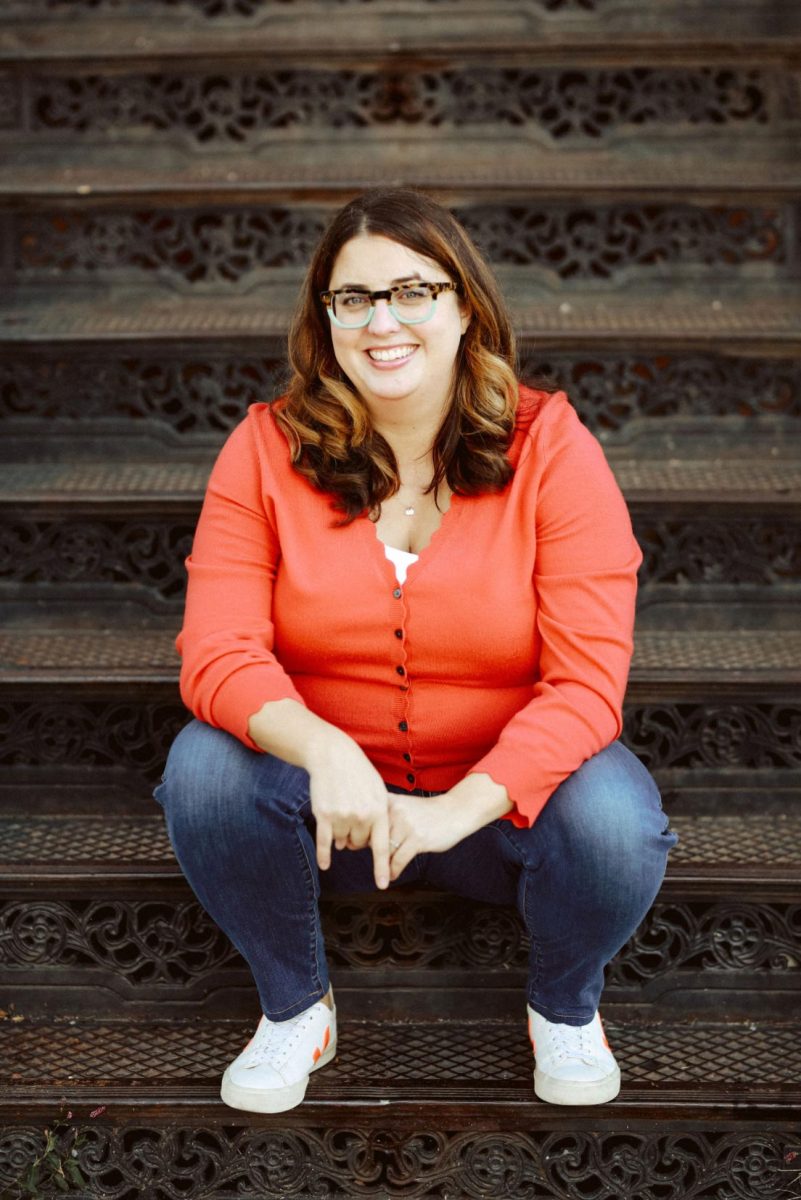
Virginia Sole-Smith is the journalist diet culture never wanted to exist. She writes about bodies, food, and the industrial complex that profits from making people hate both - and she does it with the precision of a surgeon and the warmth of someone who actually listens. Her newsletter, Burnt Toast, has pulled in more than 66,000 subscribers by doing something radical: telling the truth about why diets don't work, why the "war on childhood obesity" is a war on children, and why your body is not a problem to be solved.
She grew up in small-town Connecticut, spent a year in London, and nearly a decade in New York City before finding her footing - and her mountain - in the Hudson Valley. She writes from a house with one cat, one dog, two daughters, and, by her own admission, "way too many houseplants." She wakes at 5 a.m. every day, an hour and a half before her kids, because she figured out early that you cannot pour from an empty cup and that being "shotgunned straight into their needs" without any forewarning is a particularly bleak way to start a Tuesday.
Her career traces an arc that most journalists would recognize and many would rather not admit to: she spent years writing for women's magazines covering health, nutrition, and fitness while simultaneously, quietly, enabling the very culture she would eventually spend a decade dismantling. She was a contributing editor at Parents Magazine. She wrote for Glamour, Harper's, Elle, Scientific American, TIME, Slate, and the New York Times. She covered bodies and food from every angle. And somewhere in that process, she noticed what she was building and decided to build something different instead.
"I want parents to realize they're not parenting a body size. They're parenting a person."
- Virginia Sole-Smith
The pivot was not abstract. It was a daughter - Violet - born with hypoplastic left heart syndrome, a rare congenital heart condition. Three open-heart surgeries. A child who needed to learn how to eat in the most literal sense. A mother who suddenly had to examine every single assumption she had ever held about food, health, and what a "good" body even means. That experience became her first book, The Eating Instinct, published in 2018. It was not a parenting manual. It was an investigation - into orthorexia, food access disparities, bariatric surgery, and the wildly different ways American families relate to the act of eating.
Five years later came Fat Talk: Parenting in the Age of Diet Culture, and the world paid attention. The New York Times bestseller list. Book Riot's best of 2023. Science Friday's best of 2023. Audible's best well-being audiobook of 2023. Anne Helen Petersen called it "an uncompromising, clear-eyed dismantling of diet culture." Lyz Lenz said Virginia "cuts to the quick of everything that is wrong with diet culture in America." That's the thing about writing the truth with enough specificity and enough warmth - eventually, people can't look away.
What makes her work land where so much in this space tends to float is the reporting. Virginia Sole-Smith is, before anything else, a reporter. She doesn't just have opinions; she has sources, studies, and the willingness to sit with people whose experiences challenge her assumptions. She describes herself, with characteristic self-awareness, as "an extremely nosey person who likes to know everybody's business" - which is, she notes, basically the job description for journalism. She once went undercover in Mexican sweatshops. She attended beauty school and used the credential to report from the inside of an industry that profits from insecurity. She put on a mermaid tail and swam for a story. She has sat in nail salons investigating labor conditions. The mermaid tail is, somehow, not even the most remarkable part.
Deep Dive
Burnt Toast and the Business of Burning It Down
The Burnt Toast newsletter launched on Substack as a deliberate act of independence. No editorial interference. No advertiser relationships. No corporate compromise on the questions she wanted to ask about diet culture, fatphobia, anti-fat bias, and the parenting landscape that normalizes all of it. The name is the ethos: sometimes things burn, and that's fine, and you don't have to be perfect at feeding yourself or your family to deserve peace around food.
Within a few years it crossed 66,000 subscribers and extended into a weekly podcast - conversations with authors, activists, researchers, and fat liberation advocates that give the newsletter's ideas room to breathe. The audience includes fat people, people recovering from eating disorders, parents trying to undo the damage that diet culture did to their own childhoods so they don't pass it on, and anyone curious about what a different relationship to their body might feel like. It is, as she describes it, a safe space built on the not-especially-radical idea that people deserve to exist in their bodies without apology.
Virginia speaks to parents, clinicians, educators, treatment providers, and healthcare workers. She speaks at storytelling events and keynotes. Her speaking contact is Ariel Lewiton at the Tuesday Agency - which tells you something about how far the newsletter-to-book-to-speaking pipeline has developed. She is, at this point, a full institution: journalist, author, podcaster, speaker, and community builder, all operating from a small mountain in the Hudson Valley with more trees than neighbors.
There is a through-line in everything she does that has nothing to do with diet culture per se and everything to do with a certain kind of journalism. She goes where the story is. She asks the people who are actually living the experience. She doesn't flinch from the systems - the healthcare industry, the wellness-industrial complex, the school lunch programs, the pediatrician's office - that make bodies political. And she writes about all of it with a clarity that is, frankly, the opposite of comfortable if you've spent any time believing what diet culture told you.
The peers who praise her work - Anne Helen Petersen, Lyz Lenz, Rebecca Makkai - consistently use words like "uncompromising," "clear-eyed," and "smart." What they're describing is someone who figured out that warmth and rigor are not opposites, that you can care deeply about the people you're writing about and still tell the hardest truths. That's not common in health and wellness writing, which tends to traffic in either judgment or false comfort. Virginia Sole-Smith does neither. She is, in the most literal sense, a different kind of reporter doing a different kind of work.
She is also, by her own account, a person who once used a vintage 1920s typewriter from Etsy as a wedding guest book. This is either completely consistent with everything else about her or completely surprising, depending on how well you've been paying attention.
Timeline
How We Got Here
1990s-2000s
Begins career writing about health, nutrition, and fitness for women's magazines. Builds the bylines. Also, unknowingly, builds the problem she'll spend years solving.
2010s
Contributing editor at Parents Magazine. Bylines in Glamour, Harper's, Elle, Scientific American, NYT, Slate, TIME. A full career. A mounting awareness of what that career is enabling.
2015
Daughter Violet born with hypoplastic left heart syndrome. Three open-heart surgeries. A mother learns to watch her child learn to eat. Everything changes.
2018
The Eating Instinct published by Henry Holt. The book that begins the reckoning - with the food industry, with diet culture, with herself.
2021
Burnt Toast newsletter launches on Substack. The Burnt Toast podcast follows. The community starts to form.
2023
Fat Talk: Parenting in the Age of Diet Culture published. NYT Bestseller. Named to three best-of-2023 book lists. The argument lands.
2024-2026
66,000+ subscribers. Regular contributor to TIME. Active speaker and podcaster. Still on the mountain. Still waking at 5 a.m. Still going.