Company Profile · Attainable Housing
Vessel
Technologies
Housing that behaves like a product, not a one-off project - flat-packed in a factory, snapped together on the leftover lots nobody else wanted.
Housing that behaves like a product, not a one-off project - flat-packed in a factory, snapped together on the leftover lots nobody else wanted.
On a half-acre of Bank Street in New London, Connecticut, a five-story building went up where a vacant lot had been collecting weeds for decades. The panels arrived flat. The crew assembled them. Inside: thirty one-bedroom apartments, all-electric, solar on the roof, renting at roughly four-fifths of the market rate.
That building is the entire argument Vessel Technologies has been making since 2017. Housing in America gets built the way it was built a century ago - bespoke, slow, expensive, and almost never aimed at the people in the middle. Vessel decided the building itself should be a product. Design it once. Manufacture the parts off-site. Ship them flat. Reassemble on a small lot in a fraction of the usual time. Then do it again, somewhere else, the same way.
“Vessel represents a whole new category of housing, innovative in every way, to fill a tremendous void.”
Sam Landman, Mastry Ventures Co-FounderIt is a tidy idea. It is also, in an industry that treats innovation with the enthusiasm of a cat being given a bath, a genuinely awkward one. Vessel is a New York company of about 28 people betting that the apartment building can be standardized without being grim. So far, the people writing checks include a national homebuilder.
There is a group of people the housing market quietly forgot. They earn too much to qualify for subsidized housing and too little to absorb market-rate or luxury rents. Economists call them the “missing middle.” You probably call them the firefighter, the third-grade teacher, the ER nurse, the town clerk - the people a community cannot function without, increasingly priced out of the communities they serve.
The reason is structural, not moral. Conventional multifamily construction is so slow and costly that the math only closes at the top of the market. A developer who spends 18 to 24 months and a fortune building a mid-rise has every incentive to charge premium rents. Attainable housing, built the old way, simply doesn’t pencil. So most of what passes for “new housing for working people” is really just the rehabbing of old stock.
If subsidized housing is a safety net and luxury rentals are a velvet rope, the missing middle is the crowd standing in between - waving cash nobody will take.
The structural problem Vessel exists to solveVessel’s read was that you cannot rent-control your way out of a manufacturing problem. If the building is too expensive to make, no amount of policy fixes the price tag. You have to make it cheaper to make. Which is a sentence about factories, not real estate.
Neil Rubler spent roughly two decades inside the multifamily industry before he started questioning its core assumptions. The unlikely inspiration, by his own account, came from watching companies like SpaceX and the electric-vehicle makers re-engineer industries everyone assumed were finished. If rockets could be rethought from materials up, why not the apartment building?
“This investment gives us the capacity to grow far more quickly and accelerate our efforts to offer each person an equal opportunity for an extraordinary life.”
Neil Rubler, Founder & CEOThe bet had two halves. First: treat housing as a designed, repeatable product rather than a series of one-off projects. Second - and this is the part that makes traditional developers reach for the smelling salts - sell that product the way fast-growing consumer businesses scale, through franchising. In 2023, Vessel launched what it describes as the multifamily industry’s first franchise model: a turn-key system an experienced developer or an ambitious newcomer could deploy without reinventing the building each time.
It is the kind of idea that sounds obvious right up until you remember nobody had done it. Standardizing the apartment is not glamorous. It is, however, the only version of the story where the numbers move.
Neil Rubler launches Vessel Technologies in New York to industrialize the construction of attainable apartment buildings.
Vessel breaks ground on its first Connecticut development - a five-story, 30-unit building at 174 Bank Street, New London, on a long-vacant lot.
Vessel announces a turn-key franchising opportunity, letting developers and entrepreneurs deploy the housing system on small sites.
Mastry Ventures and LENx (Lennar’s venture arm) co-lead a Series A to accelerate Northeast expansion and a national rollout.
One-bedrooms come to market at roughly 80% of the local rate - about $1,600-$1,700 a month - as the CT portfolio aims to be a national showpiece.
Most prefab housing is modular - whole room-boxes built in a factory and craned into place. Vessel went a different route: panelized. Walls, ceilings, and floors are manufactured off-site as precision-fit panels using engineered materials, then packed and shipped flat. On the lot, the crew reassembles them. The company likes the IKEA comparison, and it earns it - flat-pack logistics cut weeks of weather delays and waste, and a Vessel building can be occupancy-ready in under a year instead of the usual year and a half to two.
“Ship the panels flat, snap them together on a half-acre - the apartment building, finally, has an assembly manual.”
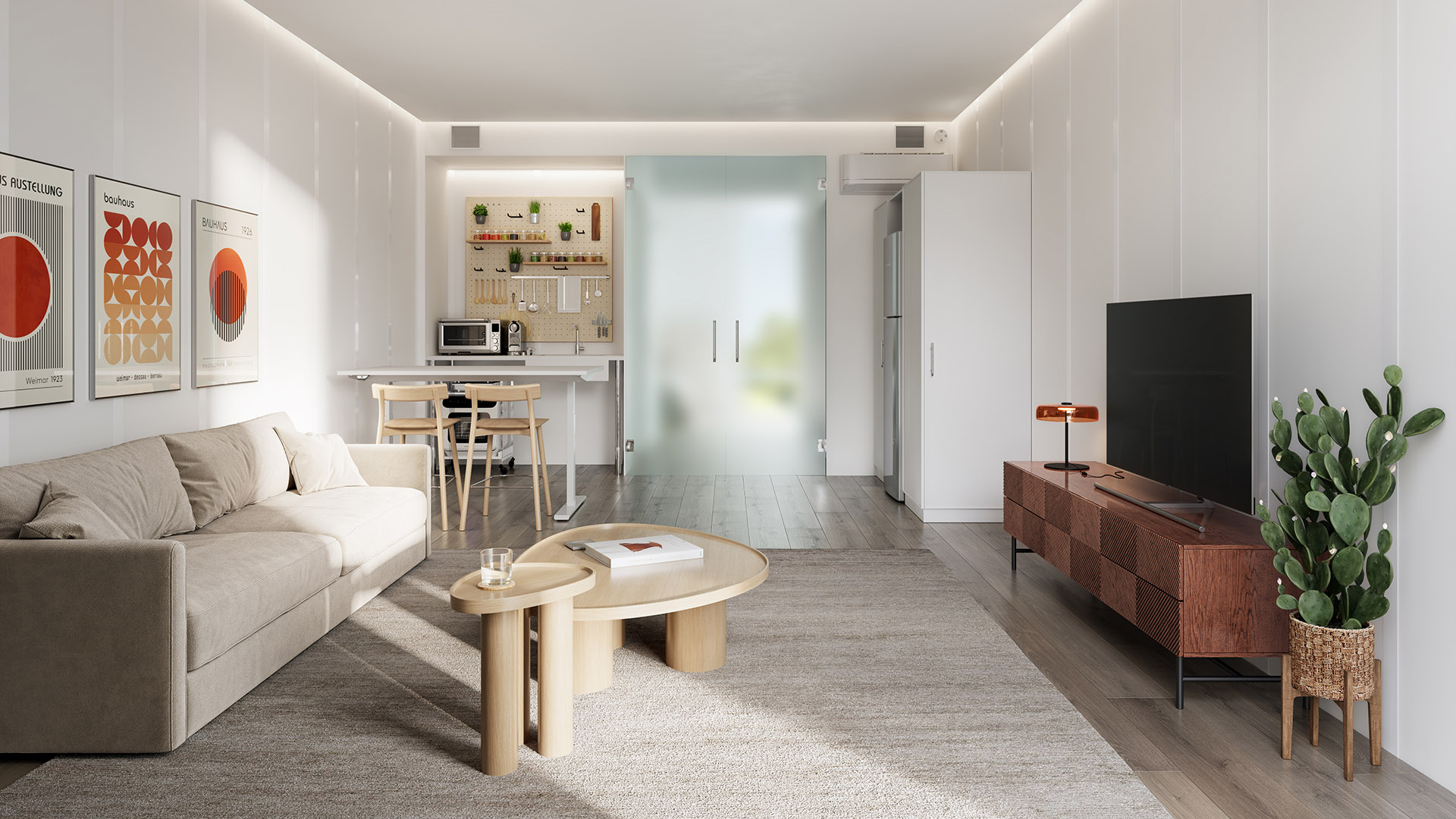
On Vessel’s panelized systemAttainable is not a synonym for bleak. Vessel homes carry nine-foot vaulted ceilings, 45-square-foot windows, oversized showers, and private dressing rooms. The kitchen - branded the “Yoga Kitchen” - is built on universal-design principles, meaning it works for nearly every body type and ability rather than the statistical average of one. Each home is 100% electric, powered entirely by rooftop solar, with in-unit monitoring of electricity and water that puts the building on a carbon-neutral path.
Panelized, off-site-manufactured components engineered to fit on lots as small as a half-acre.
All-electric one-bedrooms with vaulted ceilings, oversized windows, and the universal-design Yoga Kitchen.
A turn-key model letting developers deploy the system without redesigning each building.
In-unit tracking of power and water, supporting the carbon-neutral pathway and lower running costs.
Ideas are cheap in real estate; capital is the tell. Vessel’s Series A was co-led by Mastry Ventures and LENx, the venture arm of homebuilder Lennar. A national builder backing a startup that wants to standardize - and franchise - the apartment building is not a casual signal. It is a vote that the manufacturing thesis might actually scale.
Faster build cycles and small-lot siting are what let Vessel price one-bedrooms at roughly 80% of the local market in New London (about $1,600-$1,700/mo). Figures are approximate and drawn from public reporting.
The customer base runs in two directions. On one side, the residents - working people who finally clear the rent without clearing the income ceiling for aid. On the other, the buyers of the system: developers, franchisees, and increasingly municipalities, hospitals, and universities that need housing fast and cannot wait two years to get it.
“Truly excellent, deeply desirable and economically accessible rental homes” - the void Vessel says it was built to fill.”
Mastry Ventures, on the investment thesisVessel states its mission plainly: equal opportunity for an extraordinary life, through homes that are exciting, sustainable, and attainably priced. It is a big phrase for a one-bedroom. But the company’s whole design philosophy - the universal kitchen, the natural light, the solar roof, the price - is an argument that “attainable” should not mean “settle.”
The keywords Vessel surrounds itself with - universal design, housing affordability, carbon-neutral buildings, off-site manufacturing, resource conservation - read less like marketing and more like a checklist for fixing a market failure. Whether the franchise model can carry that mission to national scale is the open question. The early proof is concrete, literally: buildings that exist, rented to people who needed them.
Rent an attainable, solar-powered home if you’re in the missing middle. License the system if you’re a developer. Site fast housing on small or awkward lots if you’re a city, hospital, or campus that’s out of time and out of land.
Three doors into the same buildingReturn to that half-acre in New London. The lot that sat empty for decades is now five stories of homes - lights on, solar overhead, a teacher and a firefighter somewhere inside paying rent they can actually carry.
Multiply that lot by every overlooked parcel in every priced-out town, and you have the future Vessel is underwriting. The thesis is unglamorous and that is the point: you do not solve a manufacturing problem with a slogan. You solve it by making the thing cheaper to make, and then making it again. A factory that happens to make apartments, one small lot at a time.
Skeptics are right to ask whether a franchise can scale a mission, whether panels can outrun the cost curve, whether “attainable” survives contact with a national rollout. Fair questions. The honest answer is that the proof is still being assembled - flat-packed, shipped, and snapped together, building by building.