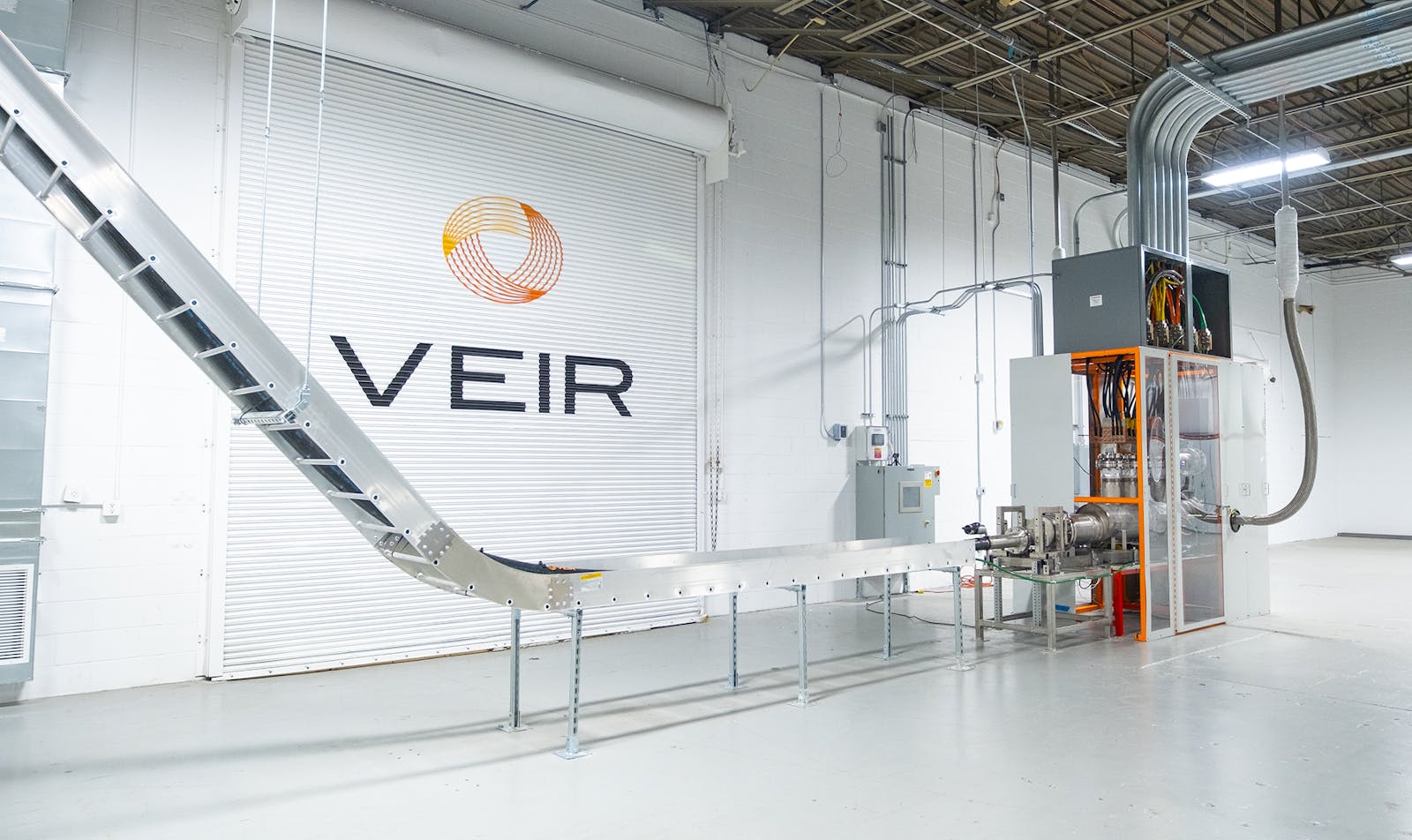
In a parking lot in Woburn, Massachusetts, there is a length of black pipe that does something the electrical grid has wanted for a century. Run high power through it and it does not heat up, does not waste much of what passes through, and does not need a forest of new towers to carry more. Inside that pipe, liquid nitrogen runs cold at about minus 321 degrees Fahrenheit, keeping a ribbon of superconducting tape in the one state where electricity flows almost free of resistance. VEIR built it. And the people who run the grid have started showing up to watch.
VEIR is a roughly 110-person company that has decided the most boring object in modern infrastructure - the wire - is also the most overdue for reinvention. Its product is not flashy. It is a cable, dressed in a pipe, cooled by evaporating gas. The claim attached to it is not boring at all: five to ten times the power of a conventional line, at the same voltage, in the same footprint.
The grid's bottleneck was never the power plant. It was always the wire.
Everyone wants more electricity. Nobody wants more power lines.
Here is the inconvenient arithmetic of the energy transition. Wind farms and solar arrays get built where the wind blows and the sun shines, which is rarely where people plug things in. Data centers are now asking for power at a pace that makes utility planners reach for stronger coffee. The fix, in theory, is more transmission. The fix, in practice, runs into landowners, permitting offices, environmental review, and the simple fact that a new high-voltage corridor can take a decade to approve and nobody especially wants one in the backyard.
Conventional transmission lines are steel and aluminum, and they have an unglamorous habit: the more current you push, the more they heat, sag, and lose. To move more power the old way, you build taller towers, raise the voltage, or cut a wider path. All three are slow, expensive, and politically allergic to speed. The grid, in other words, has a throughput problem dressed up as a real-estate problem.
It is a tidy irony that the century's cleanest ambitions keep colliding with the century's least popular request: please, may we have one more power line.
You can decarbonize the plan all you like. The electrons still have to get there on a wire that someone approved.
A grid investor, a cooling trick, and one stubborn idea.
VEIR's founding insight surfaced in 2019, when researchers at Breakthrough Energy Ventures were digging into why expanding the grid is so painfully hard. One of them was Tim Heidel, who arrived with an almost suspiciously specific resume for the job: four MIT degrees in electrical engineering and technology policy, a stint running a 75-project portfolio at the federal energy lab ARPA-E, and time as deputy chief scientist at a rural electric cooperative association. If you wanted to design a person to obsess over transmission, you would build something close to him.
The other half of the bet was a cooling concept from co-founder Steve Ashworth. High-temperature superconductors were not new - the materials science had been maturing for decades. The catch was always the refrigeration. Keeping a cable cold enough to superconduct, over miles, usually meant heavy machinery and energy bills that ate the advantage. Ashworth's idea was to let physics do the work: a passive, evaporative nitrogen system that delivers roughly twenty times the cooling power per kilogram of coolant compared with conventional approaches. Less machinery. More cold. The economics finally tilted.
The superconductor was never the hard part. The hard part was keeping it cold without spending everything you saved.
A wire that refuses to waste.
What VEIR sells looks, from the outside, like industrial plumbing: a vacuum-insulated pipe with a superconducting tape running through a bath of liquid nitrogen. What it does is carry alternating current at up to around 400 megawatts at 69 kilovolts to start, with multi-gigawatt and direct-current versions on the roadmap. The same corridor, the same voltage class, several times the throughput, and more than 90 percent fewer resistive losses than the metal it replaces.
Superconducting lines
High-temperature superconducting tape that carries 5-10x the power of steel-and-aluminum lines at the same voltage and footprint.
Passive nitrogen cooling
A vacuum-insulated, evaporative system delivering roughly 20x the cooling power per kilogram of coolant - mostly without heavy chillers.
Data center power
Megawatt-class, low-voltage superconducting cable that moves power 5x farther using 20x less space than copper.
Grid-scale roadmap
AC lines today; DC and multi-gigawatt versions planned for long-haul transmission and renewable interconnection.
The VEIR file, by year
The numbers, and the people who wrote checks against them.
A demo in a parking lot is a start, not a verdict. The more interesting signal is who has decided to participate. In January 2025, VEIR closed a $75 million Series B led by Munich Re Ventures, with Microsoft's Climate Innovation Fund, National Grid Partners, Tyche Partners, Piva Capital and others joining a roster that already included Breakthrough Energy Ventures, Congruent Ventures, Engine Ventures and Galvanize Climate Solutions. Total funding sits near $117 million. When an insurer's venture arm, a hyperscaler's climate fund and a utility's investment group all show up on the same cap table, they are not buying a science project - they are hedging a future they think is coming.
Power through the same corridor
The customer list points in three directions: utilities looking to relieve congested corridors, renewable developers trying to get power off remote sites, and - increasingly - data centers. That last market arrived faster than anyone scheduled. Racks that drew tens of kilowatts a few years ago now draw 200, with 600-kilowatt and megawatt racks on the horizon. Copper at those power levels turns into a heat-and-space problem. A superconducting cable that moves power five times farther in a twentieth of the space stops being exotic and starts being practical.
The pace at which the data center community is moving, evolving, growing, scaling, and tackling challenges is far higher than the transmission community.
So that power never limits progress.
VEIR describes what it is doing as defining a new category of power delivery, but the company's plainer phrasing is the one worth keeping: power should never be the thing that limits progress. It is a deceptively large claim. If moving electricity stops being a real-estate fight and starts being a matter of swapping in a denser wire, then a lot of stuck plans - clean energy interconnections, industrial expansions, the next wave of computing - get unstuck at once.
There is a useful humility in the approach, too. VEIR is not asking the world to rebuild the grid or rethink voltage standards. It is asking to put a better wire where the old wire already goes. Revolution, delivered as a retrofit.
Five things worth knowing
- The cable runs liquid nitrogen at roughly minus 321°F - colder than most of the solar system you can name.
- The cooling is largely passive: the nitrogen does much of the work by simply evaporating.
- Founder Tim Heidel collected four MIT degrees before starting a company about wires.
- The whole thing hides inside a plain black pipe that looks like ordinary plumbing.
- The founding spark came from investors asking why grid expansion is so hard - and not liking the answer.
Back to the pipe in Woburn.
Return to that length of black pipe in the parking lot. A few years ago it was a demonstration - a way to prove that high power could move through a superconductor outdoors, cooled by nothing more dramatic than evaporating nitrogen, and behave. Today the same idea has a $75 million round behind it, a utility running field tests, a hyperscaler's climate fund on the cap table, and a data center industry knocking on the door ahead of schedule.
The pipe still looks like plumbing. That is rather the point. The most consequential infrastructure rarely announces itself, and the wire that finally lets the grid carry what the next decade demands will probably look like something you would walk past without a second glance. VEIR is betting the future fits inside it.