Breaking
FORBES 30 UNDER 30 ASIA 2025  Vaikkunth Mugunthan honored for enterprise GenAI compliance $15.1M SERIES A  Dynamo AI scales privacy-first generative AI MIT PhD + HARVARD MINOR  privacy, fairness & law GARTNER  Dynamo AI named an Emerging Visionary, 2025 CRICKET CAPTAIN  he also led MIT's team between research deadlines
Founder · Computer Scientist · CEO

Vaikkunth Mugunthan

He taught machine learning how to forget. Then he built a company on it.

Co-founder and CEO of Dynamo AI - the privacy, security, and compliance layer that lets banks, insurers, and carmakers turn generative AI loose without it leaking, lying, or breaking the rules.

// Vaik, in the lab coat he never wore - PhD, CSAIL, MIT

Vaikkunth Mugunthan, co-founder and CEO of Dynamo AI
$19.3M
Raised to date
2021
Dynamo AI founded
16
Countries visited
30u30
Forbes Asia 2025
The dispatch

A Fortune 500 bank wants a chatbot that answers customer questions. It also wants that chatbot to never repeat a Social Security number, never get talked into ignoring its instructions, and never confidently invent a policy that does not exist. Those three wants used to be a research problem. Vaikkunth Mugunthan turned them into a product.

Dynamo AI, the San Francisco company he co-founded in 2021 with Christian Lau, sells the unglamorous part of artificial intelligence: the brakes, the seatbelts, the audit trail. Its guardrails catch prompt injection, jailbreak attempts, PII leakage, toxicity, and hallucinations - in real time, before a regulator or a customer ever sees them. The company serves enterprises in finance, insurance, electronics, and automotive, the industries where an AI mistake is not a funny screenshot but a compliance violation.

Mugunthan did not arrive at this by accident. He spent six years studying how to make machine learning models share what they have learned without surrendering the data they learned it from. The technical name is privacy-preserving AI. The plain version: he figured out how to let a hospital and a bank collaborate on a model without either one handing over its files. When generative AI exploded into every enterprise roadmap, the question he had been answering quietly in a lab became the question everyone was suddenly shouting.

He is, by the measure of most resumes, early. Forbes put him on its 30 Under 30 Asia list in 2025. Gartner called his company an Emerging Visionary the same year. He has an MIT PhD, a Harvard minor in privacy law, and a Series A. He also captained a cricket team and plays the violin, which tells you he was never only the person you would expect.
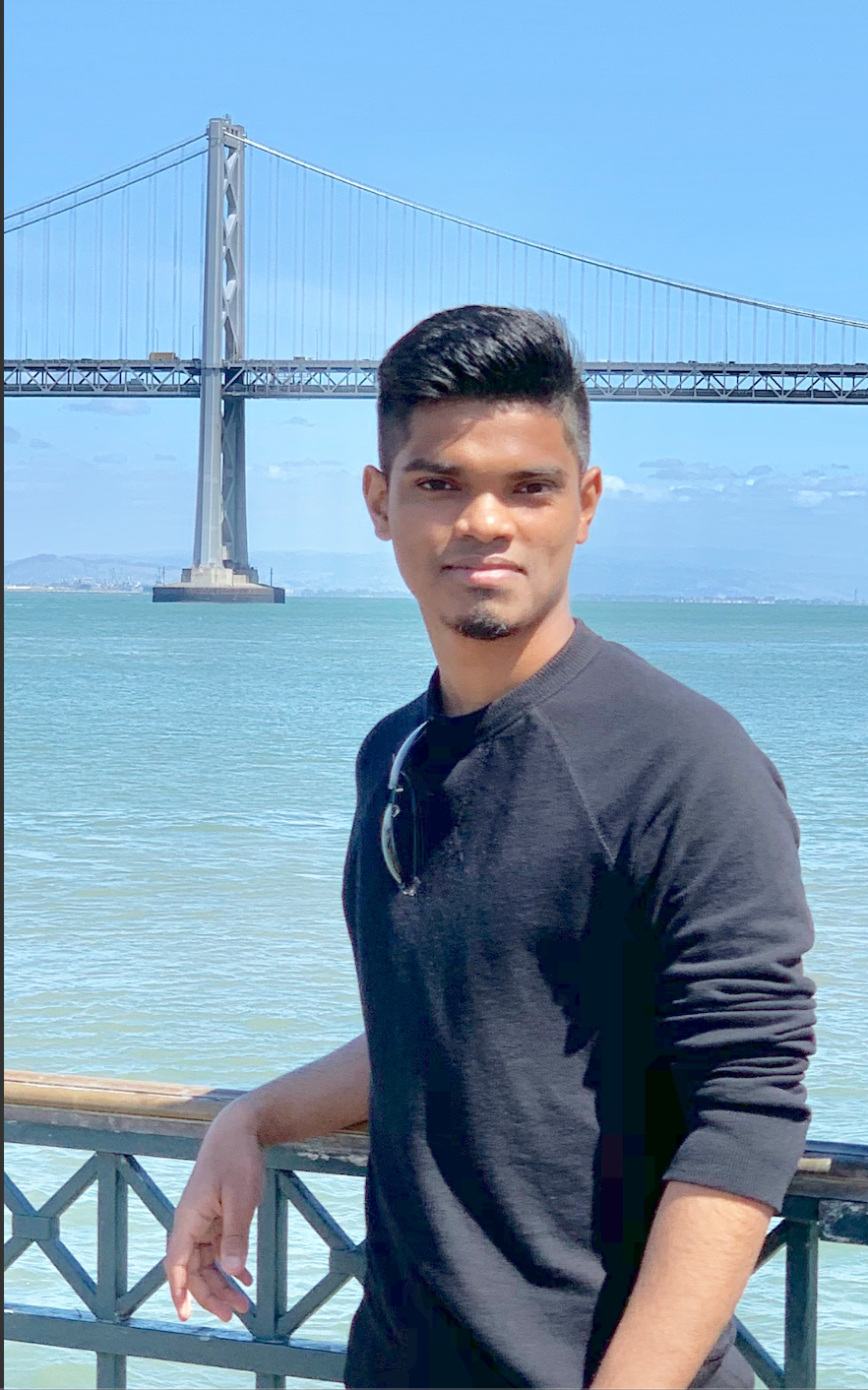
This investment validates our philosophy that AI platforms need to be built with a focus on privacy and security from day one in order to scale in enterprise use cases.
- Vaikkunth Mugunthan, on Dynamo AI's $15.1M Series A
The work

Guardrails are boring. Until the day they are the only thing standing.

The pitch for Dynamo AI is easy to underrate because it sounds like plumbing. Every enterprise wants generative AI. Almost none of them can deploy it without a way to prove, on demand, that the model behaved. Did it leak a customer's data? Did someone jailbreak it into saying something it should not? Did it hallucinate a number into a financial report? In a regulated industry, "we think it's fine" is not an answer a compliance officer can sign.

Dynamo AI answers those questions with a stack of products. DynamoGuard sits in front of a model and enforces custom policies in real time, blocking the bad and logging the rest. The Evaluations suite stress-tests models before launch and produces documentation built for regulatory audits. AgentWarden extends the same idea to autonomous AI agents - the systems that do not just talk but act. The company's research roots show up in the modules with names only a privacy nerd would love: Differential Privacy, Federated Learning, a Privacy Evaluation Suite.

What makes the founding bet interesting is its timing. Mugunthan and Lau were two MIT PhDs with six years of privacy-focused machine learning research between them before "AI safety" was a board-level line item. They built the seatbelt before the car got fast. By the time enterprises were panicking about what their shiny new language models might say, Dynamo AI had a head start measured in years of papers.

Follow the money

A seed, a Series A, and a thesis that paid out

$4.2M
Seed
$15.1M
Series A · Aug 2023
$19.3M
Total to date

// The Series A was led by Canapi Ventures and Nexus Venture Partners, with angels from Apple, Dropbox, and Snowflake along for the ride.

The road here

India to MIT, by way of a professor's paper

He grew up in India and studied information technology at SSN College of Engineering. Somewhere in there he picked up a certification in ethical hacking - the kind of detail that explains a lot about a person who would later build his career around the question of what systems can and cannot be trusted to keep. Then he read MIT Professor Lalana Kagal's research on privacy, and crossed an ocean for it.

BEFORE MIT
B.Tech in Information Technology, SSN College of Engineering, India. Plus a certification in ethical hacking.
AT MIT
M.S. then PhD in computer science, working with Prof. Lalana Kagal in CSAIL's Decentralized Information Group on federated learning and differential privacy.
ALONG THE WAY
A Harvard minor in Privacy, Fairness, and Law. Internships at J.P. Morgan and as a microprediction research scientist at Intech.
2021
Co-founds Dynamo AI (DynamoFL) with Christian Lau, taking the research out of the lab.
2022
Through Y Combinator's W22 batch; featured in MIT News for privacy-preserving collaborative machine learning.
2023
Raises a $15.1M Series A. Fortune 500 customers sign on.
2024
Dynamo AI joins forces with Lenovo; ships DynamoGuard.
2025
Forbes 30 Under 30 Asia. Named in Gartner's GenAI innovation guide and Forrester's AI governance landscape.
The science underneath

"I come up with differentially private algorithms and integrate that with deep learning."

That single sentence, which he gave to MIT's CSAIL Alliances, is the whole company in miniature. Differential privacy is the mathematics of forgetting on purpose: you add just enough noise to a dataset that no individual can be reverse-engineered out of it, while the model still learns the pattern. Federated learning is the other half: train across many parties' data without that data ever leaving home. Put the two together and a hospital, a bank, and an insurer can build something none of them could build alone, without trusting each other with the raw files.

His academic fingerprints are on real systems. He co-developed BlockFLow, a fully decentralized, privacy-preserving, and accountable federated learning system. He built a simulator on Apache Spark so organizations could test models against accuracy-versus-privacy tradeoffs before deploying them on real data clusters. He presented a master's thesis on differential privacy at a fintech event - the kind of room where theory meets people who have to answer to auditors.

The throughline is a refusal to treat privacy as a feature you bolt on at the end. It is, in his telling, the foundation or it is nothing. The whole reason Dynamo AI exists is that he believed the industry would eventually agree. In 2025, with regulators circling generative AI and every enterprise asking how to govern it, the industry mostly does.

Off the clock

The captain, the violin, and 16 stamps in a passport

01 / FIELD

Cricket captain

He captained MIT's cricket team and ran its cricket club as president. The competitive streak did not stay on the pitch.

02 / STAGE

The violin

He plays the violin and has been active in music, photography, and cultural clubs - the parts of a CV that rarely make the pitch deck.

03 / MAP

16 countries

By the count he gave MIT, he had traveled to sixteen of them. A researcher who collects borders as well as citations.

In his words

Clipped and pinned

"I come up with differentially private algorithms and integrate that with deep learning."- on his research, MIT CSAIL Alliances
"AI platforms need to be built with a focus on privacy and security from day one in order to scale in enterprise use cases."- on Dynamo AI's Series A
"It also reflects the growing interest and demand for in-house Generative AI solutions across industries."- on why enterprises are buying
Inspired by a professor's research on privacy, he left India for MIT - and turned the thesis into a company.- the short version of the arc
Where it goes

Make compliance the default, not the afterthought

The aspiration is consistent with everything before it. He wants privacy and compliance to be a property enterprise AI is born with, not a patch applied after something goes wrong. If he is right, Dynamo AI becomes the trust layer that lets the most cautious industries on earth - the ones that move money, insure lives, and answer to governments - finally let generative AI off the leash. That is the bet. He has been making it since before it was fashionable.

The file

Follow the thread

Share this in · LinkedIn X · Twitter f · Facebook IG · Instagram