The surprising thing about United Vein & Vascular Centers is how ordinary it wants a specialist procedure to feel. You notice a heavy leg, swelling, an ache that gets worse after standing. You book a neighborhood clinic, get an ultrasound, hear the plan and, if you qualify, return for a procedure that may take less time than a leisurely lunch. No marble hospital lobby. No overnight bed. The company’s promoted vein treatments can run about 20 to 30 minutes.
That compact patient experience sits on top of a much larger machine. Founder and physician Gamal Wazni started the business in Florida in 2014. By November 2022, when healthcare investor Amulet Capital Partners acquired it, United Vein operated more than 30 clinical locations in Florida, the Chicago area, Colorado and Arizona. The price was not disclosed. Wazni stayed in charge. By 2026, the company said it had more than 60 clinics across eight states, with new openings in Texas, Florida, Georgia and Arizona.
01 / The wedge
Start with the leg nobody understands
Vein disease is a useful entry point because its early symptoms are easy to normalize. Heavy legs sound like a bad day. Night cramps sound like age. Visible veins get filed under cosmetics. Underneath, damaged valves can allow blood to pool and pressure to build. United Vein’s first job, therefore, is not the procedure. It is category education: teaching a patient that an everyday annoyance can be a circulatory problem worth evaluating.
The customer is generally an adult with symptoms such as aching, swelling, throbbing, restless legs, skin changes or visible varicose veins. Referring clinicians matter too. Primary-care doctors, orthopedic practices and pain specialists can send in patients whose complaints might have a vascular cause. The clinic then joins the pieces that are often scattered across healthcare: consultation, physical exam, duplex ultrasound, authorization, procedure and follow-up.
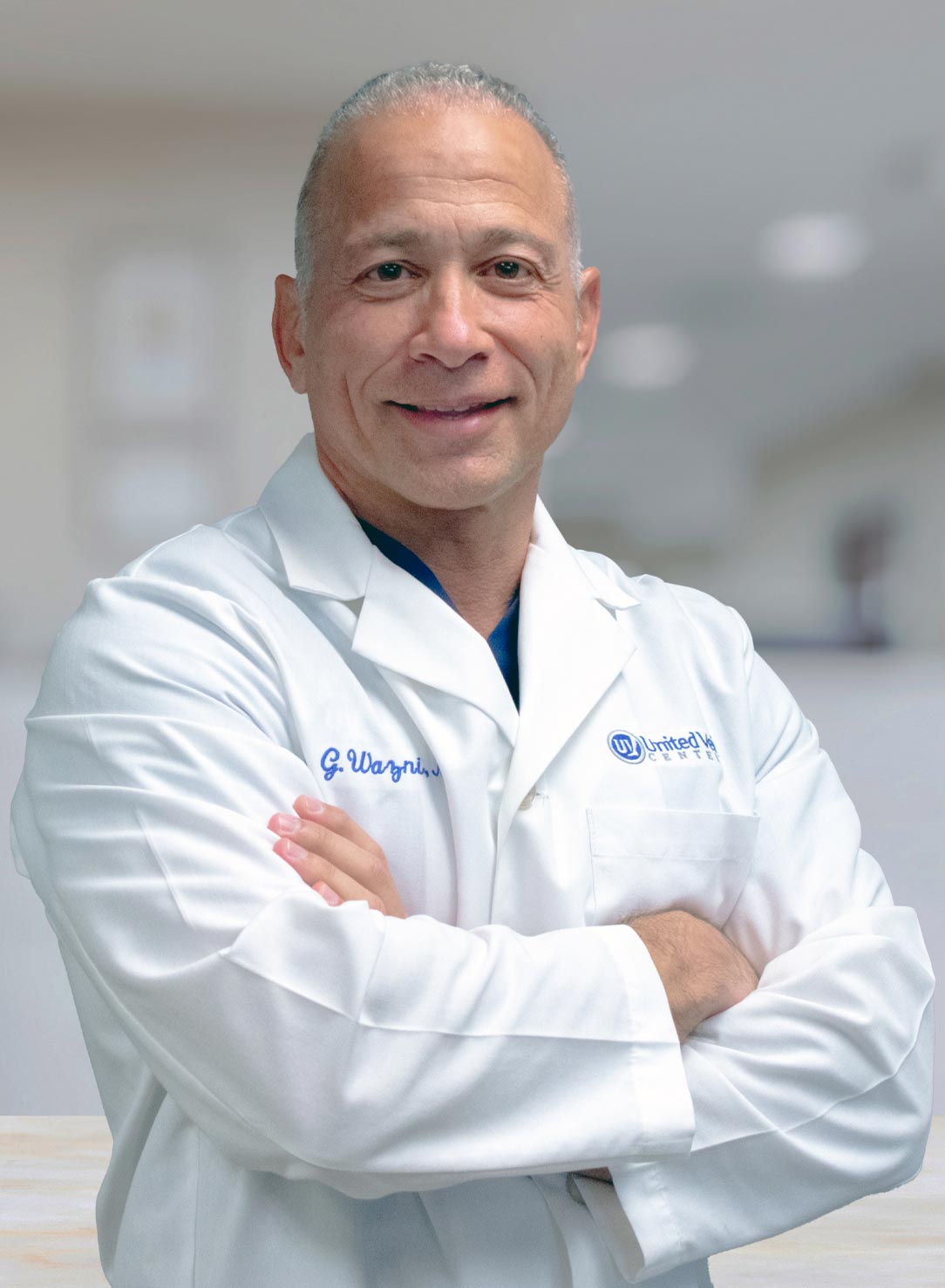
Gamal Wazni built the company around a simple wager: specialist vascular care could travel farther if the hospital did not have to travel with it.
The treatment menu is deliberately broad. For vein disease, the company lists radiofrequency ablation, sclerotherapy, Varithena microfoam, VenaSeal adhesive and microphlebectomy. Its vascular side includes angioplasty and atherectomy, plus embolization procedures for uterine fibroids, enlarged prostate, knee pain, hemorrhoids and varicocele. Lymphedema and persistent wound care widen the catchment further. The common denominator is not one device. It is a patient who can be diagnosed and treated in an office-based setting without hospitalization.
That puts United Vein in a busy middle of the market. It competes with national chains such as USA Vein Clinics and Center for Vein Restoration, hospital-owned vascular surgery and interventional radiology groups, and the independent specialist whose reputation may be stronger than any brand. The chain’s answer is reach plus breadth. A patient can find a clinic near home, while a referring doctor can send several kinds of vascular complaint into one system. Hospitals retain the advantage when a case needs complex surgery, intensive monitoring or several specialties at once. Independents can win on continuity. United Vein wins when access and a repeatable outpatient journey matter most.
There is also a subtle change in what the company sells. “Vein center” sounds cosmetic to many people; “vascular center” signals a larger clinical canvas. The ampersand in the current name earns its keep. It lets one neighborhood front door serve leg swelling today, peripheral artery disease tomorrow and a fibroid or enlarged-prostate referral next week, provided the local site and physician offer the relevant service. That widens both the referral base and the lifetime value of the infrastructure without pretending every clinic performs every procedure.
The real product is not a 20-minute procedure. It is the confidence that every step around those 20 minutes will work.YesPress analysis
02 / The machine
A clinic is a format before it is an address
A rollup can collect logos and still fail to build a company. United Vein’s pitch is more systematic. Local specialists work inside a platform with shared technology, scheduling, patient engagement, marketing, revenue-cycle support and operating processes. The clinic remains the human face; the invisible work is centralized. That balance is the source of its difference from an independent practice and a hospital department.
The repeatable care loop
Economically, this is a reimbursed-services business. Consultations, diagnostics and procedures generate revenue through commercial insurers and government payers, with deductibles, copays or self-pay filling the patient portion where applicable. The company says it accepts most major plans. Office-based labs can be more convenient than hospitals, but they are not cheap retail storefronts. They need credentialed clinicians, ultrasound equipment, procedure rooms, sterile workflows, accreditation, payer contracts and a staff that can shepherd a case through authorization.
Accreditation is part of that infrastructure, not a decorative seal. In 2019, the company’s Sarasota operation received IAC accreditation for peripheral venous testing, while its Louisville, Colorado location received Vein Center accreditation for superficial venous treatment and management. The process includes self-evaluation and outside review of clinical cases, reports, equipment, personnel and quality systems. For a patient, that can turn a hard-to-judge technical service into a visible trust signal. For an operator, it forces the boring disciplines that make expansion less reckless: document the work, measure it and let somebody external inspect the system.
The expertise layer is distributed. The network lists physicians with backgrounds in vascular surgery, general surgery, interventional radiology and vein medicine, supported by sonographers, advanced-practice clinicians, nurses and patient-engagement teams. Scale does not erase the fact that a result depends on the person holding the probe and the person advancing the catheter. It does, however, give those people shared protocols, a larger recruiting apparatus and more internal peers. That is the platform bargain: clinicians trade some autonomy for operating leverage, and the company must prove the leverage improves care rather than merely throughput.
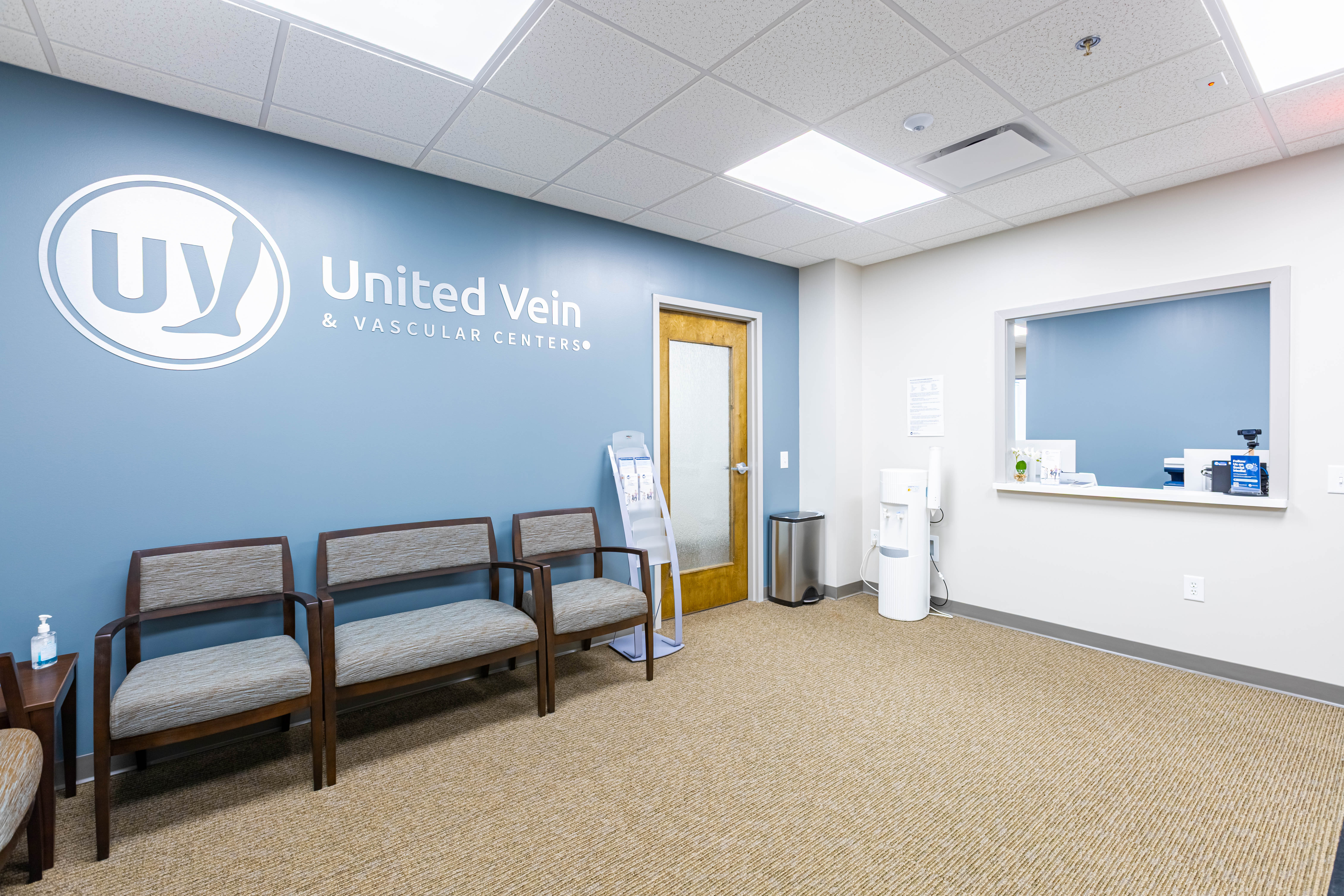
Four chairs, a water cooler and a procedure platform hiding behind the blue wall. Healthcare scale often wears beige carpet.
Publicly stated counts use “more than,” so this is a directional comparison, not an audited same-store series.
Amulet’s 2022 thesis was explicit: add locations, enter new markets, widen the service mix and handle more complex lower-extremity vascular conditions. The 2025 addition of Vascular Health, a New Jersey practice known for peripheral artery disease and limb-preservation work, shows the adjacency strategy in action. United Vein described it as a hub-and-spoke model - deep expertise in a regional hub, connected to a wider network of access points.
The expansion has come in clusters, which matters. A lone clinic in a new state must teach the market, recruit referrals and carry regional overhead by itself. A cluster can share awareness, talent and a specialist hub. In late 2025 and 2026, United Vein added a run of Georgia sites, opened Rockwall near Dallas, Mesa in Arizona, Venice and Loxahatchee in Florida, and Atascocita near Houston. The map looks less like a flag-planting exercise than a density game: fill in metro areas, then connect them to the broader platform.
Culture has to travel too. The company names six values - Understanding, Nurturing, Ingenuity, Trust, Excellence and Diversity - and its hiring spans clinical, physician, business-development, patient-engagement, revenue-cycle and corporate work. The list is conventional. The operational question is sharper: can a patient in Queens and a patient in Phoenix feel the same standard without feeling the same script? Multi-site healthcare lives in that tension. Central teams want consistency; local teams need judgment. A culture earns its keep when it tells people which one matters in the moment.
03 / The useful mistake
What failed first, and what changed minds
The clearest documented learning curve is clinical, not corporate. In a 2021 trade-journal article, Wazni and coauthors examined early use of Varithena, a regulated polidocanol microfoam. Some early users approached it too much like older physician-compounded foam. Reports of deep-vein thrombosis and thrombus extension fed hesitation, alongside questions about practice economics, treatment outcomes and where the therapy belonged.
What changed the conversation was unglamorous: stricter adherence to labeled instructions, more careful patient selection, controlled dosing, better technique, post-treatment care, Category I billing codes and accumulating real-world evidence. That is a business lesson wearing clinical clothing. New services do not scale because a brochure calls them innovative. They scale when risk, workflow, evidence and reimbursement become boring enough for repetition.
Notice the sequence. Technique alone was not enough. Evidence without reimbursement could leave a practice unable to offer the treatment sustainably; billing codes without clinician confidence would not create demand; enthusiastic adoption without protocol discipline could create harm. All four systems had to move together. This is why the most attractive healthcare ideas can fail on their first contact with operations. The breakthrough may be scientific, but adoption is a negotiated settlement among safety, training, workflow, economics and patient preference.
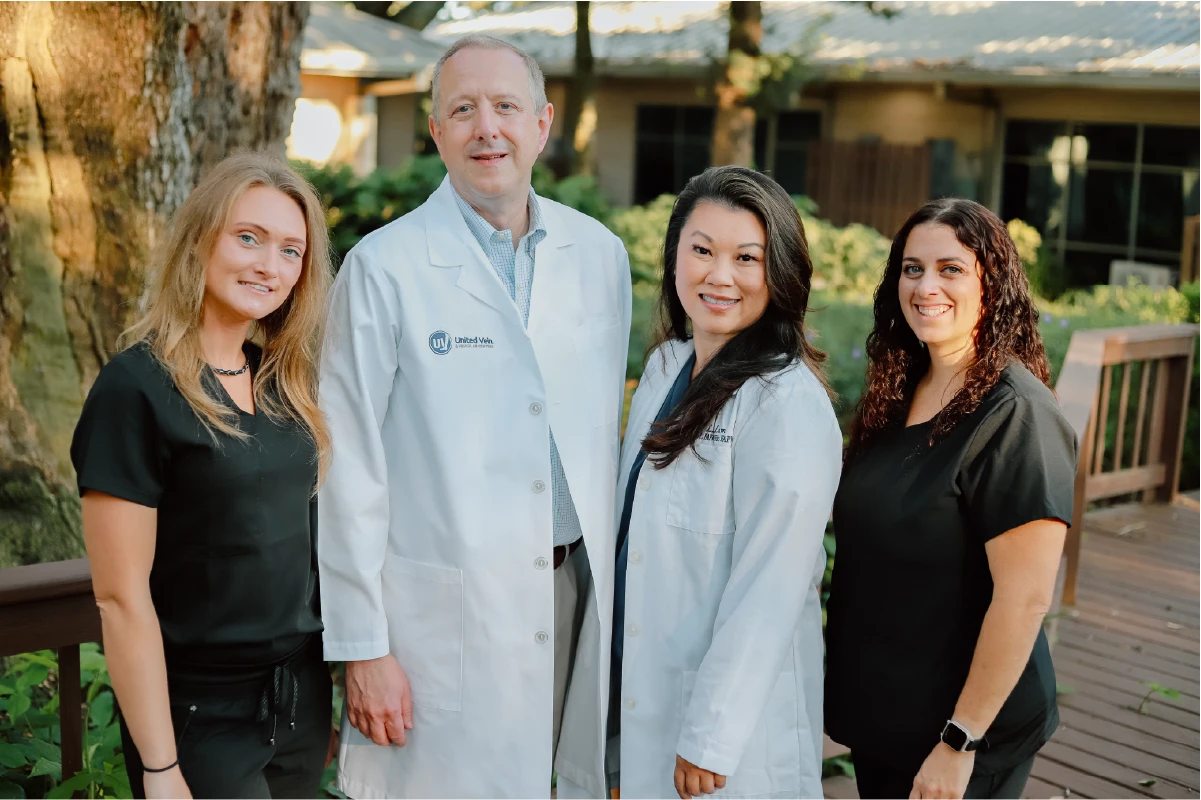
The platform can standardize the playbook. Trust still walks into the room wearing a name badge.
04 / The catch
Convenience stops when the bill surprises you
United Vein does not publish a universal cash price list, which is understandable clinically and frustrating commercially. A full vein plan can include several appointments and multiple procedures; eligibility and coverage vary. The company’s own guide says treatment often requires a real time commitment, sometimes with visits a couple of times a week. Public reviews and complaints include patients who say their final responsibility differed from what they expected. In public responses, the company has said final coverage and responsibility are determined by the patient’s insurance plan.
This is not a side issue. The company’s core promise is to remove friction from specialist care. If a patient can understand radiofrequency ablation but cannot understand the likely bill, the experience is only half designed. The next operating advantage in outpatient medicine may be a plain-language estimate, procedure by procedure, with the assumptions written beside it.
Procedure time can also be a misleading shorthand. A single treatment may be quick, while the care plan includes an initial consultation, diagnostic imaging, conservative-treatment requirements imposed by an insurer, authorization, staged procedures on different veins, compression, walking instructions and ultrasound follow-up. United Vein’s patient material says the exact number of visits depends on imaging, medical history and examination. The honest unit of convenience is therefore not minutes in the procedure room. It is total patient effort from first call to final follow-up - travel, forms, time off work, uncertainty and money included.
05 / The steal
Copy the choreography, not the catheter
The most transferable part of United Vein is the way it packages expertise. A founder in home services, legal work or education can use the same logic without touching medicine: find a painful journey split across providers, create a local front door, standardize the invisible steps, explain the category in the customer’s language and expand into adjacent problems only when the operating core is stable.
Five moves worth borrowing
- Choose a symptom customers recognize before they know the category.
- Put diagnosis and delivery in one understandable journey.
- Centralize administration while keeping expertise local and visible.
- Expand by adjacency, using the same facility and referral relationships.
- Make price expectations part of service design, not an accounting sequel.
The conditions for success are demanding. Local demand must be dense enough to support a specialist clinic. Procedures must be safe and appropriate outside a hospital. Payers must reimburse them. Clinicians must accept common systems. Patients and referring doctors must trust a scaled brand without feeling processed by it. Miss any one of those and the clean-looking growth loop develops a wobble.
United Vein’s achievement is not that it invented vein care. It made a fragmented corner of medicine easier to find, easier to explain and easier to reproduce across markets. Its expansion from 30-plus clinics to 60-plus after the Amulet deal suggests the format travels. The open question is whether the company can make financial communication travel just as reliably as its clinical playbook. In healthcare, the last mile is often not the procedure. It is the moment a patient opens the envelope.
Keep exploring
United Vein around the web
This profile is editorial information, not medical advice. Treatment eligibility, risks, benefits, coverage and cost should be discussed with a qualified clinician and insurer.