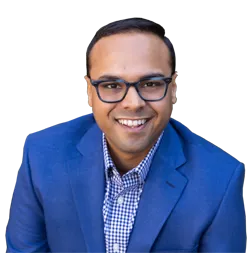
Umesh Sachdev runs Uniphore from a glass building on Page Mill Road in Palo Alto, but the company's accent is still Chennai. He co-founded it there in 2008 with Ravi Saraogi, a college friend from Jaypee Institute of Information Technology in Noida. Two engineering graduates, one shared interest in how machines hear language, one $100,000 grant from India's National Research Development Corporation, and a recession on the other side of the world that nobody was sure how to interpret yet. They named the company Singularis. They incubated it at IIT Madras. They were, depending on the audience, brave or naive. They were probably both.
The original product was a multilingual speech engine. The original ambition was not Wall Street. It was rural India. Sachdev and Saraogi partnered with IIT Madras to run a small BPO that employed visually impaired workers, using their speech recognition to make voice the interface instead of a screen. That detail is easy to skip past. Don't. It tells you what kind of founder Sachdev is. He picked the harder version of the problem - many languages, many dialects, accents nobody else was modelling - because the easier version did not exist for the people he wanted to help.
In 2013 he renamed Singularis to Uniphore and turned the boat toward enterprise. The conversational AI category did not really exist yet. There were call-center analytics vendors, there were IVR companies, there were a few research labs muttering about virtual assistants. Sachdev had something they did not: a working speech stack that had been hardened against the most chaotic acoustic environment on earth - the Indian customer-service phone line. When the world's banks and insurers eventually decided they wanted to listen to their own calls, Uniphore was already fluent.
TIME noticed first. In 2016 the magazine put him on its list of ten millennials changing the world, with a caption about a young entrepreneur who had built "a phone that can understand almost any language." MIT Technology Review followed with Innovators Under 35. The Economic Times put him on its 40 Under 40. The World Economic Forum named him a Young Global Leader. The list looks like a victory lap. It was not. It was a long, patient bet that voice would matter to enterprises in the same way data had mattered a decade earlier - and that the company that owned the voice layer would own something durable.
The bet looks correct now. Uniphore says it serves more than 2,500 enterprise customers, many of them Fortune 500. Bookings are approaching $1 billion. Growth, per the company, is roughly doubling year on year. None of which is unusual for an AI company in 2026. What is unusual is the vintage. Uniphore is not a generative-AI startup that pivoted out of stealth in 2023. It is a 17-year-old company whose founders did the unglamorous work of building speech infrastructure when no one cared, and then watched the rest of the industry walk into their market.
In October 2025 the Series F made that explicit. Two hundred and sixty million dollars, a list of strategic investors that reads like a roll call of the AI stack itself - NVIDIA on the chips, AMD on more chips, Snowflake on the warehouse, Databricks on the lakehouse - and a quartet of financial backers including NEA, March Capital, BNF Capital, National Grid Partners and Prosperity7 Ventures alongside. Sachdev was careful about the framing on CNBC. "Pure financial investment, pure equity investment, no strings attached, no stipulations," he said, which is a sentence you only deliver if you have been asked about strings. He then sized the prize: a "$5 trillion opportunity, and everyone on the table recognizes that there's enough to be had for everybody." Which is either the boldest market thesis of the year or the most reasonable, depending on whose pitch deck you read last.
What is Uniphore actually selling? In Sachdev's framing, it is "business AI" - a sovereign, composable, multimodal platform that lets a large organization deploy AI agents on top of its own data without handing the data, the model or the workflow over to someone else. The platform spans contact-center automation, agent assistance, conversational intelligence, voice biometrics, knowledge-as-a-service and, increasingly, the orchestration layer that ties pre-built AI agents to the legacy systems enterprises actually run. The bet is that the Fortune 500 will not standardize on one foundation model and will not standardize on one cloud and will not standardize on one vendor's agent runtime. They will need a layer that pretends none of that fragmentation exists. Uniphore wants to be that layer.
Strategy is easier to draw than to build. The harder thing about Sachdev is temperament. He is, by every public account, not loud. He gives a lot of interviews and they all sound the same - even, factual, slightly understated, founder-as-operator. He credits his mother, a homemaker, for the values part, and his father, an engineer and entrepreneur, for the rest. He has held the CEO job for the entire life of the company. He has held the same co-founder for the entire life of the company. In a category whose founders churn through three startups in the time it takes Uniphore to ship a quarter, that continuity is itself a kind of moat.
There is a quieter civic line in his biography too. He sits on the board of the US India Strategic Partnership Forum. He is a member of Indiaspora and the Forbes Technology Council. He runs StartUp Connect, a nonprofit that mentors emerging founders trying to scale. He won an AI Innovator of the Year award in 2023 and barely posted about it. The collected impression is of a founder who would rather your attention sat on the company than on him - and who understands, very precisely, that this preference is itself a brand.
If you look for the strange specific in Umesh Sachdev's story, it is not the funding round. It is the rural BPO with visually impaired workers in 2008. It is the decision to build for seven Indian languages before building for one American one. It is the patience to spend a decade in a category that did not yet have a name, then to watch four of the most powerful companies in computing line up to fund the version of it he had been describing all along. The phone that understood almost any language is now a platform that wants to understand almost any business. The man behind it has not changed much. The world finally did.