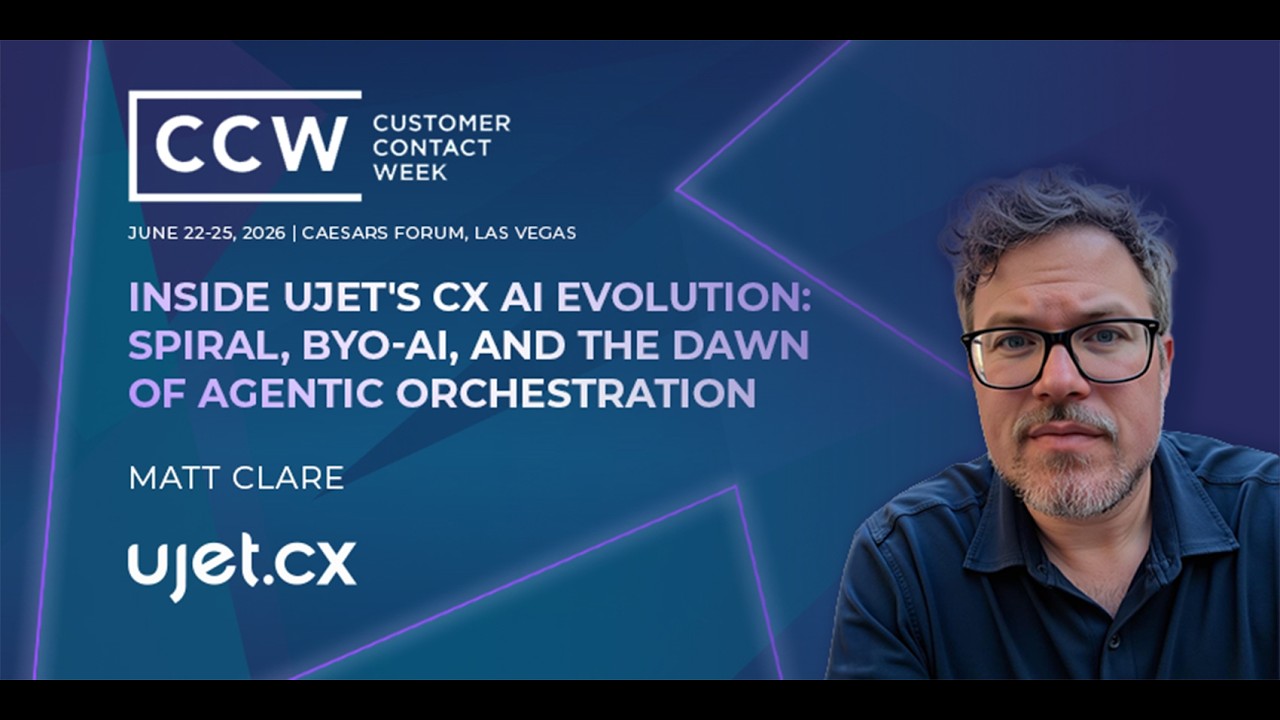
There is a peculiar kind of silence one can only find inside a very loud room. Walk the expo floor of CCW 2026 and you will hear it — the deafening, unanimous, chandelier-rattling shout of an entire industry saying precisely the same thing. Artificial intelligence. Every banner. Every booth. Every lanyard-wearing evangelist promising to automate the human right out of the conversation. It is, as CX Today's Rob observed while broadcasting from the thick of it, no longer a floor about adopting AI at all. "There's one thing here this week," he said, "and it is the pressure to move past the AI and actually value from the contact center investments you already have."
To be fashionable is simply to be like everybody else, and the whole floor had achieved fashion. Which is why the most interesting person in the building was the one committing quiet heresy. UJET's Matt Clare had come not to add his voice to the chorus but to sing, gently, in a different key. Where his neighbours sold the machinery of deflection — clever ways to stop the customer from ever reaching a person — Clare arrived carrying an unfashionable proposition, dressed up as an obvious one. The future, he suggested, is human.
People trust people.
— Matt Clare, VP Product Marketing, UJETIt is the sort of line that sounds like a platitude until you notice that nobody else in the room dares to say it. The prevailing wisdom of the tradeshow is that the ideal customer interaction is the one that never happens — a call snuffed out at the doorway, a chat throttled by a chatbot, a human being politely refused entry to another human being. Clare's counter-argument is not sentimental. It is economic. With the global economy what it is, he noted, and the pressure to control cost what it is, companies have reached for AI as a bouncer at the door. And yet customers, he has found, keep insisting on a human on the other side of it. He described watching a row of travellers at an airport gate, each one, at the moment it mattered, reaching for a voice rather than a menu. Trust, it turns out, is stubborn.
The Bouncer and the Detective
Here lies the whole quarrel in miniature. The industry's dominant instinct is to treat the contact center as a door to be defended — to measure success by how many people were turned away. UJET proposes the opposite posture entirely: not a bouncer at the entrance, but a detective in the parlour, forever asking the one question that deflection is structurally incapable of asking. Not how do we stop you calling, but why did you call at all?
The Fashionable Way
Use AI to stop the customer from reaching you.
The UJET Way
Use AI to learn why they reached out — then fix it.
That detective has a name: Spiral. Founded by former Amazon engineers who grew tired of watching mountains of customer conversation go unread and unexplained, Spiral was acquired by UJET to become what the company calls an AI Issue Hub. Its trick is a matter of appetite. Where a human quality team might sample a thimbleful of calls, Spiral swallows the ocean — voice, chat, email, surveys, reviews — the whole unruly correspondence of a company with its public. It reads all of it.
And having read everything, it does something almost impertinently useful. It detects the ultra-specific issues hiding in the noise, quantifies them in the only language a boardroom respects — money — and hands back a clear, explainable answer to whatever question a business cares to ask. If UJET's contact center platform provides the how of a resolution, Spiral supplies the why behind the whole affair, and the two form a loop that keeps tightening. To know why your customers keep calling is, of course, the first step toward ensuring they no longer need to. The irony is exquisite: the company least obsessed with stopping contact may be the one that reduces it most.
What, exactly, is Spiral?
An AI "Issue Hub" that ingests 100% of your customer conversations and feedback, detects the ultra-specific issues buried in the noise, and returns a clear, explainable, financially quantified answer to any business question — turning a haystack of complaints into a searchable map of causes.
In Praise of the Superpowered Human
Nothing is so dangerous as being too modern; one is apt to grow old-fashioned quite suddenly. UJET's wager is that the fashion for replacement will age badly, and that the durable idea is amplification. Clare is careful with his verbs. AI, in his telling, is not a substitute for the agent but a tool for the agent — a way, "broadly speaking, really as a tool, using AI to superpower those humans so they can do even more." The machine does not take the chair. It pulls the chair closer.
Using AI to superpower those humans so they can do even more.
— Matt Clare, on AI's proper jobThere is a delicious piece of evidence for this posture buried in UJET's own research: a finding that while 100% of customer service agents now interact with AI every single day, precisely 0% of them consider it critical to their daily success. A tool everyone touches and no one treasures is not a colleague. It is a keyboard. The lesson UJET draws is not to fire the humans and keep the keyboard, but to make the keyboard worthy of the humans.
The AI Paradox — From UJET's Own Research
Source: UJET research on customer service agents and AI. Ubiquity, it seems, is not the same thing as usefulness.The Tyranny of No Choice
The second heresy is subtler than the first, and dearer to Clare. The industry, in its enthusiasm, has developed a habit of deciding on the customer's behalf how the customer shall be helped — a single channel, a single script, a single obligatory chatbot standing sentinel. UJET regards this as a small tyranny. "Customers want that choice," Clare said. "They need that choice." He says it twice, as one does with the things one actually believes.
This is why UJET has bothered to build the unglamorous plumbing that lets a company control the branding of its own mobile and chat experiences through an SDK — so that the doorway to help looks and feels like the brand a customer already trusts, rather than a generic widget bolted on as an afterthought. Personalization, in UJET's framing, is not a cosmetic flourish but a matter of respect: help grounded in your own customer, offered in the shape they prefer, arriving through the door they chose to knock on. To insist that everyone be served identically is merely the modern manner of serving no one particularly well.
Choice as a feature, not a footnote
UJET's SDK lets brands control the look and feel of their mobile and chat experiences, so the path to a human is branded, familiar, and — crucially — the customer's own decision. The channel bends to the person, not the person to the channel.
From the "How" to the "Why" — and On to the Agentic Dawn
If all of this sounds like nostalgia dressed as strategy, look at where the loop is heading. The genuinely radical idea is not that Spiral can tell you why customers call; it is what happens next. UJET describes a chain that runs from analysis straight through to action — the system does not merely diagnose the ache, it proposes the remedy, configures it, optimizes the process, and drives the whole business toward resolution. The detective, having named the culprit, is permitted to make the arrest.
This is the territory UJET has begun to call agentic experience orchestration — a persistent layer of intelligence stretched across the whole toolchain, coordinating rather than merely answering. It is the natural destination of a company that decided, against the fashion, that the point of AI was never to end the conversation but to understand it well enough to make it worth having. UJET is said to be running its own support on this vision before letting it loose, which is either great prudence or great confidence, and possibly both.
Customers want that choice. They need that choice.
— Matt Clare, twice, for emphasisThere is a lovely paradox in it all. Amid a hall bellowing about the machines, the most futuristic thing anyone had to say was about the people. Everyone else was selling the exit; UJET was studying the reason for the entrance. And if one truly wishes to reduce the number of times a customer must reach out in frustration, the surest method is not to slam the door — it is to find out, with unfashionable curiosity, why they keep knocking, and then to have a human, superpowered and unhurried, open it. To ask why instead of goodbye. It is enough to make the whole loud room go, for just a moment, thoughtfully quiet.
Filmed on the expo floor of CCW 2026 · A CX Today conversation with UJET