Mid-stride in a field with no satellites overhead
The tractor doesn't know where it is. No GPS signal penetrates the canopy of a dense almond orchard in the San Joaquin Valley. The branches block the sky. Most autonomy systems stall out here. Tyler Niday's doesn't. His AI reads the rows by looking at them - the same way a farm worker does, except it never gets tired and it's running on 50 machines simultaneously.
That's not a future product. It's what Bonsai Robotics deployed commercially in 2023, across tree nut orchards in California and Australia, before most of the industry had figured out that GPS-denied environments are where the real farming happens. Niday had spent years inside Blue River Technology watching exactly that problem from the inside, helping build See & Spray - the precision herbicide system that John Deere acquired for $305 million in 2017.
He left Deere in 2022. Not because the work wasn't meaningful. Because he could see the gap between what big manufacturers would build and what agriculture actually needed. He co-founded Bonsai Robotics with CTO Ugur Oezdemir, a fellow Blue River and Airbus veteran, and started building the autonomy stack that the majors couldn't - or wouldn't - prioritize.
"We're shifting the industry from iron to software. This new team unlocks the opportunity to design, build, and deploy the next generation of machines - built AI-first, field-tested, and ready for real-world agriculture."
- Tyler Niday, Co-Founder & CEO, Bonsai RoboticsBefore the robots, there were tree shakers
Niday's path into agricultural engineering wasn't an abstraction. His undergraduate degree from Cal Poly San Luis Obispo was in BioResource and Agricultural Engineering - a degree built around understanding how food actually gets grown and harvested. His first professional stop was the Irrigation Training and Research Center, then Orchard Machinery Corporation, where from 2012 to 2015 he designed hydraulic systems, drive-by-wire controls, and mechanical harvesters for the tree nut industry.
That's the part most founder profiles skip over. He didn't come to agriculture from software. He came from the machines - the physical, greasy, field-tested hardware that actually does the work. He knew what it felt like to design equipment for people who wake up at 4am and work until the light fails. He understood the economics of a bad harvest season. He understood why farmers don't buy things that don't immediately work.
MIT came in the middle. His master's focused on System Design and Management - an interdisciplinary program that trains engineers to think in architectures, not just components. It's the degree you get when you're already good at building things and want to understand how systems fail at scale. It set up the next chapter exactly.
Seven years at the intersection of cameras and crops
Blue River Technology's core insight - that a camera pointed at a field could identify individual weeds at speed, enabling targeted herbicide application - was the kind of idea that sounds obvious once someone has already done it. Niday joined as that idea was being scaled from prototype to commercial product, eventually rising to Head of Engineering, Construction Autonomy. He worked on mechatronics, robotic integration, and autonomy systems through the John Deere acquisition and the years that followed.
What he absorbed at Blue River was the gap between research autonomy and deployed autonomy. The difference between a robot that works in a controlled test and one that runs 10-hour shifts in 100-degree California heat with dust, vibration, branches, and non-uniform terrain. That distinction became the foundation of VisionSteer - Bonsai's proprietary system that navigates using cameras alone, reading crop row geometry and field features without satellite input.
"We have made significant progress building our AI model and data set for autonomous orchard management since our seed round of funding a year ago, so this additional funding is strong validation of the incredible work our team has accomplished and our future growth prospects."
Tyler Niday - January 2025, on closing the $15M Series AThe labor problem, measured in acres and dollars
American agriculture loses somewhere between $3 billion and $5 billion annually to labor shortages. Specialty crop operations - orchards, vineyards, berry fields - are the hardest hit because their work resists mechanization. You can't just drive a combine through an almond orchard. The terrain is uneven, the canopy is irregular, the work is seasonal, and the labor required is both skilled and physically demanding. Workers who spent careers doing this work are aging out. Younger workers aren't filling those roles.
Bonsai's pitch to growers isn't a futurist argument. It's a cash flow argument. The system deploys on existing equipment via a hardware kit. No new tractor purchase required. The AI runs the vehicle through the orchard while the operator monitors remotely or manages another task. In documented deployments, customers see 45% reductions in operating expenses and 60% faster job completion. Those aren't projections. They're what happened in the field.
The acquisition that changes the map
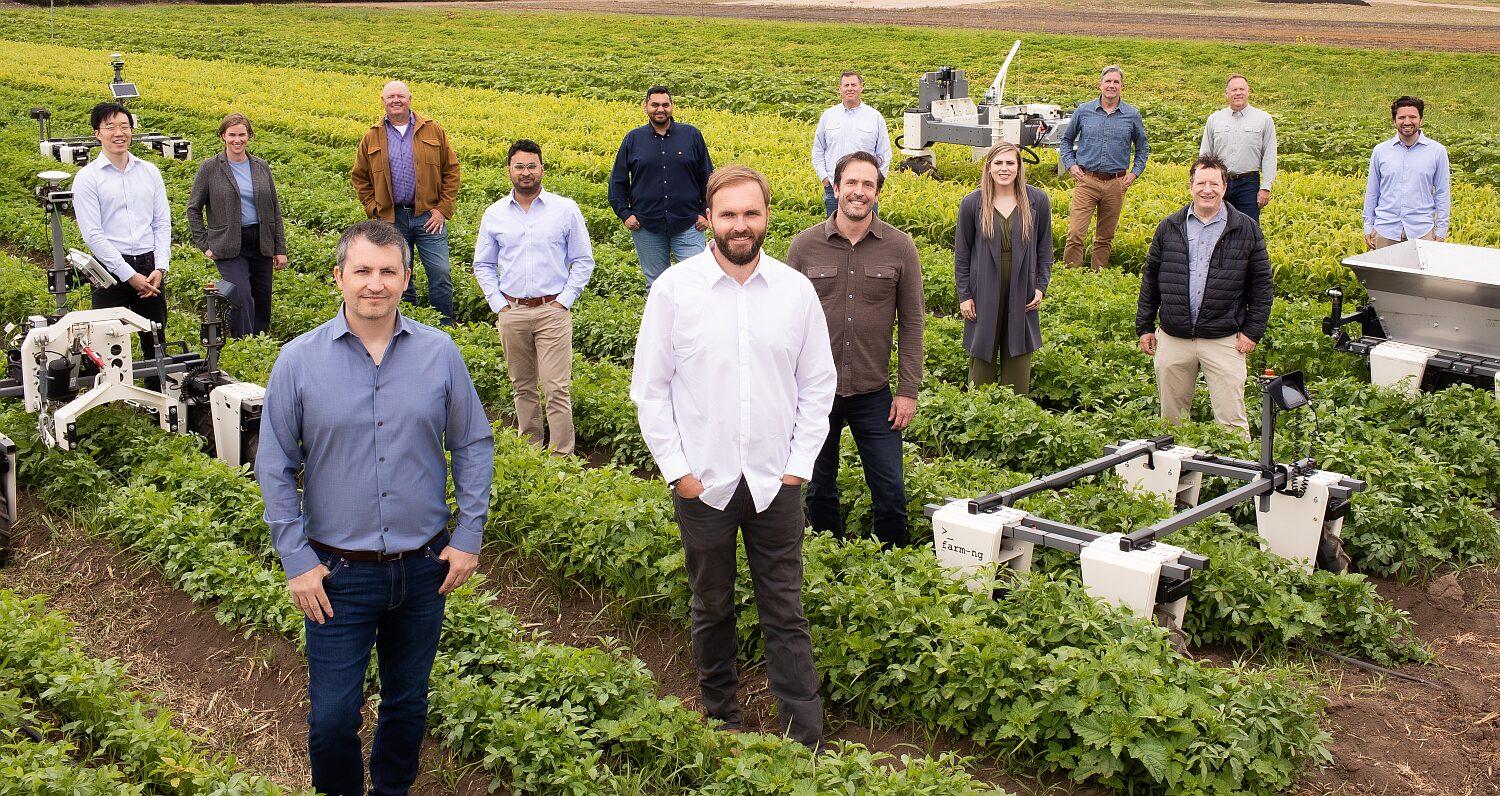
In July 2025, Niday made a move that signaled Bonsai's ambitions clearly: the company acquired farm-ng, the Watsonville-based startup that had spent five years building the Amiga - a modular, electric robotic platform with 230 units sold since 2020 and a threefold sales increase projected for 2025.
The strategic logic was clean. Bonsai had deep software and AI expertise, primarily deployed in tree nut orchards. Farm-ng had hardware and relationships in bedded crops and vineyards - the other side of specialty crop farming. Together, the two companies cover enough of the agricultural landscape to claim something close to comprehensive reach in specialty crops. Farm-ng's CEO Brendan Dowdle became Chief Business Officer of the combined entity. John Teeple, former Director of Technology at John Deere, joined as COO. Gary Bradski - founder of OpenCV, the computer vision library that underpins half the industry - signed on as Chief Science Officer.
"To date, our vision has been to make autonomy and AI accessible, easy to use, and deployable across all farm equipment whether retrofitted onto existing tractors or built into the next generation machine."
- Tyler Niday, on the farm-ng acquisition, July 2025The acquisition also marked a strategic shift: Bonsai moved from being a software-and-kit company to a full-stack platform with its own hardware. The Amiga lineup is now offered as "Bonsai Intelligence-powered Amiga" - the branding signals a tighter integration than a pure partnership would allow.
How an agricultural engineer thinks about autonomy
Niday talks about autonomous farming in a register that's unusual for Silicon Valley founders. He doesn't frame it around disruption or the future of work in abstract terms. He talks about specific crops, specific problems, specific equipment constraints. His formative years were spent designing hydraulic systems for tree nut harvesters, and that specificity shows.
In public comments, he consistently emphasizes deployment over demos. The 750,000 acres of training data Bonsai accumulated didn't come from simulation. It came from machines running in actual orchards, encountering actual conditions - variable lighting, irregular row spacing, equipment vibration, dust, wind. That grounding in real-world operation is a deliberate competitive stance. It's also the reason the oversubscribed Series A closed: investors saw commercial traction, not a demo reel.
He was featured on The Modern Acre podcast in August 2024 - episode 364, titled "From Blue River Technology to Founding Bonsai Robotics" - speaking directly to how his experience inside a major agricultural technology acquisition shaped his understanding of what independent startups can do that incumbents can't.
"This acquisition allows us to develop next generation machines to augment and empower today's workforce while optimizing farm productivity."
Tyler Niday - on acquiring farm-ng, July 2025What the career arc reveals
Irrigation systems to orchard machinery to computer vision at Blue River to running autonomy at John Deere's scale to founding Bonsai - that's not a random walk. It's a systematic accumulation of exactly the knowledge needed to build what Bonsai is building. Agricultural engineering from Cal Poly gives you the domain. MIT's Systems Design and Management program gives you the architecture thinking. Blue River gives you the applied AI. John Deere gives you the understanding of how a $50B incumbent moves (and where it can't).
The company he's building sits at a particular moment in agriculture: when the AI capabilities are finally mature enough to work in unstructured outdoor environments, the labor shortage has crossed from inconvenience to crisis, and the incumbent equipment manufacturers are too invested in GPS-based systems to pivot quickly. Bonsai's VisionSteer approach - treating cameras as the primary sensor rather than the supplementary one - is a bet on that window staying open long enough to build a defensible position.
With 59 employees, $28.5M raised, 750,000 acres of training data, and a newly acquired hardware platform, Niday appears to be executing on a plan that was never going to show up in a slide deck. It was always going to show up in the orchard.
Key Achievements
-
1Co-founded Bonsai Robotics in 2022 with CTO Ugur Oezdemir, grew the company to 59 employees in three years
-
2Raised $28.5M total including an oversubscribed $15M Series A led by Bison Ventures (January 2025)
-
3Developed VisionSteer - patented vision-based navigation enabling GPS-free autonomous operation in orchard environments
-
4Deployed autonomous systems across 750,000+ acres of orchard operations in the US and Australia
-
5Sold 50+ robots commercially in the first year of deployment, achieving 45% operating expense reduction for customers
-
6Acquired farm-ng in July 2025, adding modular Amiga electric robot platform and 230+ robot installed base
-
7Built leadership team including OpenCV founder Gary Bradski (CSO) and former John Deere Technology Director John Teeple (COO)
Five Things Worth Knowing
His Cal Poly major - BioResource and Agricultural Engineering - is one of the most agriculture-specific engineering degrees in the US. It's not a coincidence that the founder who built vision-based farm robots has a degree literally named after the field he's automating.
VisionSteer works in orchard canopies where GPS signals can't penetrate. It navigates by reading crop row geometry, just like an experienced driver does. This isn't a workaround - it's the product advantage.
The 750,000 acres of operational data Bonsai accumulated before Series A came from real commercial deployments, not simulation. It's one of the larger real-world autonomy training sets in agriculture.
Featured on Episode 364 of The Modern Acre podcast (August 2024), titled "From Blue River Technology to Founding Bonsai Robotics" - an unusually candid account of how the See & Spray acquisition experience shaped his startup thinking.
The farm-ng Amiga robot Bonsai acquired was designed and manufactured in Watsonville, CA - the agricultural heart of the US central coast. It's now paired with Bonsai's AI platform to become the company's flagship autonomous hardware.
Gary Bradski - who founded OpenCV, the open-source computer vision library used across the AI industry - joined Bonsai as Chief Science Officer after the farm-ng acquisition. OpenCV is in almost every vision system in agriculture today.