The career of Trans-Siberian Orchestra begins with a record that seemed to be over. In 1995, the progressive-metal band Savatage released Dead Winter Dead, a rock opera set during the war in Bosnia. Buried inside was a four-minute instrumental, “Christmas Eve (Sarajevo 12/24),” which braided “God Rest Ye Merry, Gentlemen” into “Carol of the Bells.” The album did not catch. The label had little reason to expect an encore.
Then WPLJ in New York played the track during the 1996 holiday season. Listeners called. Stores moved records. A song about a cellist in a battered city, performed by a metal band with little radio heat, had found the season's nerve. The industry heard an unexpected hit. Producer, composer and lyricist Paul O'Neill heard permission to build the large theatrical idea he had been carrying for years.
Atlantic Records asked for an album. O'Neill brought together Savatage collaborators Jon Oliva, Robert Kinkel and Al Pitrelli and gave the project a new name. Trans-Siberian Orchestra sounded old-world and locomotive at once. It was born in New York, dreamed partly in Russia, and assembled from ingredients that polite dinner parties usually seat far apart: Broadway, heavy rock, classical melody, Motown, narrated fiction and a lighting rig with aggressive intentions.
One unexpected radio response changed the scale of the idea. The instrumental became the doorway to an entire Christmas trilogy.
A railway, a rock opera, a very good set of initials
O'Neill had thought of the name years earlier after visiting Russia. Siberia struck him as beautiful and unforgiving; the railway joined people across it. Music, he reasoned, could run a similar line through a difficult life. Then came the practical afterthought: he liked “TSO.” Grand philosophy and good branding rarely arrive in the same sentence, but O'Neill enjoyed making roomy ideas share a berth.
Christmas Eve and Other Stories arrived in 1996 and eventually sold four million copies. Its success settled which of O'Neill's planned rock operas would come first. The Christmas Attic followed in 1998. The Lost Christmas Eve completed the trilogy in 2004. Between them, TSO released Beethoven's Last Night, a non-holiday morality play that imagined the composer's final hours as a negotiation with Fate, Twist and Mephistopheles. O'Neill did not merely borrow classical tunes. He gave dead composers speaking parts.
Later records widened the map. The two-disc Night Castle arrived in 2009, entered the album chart at number five and went gold before the year closed. Letters from the Labyrinth followed in 2015, reaching number seven overall and the top of the rock-album chart. The catalog had escaped the Christmas trilogy without abandoning its basic grammar: familiar musical language, new characters and moral questions large enough to require a choir.
The albums read like illustrated books because O'Neill believed songs gained a third dimension when woven into narrative. An attic, a runaway, a lonely stranger, a city at war: these were not excuses between guitar solos. They were the structure holding the music together. Christmas supplied a deadline and an audience. Story supplied the reason to return.
“The original concept of Trans-Siberian Orchestra was how to make music have the most emotional impact.”Paul O'Neill
The quiet mechanism inside the loud show
TSO first toured in 1999. The production has since become famous for lasers, moving platforms, video walls and pyrotechnics. Those nouns are accurate but incomplete. Fire can startle a crowd once. A story can bring the same family back for twenty winters.
Music director and guitarist Al Pitrelli identifies the emotional hinge in plain language: “Everybody misses somebody, especially on Christmas.” This is why the loudness lands. Beneath the spectacle, TSO's stories worry over regret, absence, reunion and second chances. A child can follow the plot. An adult may recognize the cost.
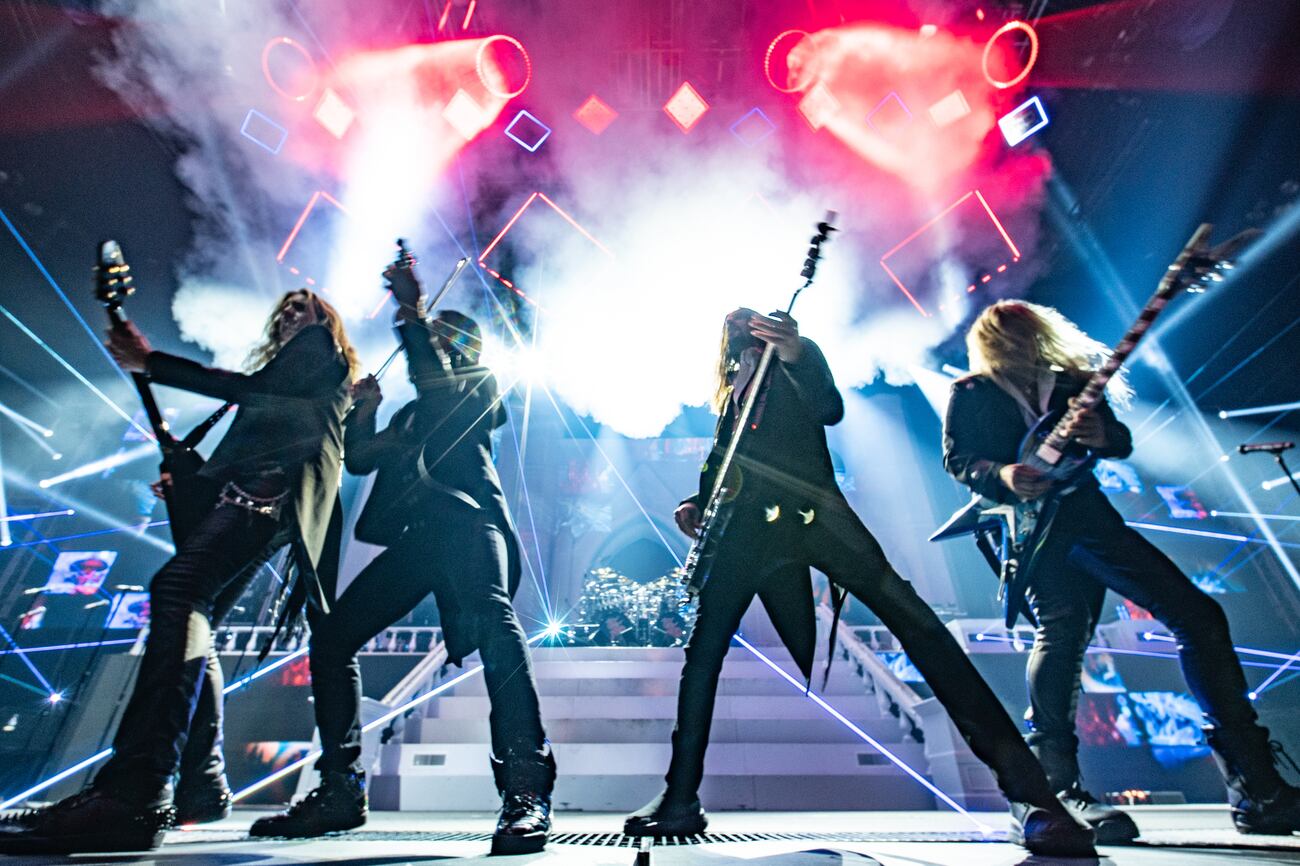
The visual scale also grew from an audience rule. O'Neill insisted there should be no second-class seats. The production was designed to reach the far corners of an arena, not merely reward the first few rows. This demanded stages at both ends, effects in the crowd and a level of choreography closer to touring theater than a loose rock bill. Spontaneity still happens inside the music. The larger machine runs on cues.
The orchestra that learned to be in two places at once
The calendar presented a less poetic problem. Demand was national; the useful touring window was about seven weeks. In 2000 the operation divided into East and West companies. Both rehearse together, then head in opposite directions, often playing a matinee and an evening show on the same day. The audience buys a ticket to Trans-Siberian Orchestra rather than to a touring cast identified by compass point.
This is TSO's least visible achievement. Every burst of fire depends on a chain of crews, trucks, venues, musicians and local hands arriving on time. Vocalists rotate through characters. String players move between lyricism and rock poses. Guitarists cross long ramps without treating the orchestra pit as a destination. The show must feel dangerous while being run with fierce discipline.
The model is unusual, but the continuity is personal. Pitrelli, drummer Jeff Plate and guitarist Chris Caffery have carried long institutional memories through changing casts. Caffery is due to play his 1,500th TSO show in November 2026. The touring troupes still rehearse together each year, a reminder that the division is logistical rather than artistic.
Even the daily rhythm is doubled. An afternoon crowd may include young children seeing their first arena show; the evening audience can stay for a free signing line after selected performances. Musicians finish one emotional arc, reset, and begin again a few hours later. Repetition at this scale is not autopilot. It is the practiced art of making the second telling feel like the first.
Fans have their own continuity. Pitrelli calls them “repeat offenders” and once estimated that nearly half had been coming since the early years. Children who first saw the show from a booster seat now bring children of their own. TSO sells spectacle, certainly, but recurrence is the durable product. The show returns when the year turns dark early.
One dollar follows every ticket home
O'Neill coupled scale with an obligation: at least one dollar from every ticket goes to charity in the city where it was sold. By 2024, that practice had directed more than $20 million to local organizations. The contribution is wonderfully untheatrical. No laser is required. The tour passes through, but a piece of each night stays behind.
The symmetry is almost too neat: more than 20 million tickets, more than $20 million given. Yet it describes a patient system rather than a single grand gesture. TSO's philanthropy accumulates exactly as its audience did, one market and one winter at a time.
“The arts have incredible power, and with that comes incredible responsibility.”Paul O'Neill
After O'Neill died in 2017, the question was whether a project so stamped with one imagination could continue. His family, longtime collaborators and management chose continuity without embalming the show. The stories remained. The production kept changing. Musical direction rested with Pitrelli, who had been part of the founding creative circle.
That balance shows in the 2026 anniversary season. The group is returning to The Ghosts of Christmas Eve, its tale of a runaway who finds shelter in an abandoned vaudeville theater. The staging has been rebuilt, followed by a second set of catalog pieces and less frequently performed material. Recognition gets the first act; surprise gets room after intermission.
Thirty winters, rebuilt one more time
The business remains formidable. The 2025 run delivered 109 performances and grossed $60.4 million. The signature Sarajevo track has crossed 100 million digital streams. None of this fits the profile of a novelty that escaped from a December playlist.
Yet TSO's current concern sounds almost domestic: can a family still afford to come? For the 30th anniversary tour, the group expanded its lower-priced ticket inventory. Pitrelli put the principle bluntly. A night at the show should not resemble a mortgage payment. O'Neill wanted audiences to receive more production than they imagined; keeping the door open is now part of delivering that excess.
Tradition has a tricky contract. Repeat too faithfully and it becomes furniture. Change too much and nobody recognizes the room. Trans-Siberian Orchestra keeps the story familiar while rebuilding the weather around it. The snow, naturally, may arrive indoors. So may a platform carrying a guitarist over the audience.
The whole unlikely enterprise still rests on the lesson of that first radio spin: pay attention when people respond. A neglected instrumental had found listeners who heard grief, motion and hope in its collision of carol and electric guitar. O'Neill did not sand down the strange parts. He built them an arena.
Thirty years later, the trains leave in two directions every November. The stories travel with them. The local charities receive their share. And somewhere in the upper deck, a first-time child watches the lights fall, unaware that a family appointment has just been placed on every December still to come.
Follow the signal