Dispatch / Diagnostics
Tom Schoenherr
CEO of Diagnostics at Tempus AI. The operator who sold his last company to the company he now helps run.
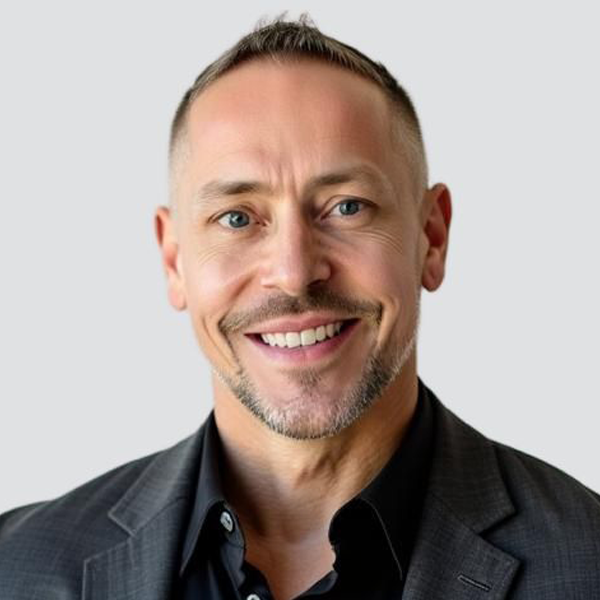
Filed: Aliso Viejo → Chicago
CEO of Diagnostics at Tempus AI. The operator who sold his last company to the company he now helps run.
Most days, Tom Schoenherr is somewhere between Aliso Viejo and Chicago. On the California end sits Ambry Genetics, the clinical genomics shop he ran as CEO from 2021 through its 2025 sale. On the Illinois end sits Tempus AI, the publicly traded precision-medicine company that bought Ambry and handed Schoenherr the keys to its diagnostics business. He is now CEO of Diagnostics at Tempus AI, which means he runs the unit that turns a patient's tumor, blood, or saliva into a data point an algorithm can use.
That sentence is doing a lot of work. Tempus AI is not a small place. The company reports roughly 2,400 employees and trailing revenue north of $1.27 billion. It sits inside a category that overlaps oncology, hereditary disease, cardiology, immunology, and the messy middle where electronic health records meet generative models. The diagnostics arm is the part that touches the patient. Schoenherr runs it.
He has been doing some version of this job since before the word "genomics" had a stock ticker behind it. His career stops, roughly in order, read like a tour of American clinical diagnostics: Abbott Diagnostics, Siemens Healthcare, Quest Diagnostics, Counsyl, Omada Health, Ambry Genetics, and now Tempus. If a US healthcare worker has ever sent a sample to a lab in the last two decades, there is a non-trivial chance the chain of custody passed through a company Schoenherr was helping to scale.
And yet, ask him what makes a place worth running, and he answers with something closer to a high-school coach than a Fortune 500 deck. "Titles get checked at the door," he told a company-culture interviewer at Ambry. "Whether you are an entry-level individual who just started here a couple months ago, or you are the CEO, everyone has an equal voice." That is the kind of line that sounds soft until you remember he is the one who decided which voices got equal time in a thousand-person clinical lab.
I have no doubt that the acquisition of Ambry Genetics by Tempus will be an industry-changing event.- Letter to customers, announcing the Tempus deal
Schoenherr's current title makes sense only if you understand the deal that produced it. In late 2024, Tempus AI and Ambry Genetics signed a definitive agreement: Tempus would acquire Ambry, the company would continue to operate as a wholly owned subsidiary under the Ambry brand, and the Aliso Viejo laboratory would keep running its full testing menu. The deal closed in 2025. Customers got a personal letter from Schoenherr promising that ordering, billing, and the team they trusted were not going anywhere.
The strategic logic was the part nobody had to spell out. Ambry brings 25 years of variant interpretation, a hereditary cancer franchise, and the recently launched ExomeReveal product. Tempus brings the AI tooling, the multimodal data, and the public-market balance sheet. Stitch the two together and you get a precision-medicine company that can read the genome and act on it at scale. Schoenherr, who had been quietly engineering Ambry's growth for years, was the obvious operator to run the combined diagnostics engine.
He arrived at Ambry in November 2017 as Chief Commercial Officer. That title - CCO - sounds like sales. In practice at Ambry it meant service, support, marketing, business development, managed care, and the genetic specialist team. Four years later, the board promoted him to CEO. Boards rarely promote CCOs into the top job unless the company's central problem is commercial. Ambry's was: a strong clinical product fighting for share in a brutal payer environment. Schoenherr's bet was that commercial discipline plus relentless variant-curation quality could win. Record growth followed.
Before Ambry, he served as Chief Commercial Officer at Omada Health, the digital-therapeutics pioneer. That detour matters more than it looks. Omada is software-first, behavior-change healthcare. It taught a lab veteran how a category gets built when the deliverable is not a tube but a screen. When he came back to molecular diagnostics, he came back with a digital-native vocabulary.
Before Omada he ran commercial strategy at Counsyl, the carrier-screening upstart that was the loud kid in reproductive genomics. Before Counsyl: senior leadership at Quest Diagnostics, Siemens Healthcare, and Abbott Diagnostics. He started at the big end of the market and worked his way toward the small, fast end, and then back to the big end again at Tempus. It is the rare diagnostics resume that includes both a Fortune 100 incumbent and a privately held disruptor in the same paragraph.
Talk to people who have worked with Schoenherr and you hear the same word: deliberate. Deliberate hiring, deliberate cadences, deliberate disagreements. He likes to say diversity has to be deliberate, and he applies the same logic to team-building, partner selection, and product positioning. In a LinkedIn post that has aged unusually well, he wrote that "the people you partner with are as important, if not more important, than the work itself." For someone whose career has been one long string of partnerships - payers, providers, biopharma collaborators, software platforms - that is not a platitude. It is the operating model.
At Tempus, the diagnostics business is the customer-facing front door. Oncologists order an xT or xR. Hereditary cancer screens get sent to the former Ambry pipelines. Cardiology and immunology assays are layered on top. Behind every test sits a database that gets bigger and better-labeled with every run, and behind that sits a suite of models that turn the data into clinical decision support. Schoenherr's job is to make the front door wider without making the back end less rigorous. The Ambry team has been doing variant interpretation since the late 1990s. The Tempus team has been doing AI on biomedical data since 2015. He is the bridge.
In April 2026, Tempus was named to TIME's list of the 10 Most Influential Health and Life Science Companies. In May, the company announced its first Investor Day. Schoenherr's diagnostics arm is the story that those headlines are about. The labs ship the samples. The samples produce the data. The data produces the moat.
Schoenherr does not tweet. He does not have a personal blog. He shows up on LinkedIn occasionally with a short post and a link to a peer-reviewed study. He gives the occasional keynote - at PMWC in Silicon Valley, at industry events on rare disease, at internal Ambry townhalls that customers sometimes get to glimpse on Facebook video. The pattern is consistent: low public surface area, high internal density. He is a builder who would rather ship a product than narrate one.
Which is probably why his customer letter announcing the Tempus deal landed the way it did. It read like a human being talking to other human beings. No buzzwords. No "synergies." Just: here is what is changing, here is what is not, here is what we owe you. In a category where most CEO communications get written by a comms agency and sound like it, that voice is a competitive advantage.
He earned his Bachelor of Science from Michigan State University and later completed the Executive Business Development Program at the University of Notre Dame. East Lansing and South Bend, ninety minutes apart on I-94. A Spartan who went to do graduate work with the Irish. That is not a fact most healthcare-executive bios spend time on, but it is a useful tell about how he thinks: get the technical foundation, then go learn how the deal gets done.
If you back out and look at the arc, Schoenherr is the operator who keeps showing up at the moment a category is about to professionalize. Abbott and Siemens when in vitro diagnostics consolidated. Quest when reference labs became a national logistics business. Counsyl when carrier screening went mainstream. Omada when digital therapeutics found a payer model. Ambry when hereditary cancer screening hit standard of care. Tempus, now, as AI-enabled precision medicine moves from press releases into clinical workflows. He keeps walking into the room about ten minutes before the room becomes important.
The next ten minutes belong to the diagnostics arm of an AI-native, publicly traded, multi-modal precision-medicine company with a Chicago HQ and a California lab. The operator at the switchboard has been studying for this exam for 25 years.
"Titles get checked at the door. Whether you are an entry-level individual who just started here a couple months ago, or you are the CEO, everyone has an equal voice."
"Everyone has this passion around what we are doing, making a difference in patients' lives. It is real here, and you feel it when you talk to the team."
"Diversity has to be deliberate."
"I have no doubt that the acquisition of Ambry Genetics by Tempus will be an industry-changing event."
"The people you partner with are as important, if not more important, than the work itself."
If a thing is worth doing in diagnostics, do it where the data is. The data is at Tempus.
Undergrad Spartan. Graduate-program Irishman. 90 miles apart, separated by an entire football rivalry.
He spent a stretch as CCO of Omada Health, the digital-therapeutics pioneer - the rare lab veteran with a screen-first chapter on the resume.
Abbott, Siemens, Quest, Counsyl, Omada, Ambry, Tempus. Almost every brand on a modern US lab requisition has shown up on his payroll at some point.
Where to keep reading, follow, or fact-check.
Tempus · Team page LinkedIn Ambry · The Letter Ambry · Leadership Profile PMWC 2020 SV Crunchbase Bloomberg Profile Tempus AI on X Video · Rare Disease Day