The quiet platform in the loud rooms.
Somewhere in a 70th-floor conference room in Singapore, a chief transformation officer is opening her laptop. She has 14 minutes before a global town hall. She is about to push a 4-minute personalized podcast - generated from a strategy deck she wrote on Tuesday - to 38,000 employees across 11 time zones, in nine languages. None of those employees will know they were the test. They will know they finally understood the change. The tool doing the work is Tigerhall.
Tigerhall calls itself a Change Activation Platform. It is the kind of phrase that ought to sound like jargon and somehow doesn't, mostly because the people buying it have given up on the alternatives. Internal comms used to mean a 47-slide deck and a Friday all-hands. Tigerhall replaced that with software.
Enterprise change has a 70% failure rate. That's the polite number.
For decades, the change management industry has been selling the same thing: a McKinsey deck, a Slack channel, an awkward video from the CEO, a survey nobody fills out. Companies spend hundreds of millions on transformations - new ERPs, restructured org charts, AI rollouts - and roughly two-thirds of those efforts underperform. Some never land at all.
The interesting part is that nobody disagrees about why. Employees get too many emails. The messaging is wrong for their role. The training arrives three weeks after the change. The data on who actually adopted what is, generously, a guess. Tigerhall's bet is that this problem is fundamentally a software problem hiding inside a consulting one.
Nellie Wartoft, ex-recruiter, decided this was a tech company.
Nellie Wartoft is Swedish. She moved to Singapore. She spent four and a half years at Michael Page running the Sales & Marketing recruitment desk, where she watched executive after executive describe the same gap: the people inside their organizations couldn't keep up with what the organization was trying to become. Training existed. Adoption didn't.
In 2018, she founded Tigerhall. The early version was a kind of Spotify for executive insight - short-form audio from senior leaders, designed to be consumed on a commute. It was charming. It was also, by Wartoft's own later framing, not yet the company. The pivot - from a content app to an enterprise change platform - took years and arrived alongside generative AI.
A small company with an unusually long memory.
Five pillars, one weirdly specific opinion.
Tigerhall organizes its platform across five dimensions: Communication, Capability Building, Feedback Loops, Measurement, and Sustainment. Stripped of the framework language, the opinion underneath is this: organizational change only happens when the same loop fires for every employee - they hear it, they learn it, they tell you what they think, you can prove they did, and the new behavior survives the quarter.
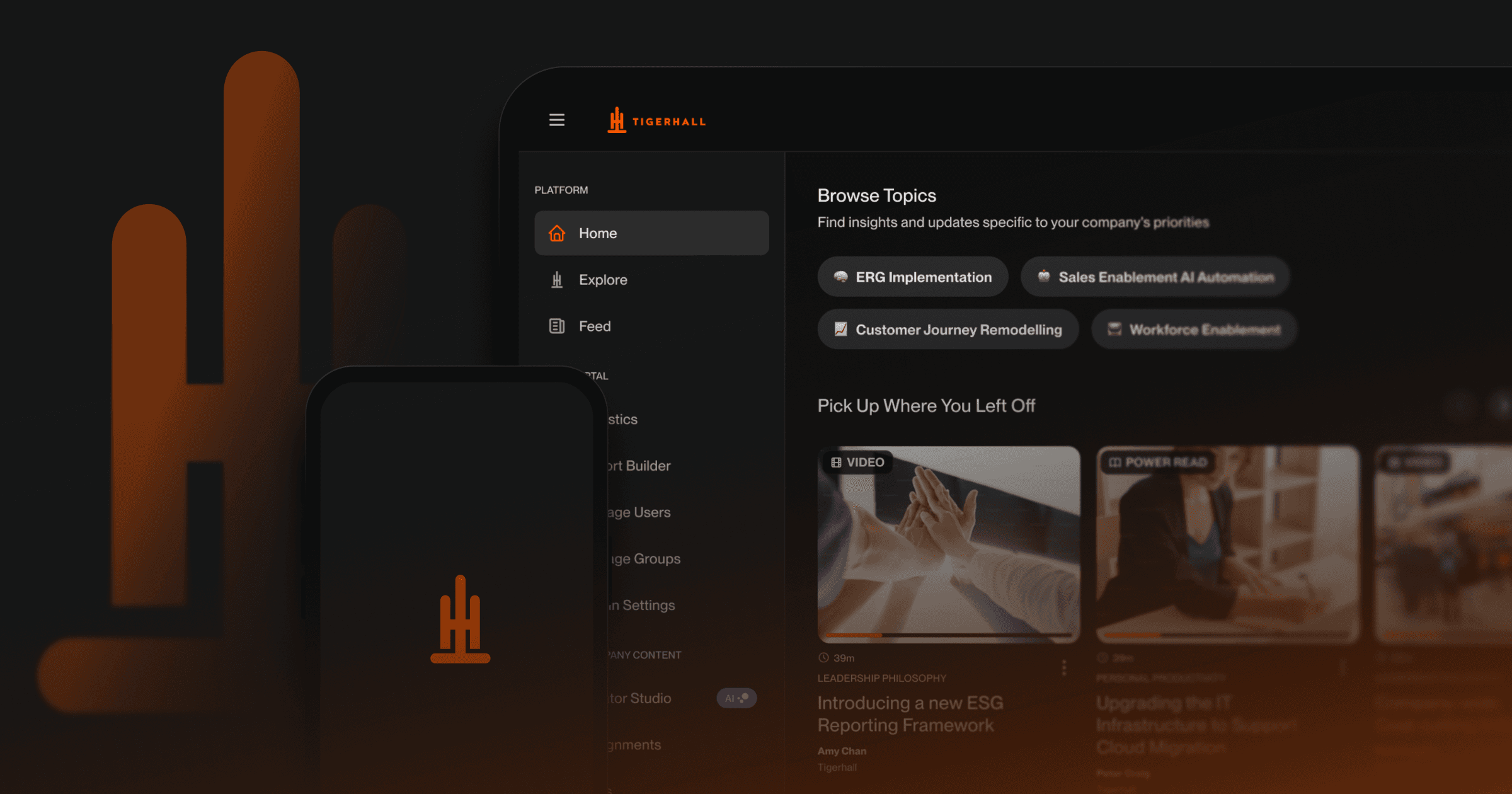
The interface is built around that loop. Change journeys segment audiences by role, region and readiness. AI Creator Studio turns a strategy deck into tailored podcasts and short-form videos. AI Translation localizes everything into more than 30 languages without a vendor on the other end. A Microsoft Teams integration delivers the whole thing inside the chat window where work actually happens. And measurement is, finally, not a survey - it is real-time sentiment, adoption signals, and the kind of ROI numbers that survive a CFO review.
The numbers nobody usually gets to publish.
Tigerhall's customers are, by design, the kind of companies whose communications teams cannot afford to look amateur. The reference list reads like an enterprise sales person's holiday wish: HP, New Relic, BNY Mellon, and a stack of global consumer goods names whose marketing departments would prefer we not mention them by surname. The platform reaches employees in more than 32 countries. The translation feature alone saved one global ERP provider roughly $500,000 a year on localization vendors.
Tigerhall by the numbers
Make the strategy deck the smallest part of the strategy.
Sequoia Surge, Monk's Hill Ventures and WDHB have all written checks against the same thesis: transformation work is overdue for software-grade tooling. Wartoft talks about it with the patience of someone who has spent six years explaining what a change activation platform is and is not. It is not an LMS. It is not internal comms-as-a-service. It is not an AI wrapper on a PowerPoint. It is, she insists, a system of record for organizational change - the way Salesforce became a system of record for revenue.
This is the kind of forecast that ages either very well or very poorly. The interesting thing is that Tigerhall is building as if it has already aged well - shipping the platform now, with full conviction, while the rest of the category is still figuring out what to call itself.
AI changed work. Now someone has to roll it out.
The next decade of enterprise software will be defined less by what AI can do and more by whether the people inside large companies are ready to use it. Almost every public AI rollout case study quietly buries the same line: the tech worked, the adoption didn't. Tigerhall sits exactly on that fault line. The platform's value isn't that it explains AI to employees. It is that it explains anything, to anyone, in a way that can be measured.
There is a version of the next five years where the change activation category looks obvious in retrospect - the same way the customer data platform category did in 2015. There is also a version where the incumbents in HR tech and internal comms catch up. Tigerhall is betting on the first version with the kind of focus that only a founder who has already pivoted once can muster.
The CTO pressed send.
The 14 minutes are up. The CTO from the opening scene has pushed the podcast. The town hall starts. Inside the dashboard - the boring, blue-tinged, beautifully unsexy dashboard - the adoption curve begins to fill in. Engagement in Manila is already at 71%. Frankfurt is lagging by a region-specific 9 points; the system will route a follow-up nudge in German tomorrow morning. Sentiment is, for once, ahead of plan.
The company will book this quarter as a successful change. Nobody will write a case study about how the message got to them. That is, of course, the entire point.