Company Profile · PropTech / ConTech
TestFit
The feasibility math that used to take weeks, answered in minutes.
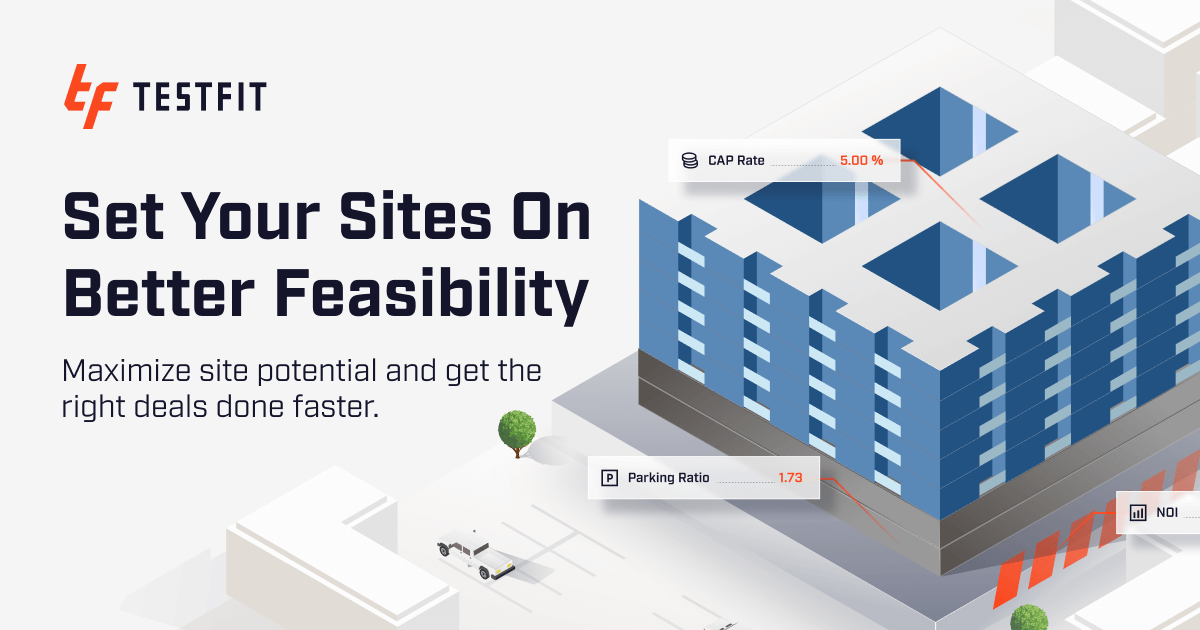
The feasibility math that used to take weeks, answered in minutes.
Clifton Harness was an architect at a development company, and he was tired. Tired of drawing apartment units by hand. Tired of counting parking stalls, one rectangle at a time, on deal after deal that might never happen. "I hated drawing parking spaces manually as an architect," he later said, "and I figured the industry spent millions on that one task each year."
So in 2016 he called his college roommate, Ryan Griege, a software developer with a background in video games, and asked whether a program could do the job faster. The first version of what became TestFit had no interface at all. It was a command-line utility that printed building diagrams. It was not pretty. It solved a real problem.
Ten years later that command-line hack is a real estate feasibility platform used on more than 1,500 deals a week across roughly 150 companies in 35 states and a dozen countries. TestFit does not sell renderings. It sells answers - how many units fit, how much parking is required, what it costs, and whether the pro forma holds - to the people who decide whether a piece of land becomes a building.
That distinction is the whole business. In real estate development, the earliest question is also the most expensive to get wrong: what can we actually build here, and does the math work? For decades the answer came from an architect billing several weeks of studies. TestFit compresses that into minutes, which changes not just how fast a decision gets made but which decisions get made at all.
We're the first to connect pro forma, construction cost, and asset design in one building configurator - so teams can de-risk decisions and win back critical time.
Feed TestFit a site, and its algorithms generate a buildable configuration: floorplates, unit mix, stair and elevator cores, road layouts, parking, area takeoffs and cost - all updating on the fly as a user drags a boundary or changes a constraint. The output is geometry and data, not marketing imagery, and that is deliberate.
The problem it attacks is optionality. Developers want to test many sites and many schemes, but manual feasibility is slow enough that most ideas never get evaluated. Bad deals survive too long; good deals move too slowly. By making a test fit cheap, TestFit lets teams kill weak sites early and prove strong ones fast.
Its customers are the people who live in that early stage: developers, architects, contractors, civil engineers, urban and city planners, brokers, universities and municipalities. One township planner reported cutting a full day of site modeling to fifteen minutes. An architecture firm credited it with winning fees on a deal it might otherwise have passed on.
And because feasibility is only the first step, TestFit exports its geometry directly into Revit (versions 2018 through 2026), SketchUp and AutoCAD - so when a deal is real, the work moves into design and documentation without being redrawn.
AI-powered site planning that generates buildable plans with customizable road layouts, turning radii and topography data, plus 3D views for faster approvals.
Since 2023Automatically generates optimal surface and structured parking layouts and takeoffs - the very task that started the company.
Core moduleParametric engine that produces floorplates, unit mixes, cores, areas and cost calculations that update live as the site changes.
Since 2016Add-on that layers site, environmental and zoning data over a project to surface constraints and reduce risk.
Add-onLive-links a financial model to the actual site plan, so feasibility is tested against the layout - not a spreadsheet guess.
Add-onDirect add-ins carry TestFit geometry into Revit 2018-2026, SketchUp (.skp) and AutoCAD (.dxf) for design and documentation.
IntegrationsTestFit sells B2B SaaS licenses - seats plus add-on modules - to the AEC and real estate development world.
In the crowded map of generative design, TestFit stayed narrow on purpose. Autodesk Forma (the former Spacemaker) leans into environmental analysis - sun, wind, noise, daylight - at the massing scale. Tools like Hypar, Giraffe, Snaptrude and Arcol tackle parametric design, planning compliance and web-native BIM. TestFit planted its flag on the numbers a developer actually underwrites: parking, yield, unit mix and cost.
That focus is why many teams use Forma for early environmental feasibility and then move to TestFit for the parking-and-unit-mix math. The company's strategic backers - Prologis Ventures among them - reflect a bet that whoever owns the earliest decision in real estate owns real leverage over everything downstream.
Clifton Harness and Ryan Griege launch TestFit as a command-line building configurator.
A roughly $2M seed round helps land around 200 commercial customers.
Parkway Venture Capital leads, with Prologis Ventures and Perot Jain - bringing total funding to $22M and quadrupling product and engineering hiring.
Generative site planning launches alongside Site Intelligence and Pro Forma; TestFit wins a PropTech Breakthrough Award.
New drive-thru layouts, web-based editing and export compatibility with Revit 2026.
It is a real estate feasibility platform that uses configurator and generative-design algorithms to turn a parcel into a buildable site plan, unit mix, parking layout, cost estimate and pro forma in minutes.
Developers, architects, contractors, civil engineers, urban and city planners, brokers, universities and municipalities - reportedly 6,000+ users across about 150 companies in 35 states and 12 countries.
Founded in 2016 in Dallas, Texas by Clifton Harness (CEO) and Ryan Griege (CTO), who were college roommates.
About $22M total, including a $20M Series A in 2022 led by Parkway Venture Capital with Prologis Ventures and Perot Jain.
TestFit centers on parking, yield, unit mix and cost for developers, while Forma emphasizes environmental analysis such as sun, wind and noise. Many teams use them together.