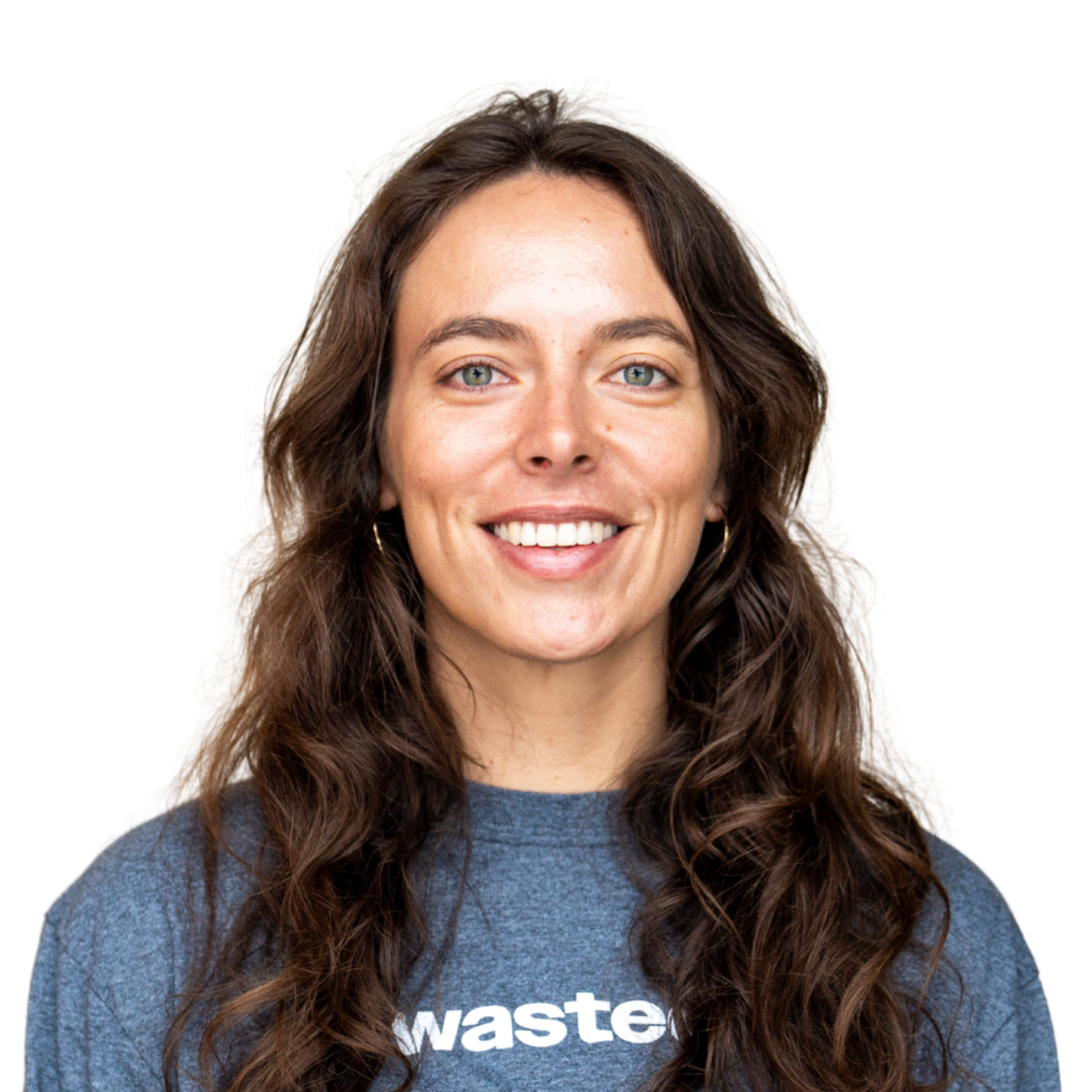
She drove from Oregon to Argentina, met her husband over a pile of waste, and decided your pee was too valuable to flush.
CO-FOUNDER & CEO // WASTED* PBC // WILLISTON, VERMONT
Most founders would rather you not think about where their product ends up. Taylor Zehren built a whole company around the question. As co-founder and CEO of Wasted* PBC, a Vermont public benefit corporation, she runs hundreds of toilets across New England that do something ordinary toilets never bother to do: they keep the good stuff.
The good stuff is urine. Specifically, the nitrogen and phosphorus inside it - the same nutrients farmers buy by the truckload, mined from finite deposits and shipped across oceans. Wasted* collects them at the source, processes them, and sells them back to the soil as WeeBloom, a powdered fertilizer that started its life inside a human being. The asterisk in the company name is doing a lot of work, and Zehren knows it.
Her path here was not the linear founder fairy tale. It started with a biochemistry degree, a public health degree, lab work on the developmental origins of disease, and a Fulbright spent studying soil in Argentina. Somewhere between Patagonian mountain trails and a porta-potty in Oregon, the science turned into a mission, and the mission turned into a balance sheet.
"There is so much opportunity, so many valuable and renewable resources, being wasted just because we consider them waste."- Taylor Zehren
Zehren grew up in the Pacific Northwest, the kind of place where the outdoors is less a hobby than a default setting. She studied biochemistry at the University of Portland and public health at UC Berkeley, then headed into research - a thesis at OHSU, and a Fulbright in Argentina digging into soil health and agricultural land management.
The Fulbright was supposed to be about dirt. It became about everything connected to it. She spent eleven months traveling the Pan-American Highway through seven countries, watching indigenous communities displaced by dams and poisoned by industry. The trip rearranged her priorities. Sustainability stopped being a topic and became the point.
It also gave her a problem she could not unsee. Climbing and hiking through remote places - Patagonia, later the Arctic, Nepal, Lake Tahoe - she kept finding human waste contaminating ground that was supposed to be pristine. The most beautiful places on earth had a sanitation problem, and nobody seemed to want to talk about it.
So she and two co-founders, Brophy Tyree and Thor Retzlaff, did the unglamorous thing. They spent two years surveying, installing, and servicing toilets in the backcountry, learning the problem from the bottom up. In 2019 that work became Do Good Sh*t, a nonprofit putting sustainable sanitation systems everywhere from Chile to Nepal.
The for-profit insight arrived, fittingly, in the field. Servicing an Oregon system with Thor - now her husband - he looked up from a pile of waste and said: "First of all, what are we doing? Second, I think we're onto something." What they were onto was urine diversion. Separate the liquid from the solid, the way nearly every other mammal already does, and waste stops being a problem and starts being a resource.
In 2021 they founded Wasted* PBC to chase that idea with venture capital behind it. By early 2023 the company had raised more than $7.5M from climate-tech investors, landed coverage in Bloomberg, TechCrunch, Fast Company, Business Insider and Rolling Stone, and put Zehren on the Forbes 30 Under 30 Social Impact list.
Biochemistry (U. Portland) and Public Health (UC Berkeley); OHSU thesis research; Fulbright in Argentina on soil and land management.
Co-founds Do Good Sh*t, a nonprofit installing sustainable sanitation from Chile to Nepal.
Co-founds Wasted* PBC, a venture-backed climate-tech public benefit corporation.
Raises $7.5M+; named to Forbes 30 Under 30 (Social Impact); national press wave.
Launches WeeBloom, a powdered fertilizer derived from human urine.
Wasted* runs the cycle backwards from how modern plumbing breaks it. Instead of flushing nutrients into waterways, it captures them and sends them back to the field.
Phosphorus is finite, mined, and essential to growing food. Estimates put its production peak around 2033. We are flushing the supply down the drain. Zehren's pitch: stop doing that.
Humans are the only mammals that combine urine and feces in one place, then add water. Wasted*'s designs copy nature instead - keeping the streams separate so the nutrients stay usable.
The urine one person produces in a year carries enough nutrients to grow roughly 320 pounds of wheat. Multiply by a festival crowd and the porta-potty becomes a mine.
She wants a "Pee for the Planet" movement - a future where flushing nutrients away seems as strange as littering does now.
Zehren is not a founder who delegates the messy part. She has serviced toilet systems at roughly 10,000 feet on Mount Rainier and on multi-day backpacking trails - the work most people would pay to never think about. Comfort with discomfort is the through-line of her whole story.
She is also, by every account, a builder who refuses to be grim about a grim subject. The branding is loud and funny on purpose. The science is delivered with jokes. Her co-founders' bios read like a tall tale: Thor Retzlaff has reportedly peed on all seven continents; Brophy Tyree "can speak to trees." Zehren's own line in the company lore is simpler and somehow bigger - she drove from Oregon to Argentina.
Underneath the humor is a systems thinker. She talks about sanitation as inseparable from water quality, regional nutrient cycles, and worker wellness, not as plumbing in isolation. The toilet is the visible part of a much larger argument about how a society handles the things it would rather ignore.
Sources: Wasted* PBC, Forbes, Bloomberg, TechCrunch, Fast Company, Business Insider, Triple Pundit, Authority Magazine, University of Portland Magazine, WCAX. Profile compiled from public reporting; figures as reported.