YesPress // Profile in Generative Biology
Surge Biswas
He taught a machine to autocomplete antibodies the way your phone finishes a sentence.
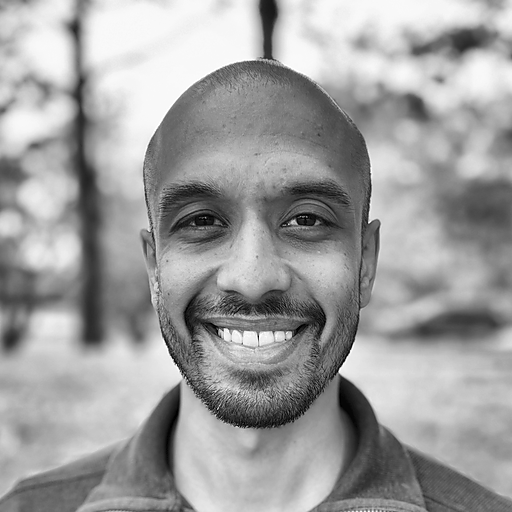
The chemist of the possible, mid-design.
He taught a machine to autocomplete antibodies the way your phone finishes a sentence.
That is the pitch, and it sounds like science fiction until you watch it run.
Surge Biswas calls his AI "molecular auto-complete." Hand it a target protein, and the system finishes the molecule that grabs onto it - at a specific spot, with atomic precision, without ever being shown a single example of a binder that already works. The system is named JAM, for Joint Atomic Modeling. The company is Nabla Bio, run out of 840 Memorial Drive in Cambridge, a short walk from the Charles and dead-center in the densest stretch of biotech real estate on Earth.
Most antibody drugs are still discovered the old way: inject an animal, or pan a giant library, and wait for biology to cough up a candidate. It takes years. It misses the hard targets entirely - the membrane proteins folded so deep into the cell surface that nobody can raise a clean binder against them. Biswas's bet is that you can skip the waiting and design the answer directly, the way an engineer designs a bridge instead of growing one.
He is not chasing a press cycle. The bioRxiv preprints come with wet-lab data and controls, the kind of receipts that make skeptical immunologists go quiet. When Nabla reported designing antibodies against CXCR7 - one of roughly 800 G-protein-coupled receptors, a family long filed under "undruggable" - it was not a slide. It was a measurement.
The story underneath is older than the company. Biswas built the foundations as a graduate student, then spent five years turning a thesis idea into a machine that pharma giants now pay to point at their hardest problems.
"JAM is molecular auto-complete."
In George Church's Harvard lab, Biswas helped pioneer protein language modeling - the trick of treating a chain of amino acids the way a language model treats a chain of words. Feed an AI enough protein "text" and it starts to grasp grammar: which sequences fold, which bind, which fall apart. That insight, published across Nature Methods and Nature Biotechnology, became the spine of modern protein design. JAM is what happens when you aim it at antibodies.
I'm incredibly excited to share new results from Nabla Bio where we show we can design antibodies de novo for use in therapeutic discovery.
De novo antibody design offers the promise of precisely engineering binding interfaces with atomic precision.
Biswas walks through the idea in his own words - what de novo design unlocks, and why "molecular auto-complete" is more than a metaphor.
"Nabla" is the gradient operator from calculus - a fitting name for a company that optimizes proteins.
He goes by Surge, but publishes as Surojit Biswas - two names, one paper trail.
Three universities on two continents before he ever filed incorporation papers.
His co-founder and Nabla's President, Frances Anastassacos, is also his wife.