A security audit has a peculiar way of arriving as paperwork and leaving as a sales problem. A prospect asks for a SOC 2 report. Someone opens a spreadsheet. The chief technology officer begins hunting for screenshots, policies and proof that access reviews happened when everyone says they did. A contract waits. The calendar becomes the enemy.
Strike Graph exists for that exact, joyless week. The Seattle company gives security and compliance teams one place to identify risks, choose controls, assign owners, collect evidence, map the same work across standards and prepare an independent auditor's package. The promise is less about making regulation charming than making it routine.
The inciting incidentA founder meets the compliance maze
Justin Beals had already built and led technology companies when he encountered SOC 2 from the customer's side. The certification was important because enterprise buyers wanted proof that a vendor handled data responsibly. The process, however, was opaque, consultant-heavy and oddly disconnected from the way software teams actually worked. Madrona Venture Labs saw the same opening: turn the expensive annual scramble into repeatable software.
Beals co-founded Strike Graph with Brian Bero in spring 2020. Bero brought a useful Seattle pedigree of his own, having co-founded Apptio and later sold security startup Greytwist. Their early wager was not that every company needed the same checklist. It was the opposite. A useful compliance system had to understand the risks, controls and evidence peculiar to each business, then translate that operating reality into the language of a framework.
The market answered quickly. Strike Graph said its pilot was oversubscribed by 250 percent in the first six months. One early customer had a Fortune 100 purchase order dependent on getting SOC 2 within 60 days. That is a fine startup lesson hiding inside a terrible fortnight: the best compliance lead is often a signed deal that cannot move.
Security certification is not the trophy. It is the key that gets a software company through procurement.The commercial logic behind Strike Graph
What it actually doesThe graph is not decorative
The company name contains its central product choice. Strike Graph stores compliance as connected objects: a risk is mitigated by a control; a control is proven by evidence; the same control may satisfy criteria in SOC 2, ISO 27001, HIPAA or CMMC. People own the work. Evidence expires. Frameworks overlap. Represent those relationships directly and a second certification can become a mapping exercise instead of a restart.
The reusable compliance loop
frameworks
In practical terms, a team begins with a risk assessment and selects or customizes controls. It can borrow from more than 55 policy templates, assign work to colleagues, connect cloud and business systems for evidence collection, and watch readiness on a dashboard. When the program is ready, the customer can bring its own auditor or select an independent firm through Strike Graph's partner network.
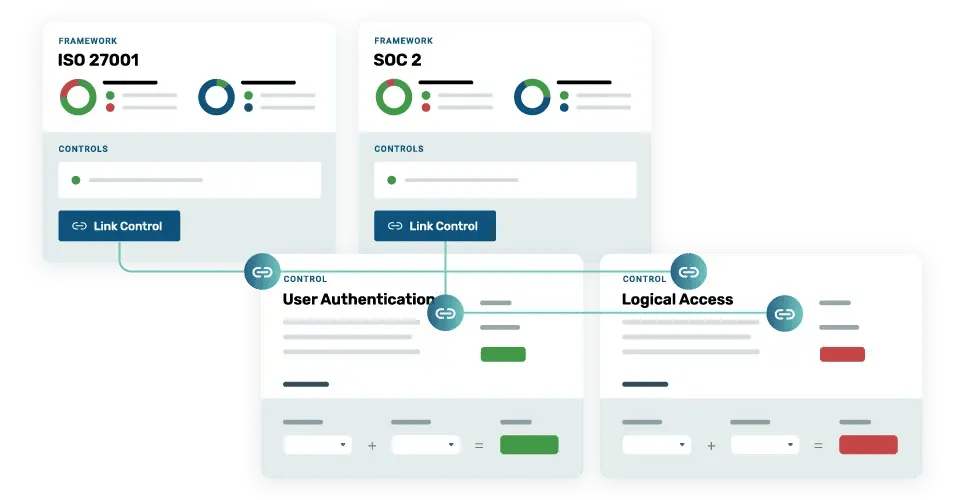
The product has since spread around that core. There are penetration tests and vulnerability scans, an SBOM Manager for tracking software components, a trust center for sharing security material and tools for answering customer questionnaires. Trust Chain moves the model into vendor risk: instead of asking suppliers to promise that controls exist, it requests documentation and tests the proof. Atlas, introduced in August 2026, studies the program's posture and recommends what to fix first.
The AI wagerCheck the receipt, do not merely rewrite it
Plenty of enterprise software now arrives with a chat box. Strike Graph's more interesting AI feature is Verify AI, which behaves like a narrow internal auditor. It examines uploaded evidence against the evidence description, compares a document with its predecessor and flags mismatches or material changes for a human owner. The system can handle text documents, tables, configuration files and text extracted from images. Its help center says the change threshold is roughly 5 percent.
That distinction matters. Drafting a policy is easy; proving that a control operated is harder. A beautiful access-control policy does not demonstrate that terminated employees lost access on time. The company's newer trio divides the labor neatly: Atlas decides what deserves attention, Security Assistant performs approved tasks, and Verify AI checks the resulting evidence. Humans remain responsible for approval and judgment.
Strike Graph also makes privacy part of the pitch. It says its compliance models run inside its own environment rather than sending sensitive policies and evidence to third-party model APIs. For customers uploading network diagrams, personnel records and security configurations, where the AI reads the document is not a footnote.
Customers and outcomesThe buyer is often a small team with a large prospect
Strike Graph sells to the person holding the compliance bag: a CISO at a mid-market company, a security specialist, an operations manager or a founder whose first enterprise deal has suddenly acquired a trust portal. The company says it serves hundreds of organizations. Named users span software, fintech and AI, including WhyLabs, Spiral, Valid8, PayLynxs, HuLoop, RedSeal and Foundation AI.
The useful case studies are specific. PayLynxs had managed its program in what its chief executive called a glorified spreadsheet. It considered Vanta, worried about coordinating software and a separate CPA, and chose Strike Graph's combined workflow. The company reported a 50 percent reduction in compliance preparation time and fewer security objections when selling to large financial institutions.
HuLoop needed bank-level discipline for customers in financial services. With Strike Graph, it completed three audits, including two SOC 2 Type 2 reviews across all five trust factors. It also nearly tripled its customer base. Correlation is not a magic wand, but the mechanism is believable: cleaner evidence and a recognized report remove reasons for a serious buyer to say no.

What it costsFree to map, five figures to certify
The business model is annual B2B software with add-ons. A free Launch plan includes core GRC functions and the SOC 2 security criteria. Certify starts at $10,000 per year, Scale at $21,500 and Enterprise at $35,000. Extra frameworks add roughly $2,000 to $8,000 depending on the framework and plan. Trust Chain has a free tier for five vendors, with paid capacity starting at $7,500 for up to 25.
- Independent audit fees are separate
- Assessment and audit services can add $4K-$8K
- No charge per general-user seat
- More frameworks cost extra
The independent audit is a separate purchase, a detail buyers should not skim past. Strike Graph says its assessment and audit services for approved certifications run from $4,000 to $8,000 annually depending on the plan, while outside auditor prices vary. The company once advised first-time customers to budget around $30,000 for an audit and collect three quotes.
That can still be economical compared with the old stack of software, consultants, employee hours and delayed revenue. At launch, Strike Graph said typical customers could reach SOC 2 Type 1 in 45 days and avoid $50,000 in consultant fees. Those are company-reported figures from 2020, not a universal outcome. The important comparison is not subscription versus zero. It is subscription versus the entire cost of improvisation.
What failed firstThe annual spreadsheet had no memory
The first thing to fail was the traditional operating model. Spreadsheets could list controls but did not collect proof, test it or preserve the relationships for another framework. Consultants could get a company through an audit but often left a static binder behind. A point-in-time audit certified yesterday's program. Twelve months later, the same scavenger hunt began again.
Strike Graph changed its own scope as that weakness became clearer. It started with small companies chasing SOC 2. Funding in 2021 and 2023 paid for more frameworks and larger customers. Evidence collection grew into evidence validation. Certification work grew into questionnaires, software supply-chain inventories and vendor risk. The company did not abandon the auditor; it changed its mind about where the durable value lived. The report is an output. The connected, continuously maintained program is the asset.
Five things worth stealing
- Find the forced purchase. A product tied to a contract, regulation or renewal has urgency built in.
- Model the relationships. Reuse becomes possible when risks, controls and evidence are structured data rather than folders.
- Price against the whole mess. Compare software with consultant hours, staff time, duplicate audits and blocked sales.
- Automate the repeat, not the judgment. Collect, compare and route evidence automatically; leave risk acceptance to people.
- Expand along the artifact. The same proof can serve audits, questionnaires, trust centers and vendor reviews.
The honest boundarySoftware cannot manufacture a security program
A compliance platform works when somebody owns the outcome. It can remind an engineer to review access, but it cannot make the review meaningful. It can test whether a file resembles the requested evidence, but the company still has to operate the control. It can map ISO 27001 to SOC 2, but it cannot decide how much risk the board should accept.
Automation becomes a tidier queue of ignored tasks.
Public reviews note fewer integrations and more manual collection.
Templates and AI require expert review, especially at the edges.
A spreadsheet may remain cheaper when stakes and reuse are genuinely low.
Reviewers like Strike Graph's support, templates and clear progress tracking, but they also describe a learning curve, requests for more integrations and occasional ambiguity when evidence supports several controls. Those are not trivial defects. They reveal the category's basic constraint: the world behind the dashboard is untidy.
That makes Strike Graph's market position easy to understand. Vanta, Drata, Secureframe and Sprinto compete for automated compliance buyers; AuditBoard, LogicGate and Archer reach deeper into enterprise GRC. Strike Graph sits between the startup-friendly checklist and the heavyweight risk suite. Its differentiator is a customizable graph, close audit support and AI aimed at doing compliance work rather than decorating it.
The result is not the end of the security audit. It is a calmer relationship with one. If Strike Graph succeeds, the evidence is already there, the controls already have owners and the next framework mostly looks like a new view of work the company has done. The fire drill becomes maintenance. For a buyer waiting on a report, boring is a feature.