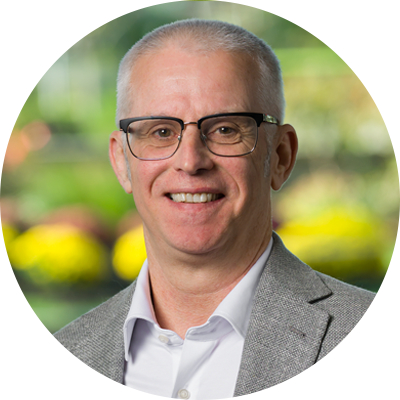
The Work Now
A drug built to miss its target on purpose
The interesting thing about VT-5006, the molecule that most of Stewart Campbell's day now revolves around, is that it is designed never to reach the organ everyone associates with Parkinson's disease. Parkinson's is a brain disease. VT-5006 stays in the gut. This is not a limitation the chemists failed to overcome. It is the entire point.
Campbell is the CEO of Vertero Therapeutics, a roughly twelve-person biotech in Woburn, Massachusetts. Until October 2025 the company was called Axial Therapeutics. Same building, same science, same CEO - the new name was chosen to say one specific thing out loud: that the company is about the connection between the brain and the rest of the body, and that it thinks we have been treating neurodegeneration from the wrong end.
The thesis is that Parkinson's has a peripheral driver - a signal originating in the wall of the gastrointestinal tract - and that a gut-selective small molecule acting there could delay onset, slow progression, and preserve quality of life without ever crossing into the central nervous system. It is the kind of bet that sounds like a mistake until you sit with it, and then sounds like the only thing worth doing. The lead program was on track to begin its first Phase 1 clinical study in the fourth quarter of 2025.
From the bench to the corner office
Campbell did not arrive here as a professional executive who was handed a science he did not understand. He arrived as a chemist. He started his career as a medicinal chemist at Boehringer Ingelheim - the person at the bench designing the molecules - and over three decades he is credited as a co-inventor on more than twenty issued patent families. One of those inventions became a real approved drug: Rezurock, or belumosudil, a treatment for chronic graft-versus-host disease. That is a rare thing to have on a resume. Most people who spend a career making molecules never see one make it all the way through.
Along the way he held leadership roles at Insmed and Surface Logix, and at Ancora Pharmaceuticals he led the company through its acquisition by Corden Pharma - the harder, less glamorous work of turning science into a transaction. That combination, someone who can both design the compound and close the deal, is unusual enough that it more or less describes the job he does now.
The pivot inside the pivot
The company Campbell inherited had spent years chasing more than one target. In its Axial era it pushed a candidate called AB-2004 into a mid-stage trial for irritability in children with autism, and it raised a $37.25 million Series C in October 2021 to fund it, part of a broader run that pulled in tens of millions from investors on three continents. The gut-brain axis was the connective idea across autism, Parkinson's, and early oncology work.
Under Campbell the aperture narrowed. He joined in 2017, took the CEO role in February 2021, and by 2025 had reorganized the whole enterprise around neurodegeneration and, specifically, Parkinson's. A $20 million round arrived to carry VT-5006 through early clinical work and prepare what comes after. In the same stretch the company added a chief business officer and an independent board chair - the scaffolding a small biotech assembles when it is about to stop being a preclinical story and start being a clinical one.
Focus, in biotech, is a decision rather than a gift. Renaming a company is the loud part; deciding which programs to stop is the quiet, expensive part. Campbell did both.
The education underneath it
The credentials read like a straight line drawn through cold-weather chemistry departments: a BS with honors in chemistry from St. Francis Xavier University in Nova Scotia, a PhD in organic chemistry from Queen's University in Ontario, and postdoctoral research at Duke. It is not the MBA-to-biotech pipeline. It is the slower route, where you understand the molecule first and learn to run the business second, and it tends to produce executives who can tell when a scientific claim is load-bearing and when it is decoration.