Profile / Media & Health
Steve Alperin
The producer who spent a career deciding what a nation heard each evening, then decided what a frightened family hears next.
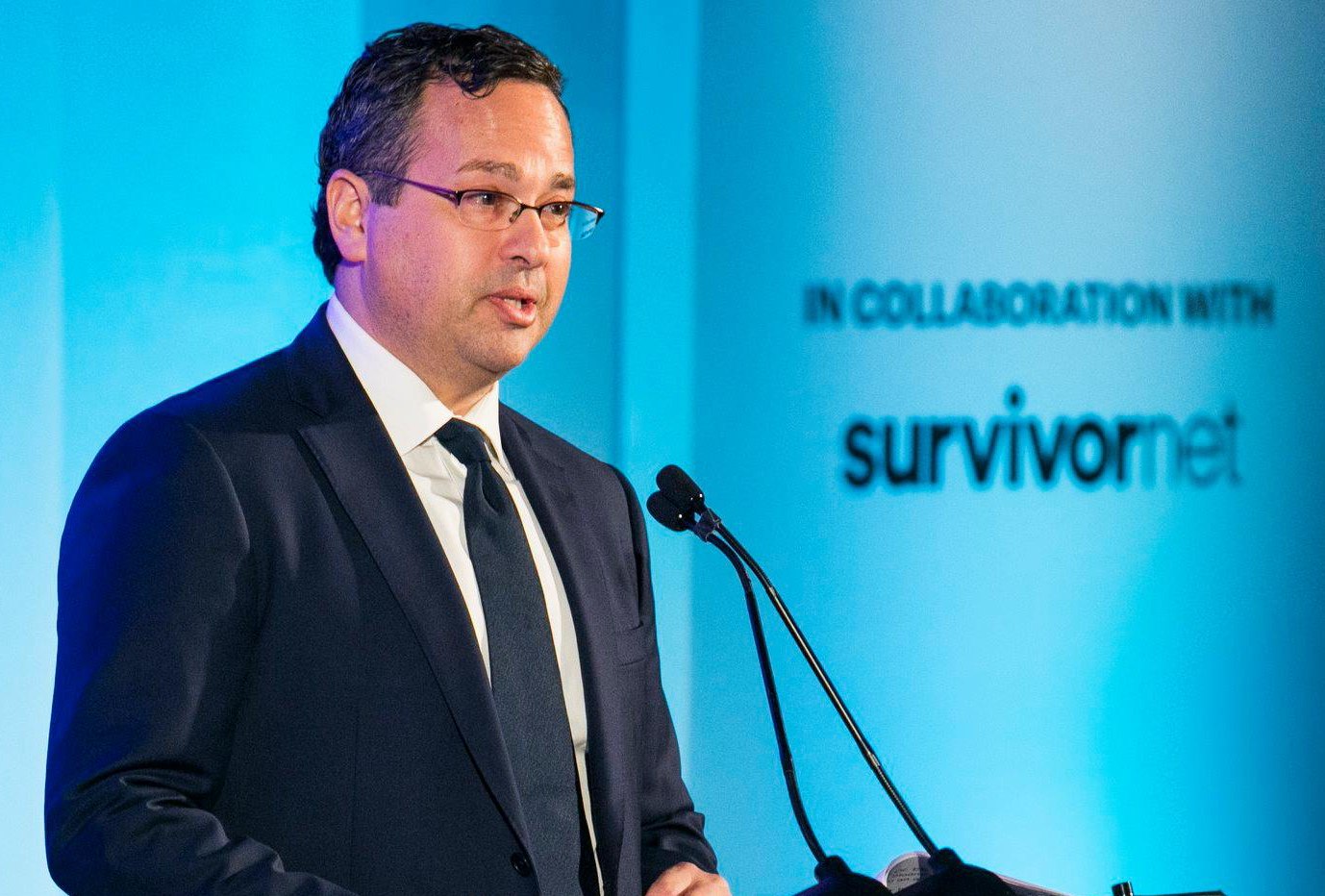
The producer who spent a career deciding what a nation heard each evening, then decided what a frightened family hears next.
Every weekday for years, Steve Alperin helped decide the exact words Peter Jennings would say to millions of Americans at 6:30. Now he obsesses over a different audience of one: the person who just got a diagnosis and is staring at a search bar at 2 a.m.
SurvivorNet, the company Alperin runs from 270 Lafayette Street in lower Manhattan, looks at first like a media outlet and behaves like one. There are short films, hosts, a tidy library of explainers. Look closer and the seams show a stranger ambition. Each piece is built alongside practicing oncologists and surgeons, then handed to a team of writers and editors trained in television. The result is the thing that almost never exists in health information: footage you would actually watch, carrying facts a physician would actually defend.
That collision of crafts is not an accident. It is a resume. Alperin studied government at Harvard, took an MBA at Columbia, and started his working life as a strategic planning analyst at CNN in the late 1990s. The pivot that defined him came at ABC News, where he became head writer and senior producer for Jennings on the network's lead evening broadcast. Writing for an anchor is a peculiar discipline. The words have to be precise, fast, and human all at once, and they have to survive being read aloud by someone the whole country trusts.
He was good enough at it to win the Writers Guild of America Award twice, once for a feature on Reagan's funeral. He was also in the chair for the messier work. In 2006 he was the editor in charge of ABC's website when it broke the Mark Foley scandal, the story of a congressman's explicit messages to teenage pages. It became an early case study in how online reporting could break news the old broadcast machinery could not move fast enough to catch.
We want to give people access to the kind of people that my family struggled to reach.
When the industry lurched toward mobile, Alperin lurched with it. In 2010 he joined The Daily, Rupert Murdoch's ambitious iPad-only newspaper, a publication that arrived with enormous fanfare and a short life. In 2013 he became Chief Business Officer at Vocativ, a venture built to combat misinformation and surface stories buried in the deep web, leaving in 2015 after a leadership shakeup. Read the list quickly and it scans as restlessness. Read it slowly and it scans as someone repeatedly betting that the format of news was about to change, and wanting to be early.
The bet that mattered most was personal. Alperin's father was diagnosed with cancer not long after Steve finished college, and the family ran straight into the wall every family runs into: the specialists are somewhere else, the research is written for other doctors, and the clock does not wait while you learn the language. He came out of it with a conviction that the problem was not a shortage of medical knowledge. The problem was distribution. The knowledge existed; it just never reached the kitchen table where the decisions actually get made.
So in 2018 he built the distributor. SurvivorNet's premise is almost embarrassingly simple to state and brutally hard to execute: take the most current expert thinking, the kind that lives inside top cancer centers, and translate it into video and writing a non-expert can absorb under stress. Alperin describes the standard he holds it to as "as close as you can get in a media product to scientific rigor, while also applying the craft and empathy of a team of professional storytellers, survivors and advocates." It is the sentence of a man who has spent his life on both sides of that hyphen.
The company found backers. It raised a Series B reported around ten million dollars and has described reaching millions of viewers a month through its programming. But the metric Alperin keeps reaching for in interviews is not a chart. "Nearly every day," he says, "I get calls from people who say they saw something on our site and it helped them." For a former producer, that is the rare review that beats the ratings.
The OperatorPeople who build mission-driven companies often flatten into saints in profiles, which makes them boring and slightly suspect. Alperin resists the treatment. He is, by his own cheerful admission, a man with a "significant chocolate-chip cookie problem," who unwinds with a glass of Sancerre, and who taught himself PowerPoint to a level he finds faintly ridiculous to brag about. The self-deprecation is real and it is also a tell: detail people are usually like this, fussy about the work and forgiving of themselves only on the small stuff.
The fussiness is the point. Anyone can publish a video about a treatment. The discipline is making sure the video tracks the actual standard of care, gets reviewed by the right physician, and still holds a viewer who is scared and distracted. That is editorial production, the same job he did for Jennings, just with stakes that do not end when the broadcast does. "If we can help people make better decisions about their care," he has said, "we're doing our jobs." It is a sentence with no hedge in it.
Fundamentally, we're trying to empower and provide comfort to millions of families like mine.
What makes him worth watching is not that he left television for a cause. Plenty of people do that and produce earnest, unwatchable work. Alperin did something narrower and harder: he refused to drop the production values on the way out the door. He treats a patient as an audience worth the full craft, not a charity case who should be grateful for whatever PDF the system coughs up. The arrogance of broadcast, redirected toward people who were used to being talked down to, turns out to read as respect.
He has carried that into the wider conversation too, speaking on cancer research at The Atlantic's "People v. Cancer" forum and steering a small New York team that punches well above its headcount of roughly two dozen. The aspiration he keeps naming is to "become the voice of the increasingly large community of cancer survivors," a community that, thanks largely to better treatment, keeps growing. It is a goal that sounds soft until you remember he means voice in the literal television sense: scripts, hosts, footage, the whole apparatus he learned at 6:30 every night.
The through line of Steve Alperin's career is not media, and it is not health. It is a stubborn belief that the way information is packaged decides whether it ever reaches the people who need it, and that packaging is a craft worth taking seriously. He spent the first act proving it on the biggest stage in news. He is spending the second act proving it for an audience that, until recently, no one bothered to produce for at all.
The ModelStrip the mission away and SurvivorNet is an interesting answer to a production question: how do you make medical information that is both true and watchable, at scale, without one quality cannibalizing the other? Alperin's answer borrows directly from the assembly line he ran in television. Content begins with the clinical baseline, anchored to the recognized standard of care, and is built in collaboration with leading physicians rather than narrated at them. Only then do the storytellers get their hands on it. The sequence matters. Get it backward and you get pretty footage that doctors quietly distrust; get it right and you get something a physician will point a patient toward without wincing.
He has described the core competency plainly: "taking complex information about health and cancer treatments and collaborating with leading physicians." That is a producer's sentence, not a clinician's. It treats expertise as raw material to be shaped for an audience, which is exactly the move that makes academics nervous and patients grateful. The output runs to hundreds of short films, work that has involved collaboration with clinical practice at institutions including Yale, and a streaming arm in SurvivorNetTV that extends the same craft into longer form.
The company is deliberately small, somewhere around two dozen people, and headquartered in the kind of downtown Manhattan address that signals media more than medicine. That is the tell about how Alperin sees the thing he built. He did not start a clinic or a research lab. He started a newsroom that happens to cover one beat with unusual depth, staffed by people who know how to hold an audience and advised by people who know what is actually true. The two-time Writers Guild winner is still, fundamentally, running an editorial operation. He just changed the subject matter to the most consequential beat he could find.
Filed UnderIf we can help people make better decisions about their care, we're doing our jobs.
Nearly every day, I get calls from people who say they saw something on our site and it helped them.
This is as close as you can get in a media product to scientific rigor, while also applying the craft and empathy of a team of professional storytellers, survivors and advocates.
We understand that most people just can't make it to specialists like the ones we have on SurvivorNet.
We want to continue to become the voice of the increasingly large community of cancer survivors.
SurvivorNet is very personal for me and many on our team.