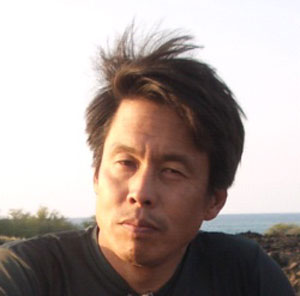
He sits in a Santa Monica office running WonderHowTo, a search engine for learning to do almost anything. Before that, he handed American television two of its most durable inventions and got himself fired in front of Rupert Murdoch.
Stephen Chao, at the office, hamming it up.
The Dispatch
The company is called WonderHowTo, and the pitch is almost suspiciously simple: type in what you want to learn, get a video that shows you. Food hacks. White-hat hacking. Augmented reality. Microbiology. The site Chao co-founded with Mike Goedecke in 2006 and launched in January 2008 grew into a how-to network reaching more than 13 million people a month. It runs on a single conviction - that practical knowledge should be searchable and free.
That is a quiet ambition for a man whose television career was anything but quiet. Chao spent the 1980s and 1990s manufacturing spectacle. He spent the 2000s and beyond trying to make the internet useful. The throughline is not tone. It is curiosity, applied without embarrassment to whatever happens to interest him at the time.
He came to it the long way. A reporter who broke tabloid scoops. A studio executive who could not sit still. A network president who lasted ten weeks. Somewhere in there, a stretch of seven months he spent doing nothing in particular except thinking, which ended with him pulling on a McDonald's uniform.
America's Most Wanted came out of nowhere. Cops came out of nowhere. They had no antecedent.- Stephen Chao
Before The Television
Chao majored in classical studies at Harvard and graduated cum laude in 1977. He returned for an MBA from Harvard Business School in 1981. Between the two, he co-wrote a Fodor's travel guide to Turkey and spent time in France.
He reported for the National Enquirer, where he broke the story of the O.J. Simpson and Nicole Brown romance years before the rest of the world would learn those names. It was an unlikely apprenticeship for a man who would soon shape network TV.
His maternal grandfather served as pre-revolutionary China's economic minister to the United States. He is a nephew of the painter Zao Wou-Ki. Chao was born in Ann Arbor, Michigan, and moved to New Hampshire at eight.
The Fox Years
In 1983 Chao joined Rupert Murdoch's News Corporation as a vice president for acquisitions and corporate development. When Murdoch and Barry Diller set out to build a fourth broadcast network on a shoestring, Chao landed on the creative team, charged with inventing shows that cost almost nothing and looked like nothing else.
The first idea had been sitting in his head for years, sparked by the wanted posters tacked up in post offices. He labeled the concept "electronic lynching" and described it as High Noon crossed with the 10 o'clock news. It became America's Most Wanted, and it put a hotline number on screen and asked the audience to help catch fugitives.
The second arrived in 1987, when a producer named John Langley pitched the idea of simply following beat cops around Broward County, Florida, with a camera. No narrator, no script, no antecedent. Chao greenlit it. Cops ran for decades. Two formats, both built from almost nothing, both still echoing through everything that calls itself reality television.
By 1992 he was promoted to president of Fox Television Stations. The promotion lasted ten weeks.
America's Most Wanted turned viewers into a search party.
Cops pointed the camera at the squad car and pressed record.
Both were cheap. Both were unprecedented. Both outlasted nearly everything around them.
June 1992 · Snowmass Village, Colorado
The topic was "The Threat to Democratic Capitalism Posed by Modern Culture." Chao's argument: television tolerates violence and flinches at nudity, and the priorities are upside down. He decided to make the point rather than merely state it.
So he hired a local waiter-model, Marco Iacovelli, to strip naked while he spoke, in front of a room of Fox executives that included Rupert Murdoch. Murdoch was, by every account, not amused. Chao was fired immediately afterward. The stunt sealed his reputation as television's resident bad boy, the executive who would risk his own job to land a rhetorical blow.
It wasn't the weirdest thing I had done in a relationship.- Chao, on why his girlfriend shrugged at the McDonald's job
The Wilderness
After the firing came seven months Chao described as intense navel-gazing. It ended in an unexpected place: a McDonald's in Redondo Beach, where he spent six weeks flipping burgers and assembling Egg McMuffins. He picked a location far enough from his Westside neighborhood that he would not run into anyone he knew - not out of shame, he insisted, but out of a real curiosity about how the operation actually ran.
It is the kind of detour that reads as a stunt and turns out to be sincere. Chao was a man who had just run a television station genuinely fascinated by drive-thru logistics. The same impulse would, years later, point him at the question of how anyone learns to do anything.
When Barry Diller once hurled a 3/4-inch videocassette in anger and dented a wall, Chao framed the dent. He later persuaded Diller to autograph it. A small monument to working for volatile geniuses.
He converted a 13-unit apartment complex into personalized quarters - units for family, a guest house for his mother, and additional guest rooms. A man who likes to redesign systems to fit the people in them.
The Comeback & The Pivot
In 1993 Chao opened his own shop, Stephen Chao Incorporated, producing for ABC, CBS, NBC, Universal, Columbia TriStar and Nickelodeon. Then in 1998 Barry Diller - the same Diller of the dented wall - hired him as president of programming and marketing at USA Network. He oversaw a roster that ran from the WWF and Baywatch to the dramedy Monk, and was promoted to president of USA Cable in 2000 before resigning in 2001.
What came next was the real reinvention. In 2006 he and Mike Goedecke started building WonderHowTo in Santa Monica, backed by General Catalyst Partners. The man who had spent two decades deciding what millions of people would watch now built a machine to help them find exactly what they wanted to learn.
The Margins
He studied the classics at Harvard, then made his name on Cops. The leap from Homer to handcuffs is its own kind of resume.
His uncle was Zao Wou-Ki, one of the most celebrated abstract painters of the 20th century.
Before television, he co-authored a Fodor's travel guide to Turkey - a footnote most media moguls don't carry.
His maternal grandfather was pre-revolutionary China's economic minister to the United States.
At the National Enquirer he broke the O.J. Simpson and Nicole Brown romance, long before the trial of the century.
He took a McDonald's job after running a TV network, just to see how the place worked. He picked a branch where nobody would recognize him.
The Index