It is Super Bowl Sunday. Somewhere, a fan opens a group chat and drops an animated emoji of his quarterback hitting a celebration. No words. None needed. That tiny moving image is licensed, sanctioned, and built by a 13-person company in Miami. The fan has no idea. That is exactly the point.
For most of sports history, being a fan was a spectator sport. You watched, you yelled at the television, and the conversation ended when the broadcast did. SportsManias decided fans should get to talk back - inside their own messages, in their own stories, with the actual faces of the athletes they love. The company calls it taking fan passion "to another level in mobile messaging and social media." That is the polite version. The real version is that they handed fandom a keyboard.
A billion fans, no way to say it
Here is the tension the company exists to resolve. Athletes have signatures - the celebration, the pose, the catchphrase. Leagues and players associations own the rights to all of it. Fans, meanwhile, were left improvising with generic stickers and screenshots, none of it licensed, most of it ugly. There was a billion-dollar conversation happening every single day and no clean, legal, athlete-approved way to join it.
SportsManias looked at that gap and saw a supply chain problem dressed up as a fan problem. Secure the rights once. Build the content. Plug it into the platforms where fans already live - the keyboard, the camera, the story. Suddenly the celebration travels at the speed of a group text.
A student-athlete, his mother, and a hunch
The idea did not arrive in a garage. It arrived in a conversation between Vicente Fernandez and his mom. Fernandez had been a Division III football player at the University of Chicago who majored in Cinema Media Studies, ran the student paper's sports desk, and built the school's first TV station. His mother, Aymara Del Aguila, came from advertising and noticed something the rest of the industry missed: her son's habits as a die-hard fan were a market.
"She wanted to start a sports website together," Fernandez recalled, "based on her seeing my habits as a die-hard fan, and she felt there was an opportunity to create a platform that serviced the more addicted niche of sports fans." So they did. A mother-and-son team, betting that the most obsessive fans were also the most underserved. It is the kind of origin story venture capital usually edits out. SportsManias kept it.
The bet attracted a notable believer. Jorge Mas of Mas Equity Partners put in $1 million - his firm's first-ever investment in a tech startup - then followed with the bulk of a $3.5 million Series A in 2014. By the company's later filings, total funding reached roughly $10.5 million. Not bad for an emoji company that started as a mom's idea.
The SportsManias clock
Three things, one obsession
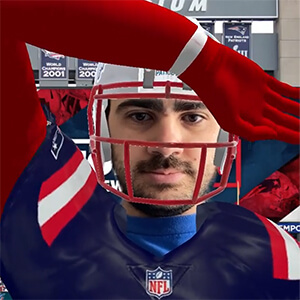
Strip away the partnership logos and SportsManias makes three things. First, animated emojis and GIFs - athletes, mascots, signature celebrations - delivered through a keyboard and pushed out to GIPHY and Tenor. Second, augmented reality effects: face filters and camera effects for Instagram, Facebook, and TikTok that let you wear your team. Third, the app itself, a real-time, personalized news feed powered by what the company describes as patent-pending AI, built for fans tracking teams and fantasy rosters.
The clever part is the business hiding underneath. SportsManias does not just sell emojis to fans; it rents space inside the most intimate screen real estate there is - the conversation. Brands like Gatorade, Burger King, Kia, and Pizza Hut have paid to be there, integrated into the very stickers fans send each other. It is advertising that arrives by invitation, which is the only kind anyone tolerates anymore.
Receipts, not adjectives
Skeptics are right to ask whether a sticker company actually matters. The receipts help. In 2016 the SportsManias app sat at #1 on iTunes' free sports chart - above the NFL's own app. In 2017 the NFL Players Association named it Licensee of the Year for Best Digital Breakout Product. And in January 2019, the company built the first-ever NFL player AR stickers and launched them on TikTok, a platform with more than 500 million monthly users at the time.
The partner list reads like a tour of who owns sports: the NFL and NFLPA, MLS and the MLS Players Association, FIFA, the US Women's National Team Players Association, the Collegiate Licensing Company, plus distribution muscle from Google, Verizon, Facebook, Instagram, and TikTok. Securing those rights is the moat. Anyone can draw an athlete. Almost no one can legally ship one.
Funding, round by round
Connecting brands and fans, one celebration at a time
The company's stated job is to connect partners and brands with fans through digital media. That sounds like a deck slide until you watch it work: a league wants reach, a brand wants relevance, a fan wants to say something. SportsManias sits in the middle and makes all three happen in a single tap. The athlete gets paid, the platform gets engagement, the fan gets a feeling. Everybody wins, which is suspiciously rare.
It has been disciplined about staying small. Thirteen people, a creative director, a technical director, a social lead - more studio than startup. When the model proved it traveled beyond sports, the team did not bolt new verticals onto the brand. They spun up Animanias to chase film, music, and pop culture separately, keeping SportsManias what it has always been: a sports company that happens to ship code.
The conversation is the stadium now
Attention has left the broadcast and moved into the chat, the story, the camera. The next generation of fans will experience a game as much through what they send as through what they watch. Whoever owns the licensed, athlete-approved, instantly shareable pieces of that experience owns a quiet but real piece of the future of sports. SportsManias bet on that future in 2012, before most leagues had figured out their own apps.
Back to Super Bowl Sunday. The fan drops the emoji, the group chat erupts, and nobody pauses to wonder where it came from. That invisibility is the win. SportsManias never wanted to be the loudest voice in the room. It wanted to be the language everyone else is speaking - and most days, quietly, it is.
Five things that make SportsManias, SportsManias
- It was co-founded by a mother-and-son team - mom came from advertising and spotted the market.
- The CEO was a Division III college football player who majored in Cinema Media Studies.
- It once beat the NFL's own app to the #1 spot on iTunes' free sports chart.
- Its NFL AR stickers debuted to 500M+ TikTok users - putting touchdown dances in pockets worldwide.
- The model worked so well outside sports they built a whole second brand, Animanias, for it.