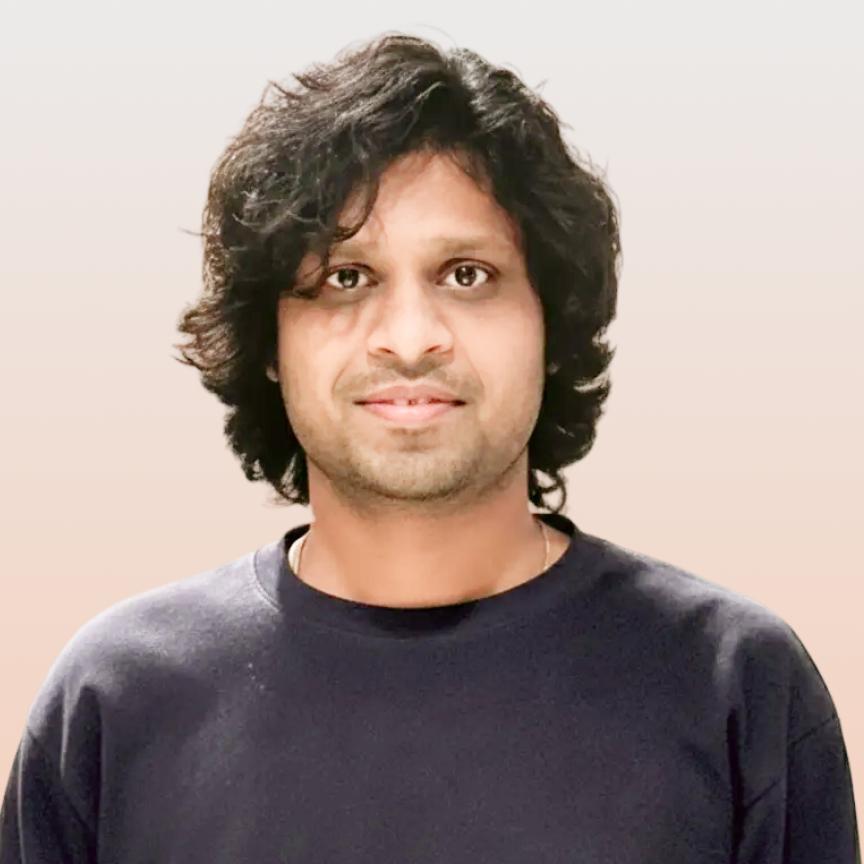
The Story
A letter from his father changed everything
In his third year at BITS Pilani - one of India's elite engineering colleges - Shourya Agarwal received a letter from his father. Inside were childhood photographs. There was nothing digital about it; just paper, ink, and memory. But Shourya found himself wishing the images could somehow move, play, come alive. That ache - the gap between physical memory and digital experience - became the seed of everything.
In 2018, freshly graduated from BITS Pilani with a computer science degree alongside classmates Malhar Patil and Rajat Gupta, Shourya co-founded Homingos. The concept was deceptively simple: printed photos that play embedded videos when scanned. They called them "Smartphotos." Within two months of launching, the app hit #1 trending on the Google Play Store. The market had just confirmed what Shourya suspected - people would pay to make still images breathe.
But consumer apps are a brutal game. Shourya and his co-founders had built something more valuable than a greeting card novelty: a proprietary pipeline for overlaying digital experience onto the physical world, fast enough to feel magical. In 2021, they pivoted Homingos into Flam - an enterprise mixed reality platform aimed squarely at brands and advertisers.
The Moment It Clicked
Britannia, March 2024. Bollywood megastar Ranveer Singh appears in a newspaper ad - in mixed reality - via a simple QR code scan. No app. No headset. The physical page of a newspaper becomes a portal. Brands stopped asking "what is mixed reality?" and started asking "how do we book a campaign?"
The Britannia-Ranveer Singh campaign was the inflection point. Flam had spent years refining the infrastructure - image recognition, AI-powered ground tracking, 3D rendering optimized for mobile GPUs - and that campaign was proof it all worked at commercial scale. Revenue grew 5X in the year that followed. More than 100 global brands signed up, including Google, Samsung, Netflix, Emirates, Flipkart, ICICI Bank, and even the US Presidential Elections campaign.
Shourya's core insight is stubbornly practical: the barrier to immersive media isn't consumer willingness, it's friction. Every AR experience that required an app download bled 80% of potential users before they ever saw the content. Flam's app-less architecture - delivering full mixed reality in under 300 milliseconds via QR codes or direct links - erased that friction entirely. Scan. Experience. No download. No waiting.
The platform runs on proprietary AI infrastructure including real-time image recognition, generative AI motion capture, and AI avatar technology. Brands upload assets; Flam's system handles rendering, tracking, deployment, and measurement across any smartphone, any channel, any surface - print, digital, out-of-home, broadcast, live events. The analytics dashboard tells a brand not just how many scans happened, but how users moved through the experience and where they converted.
In May 2025, Flam closed a $14M Series A led by RTP Global - bringing total funding to $22M. The round arrived with plans to ship a self-serve MR publishing platform, automated 3D asset generation tools, and an integrated advertising suite. Shourya describes the goal plainly: "It's time to make MR measurable, scalable and creatively limitless." The company operates from two hubs - a 60-person engineering team in Bengaluru and a sales and product operation out of San Francisco's Howard Street - with plans to expand to 180+ employees by end of 2025.
The longer arc, as Shourya frames it, is nothing less than the infrastructure layer for what he calls the "physical internet" - a world where every surface, every touchpoint, every printed page and billboard and TV spot can be made interactive, measurable, and alive. Not as a science fiction vision but as a marketing tool brands can buy today. That grounded ambition - imagination constrained by commercial reality - is what separates Flam from the wave of AR hype that came before it.