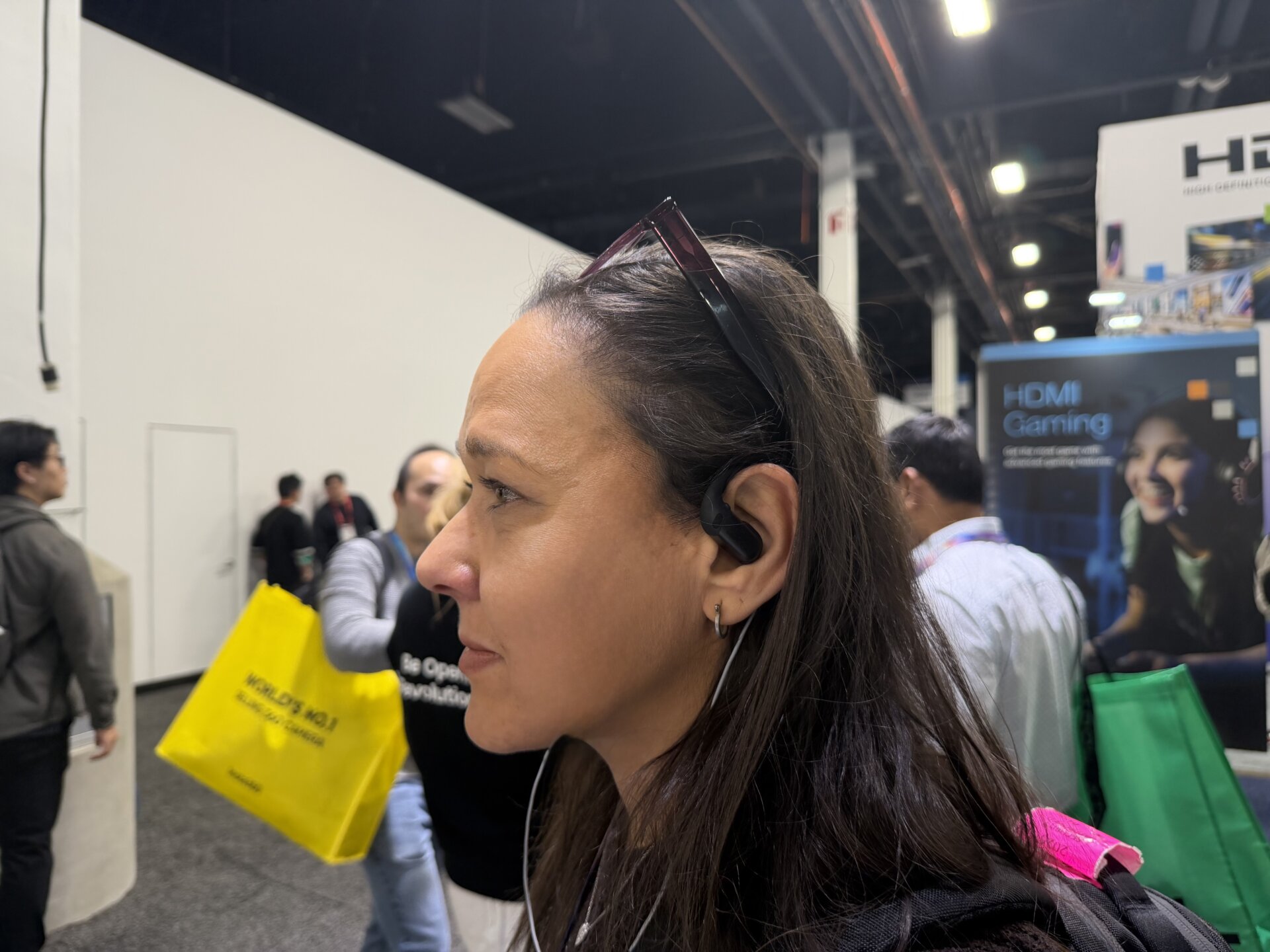
The earbud built for people who want it both ways.
Why this exists
Shokz started in 2011 making bone conduction headphones - devices that bypassed the ear canal entirely and sent vibrations through the skull. The technology worked. Athletes loved it. Hearing-impaired users loved it. The mainstream found it a bit odd. By the time the company rebranded from AfterShokz to Shokz in December 2021, it had spent a decade proving that open-ear audio wasn't a niche - it was a different philosophy.
The OpenFit range, which debuted in 2023, moved away from bone conduction and toward open-ear speaker design: small drivers hovering just outside the ear canal, delivering sound without sealing anything. The form factor caught on. Athletes stayed with it. But one complaint stuck: in noisy environments, you couldn't hear the music without cranking the volume to unhealthy levels.
The OpenFit Pro is the answer to that complaint. And it arrives not as a half-measure but as a fully-realised product with its own new technology stack, a CES Innovation Award, and a price tag that says Shokz is playing for keeps.
Sound quality - the real story
Start with the audio, because that's what earbuds are for. The SuperBoost driver is genuinely new. The dual-diaphragm design pushes frequency response further than any previous Shokz open-ear product - to 40 kHz at the top, with notably reduced distortion in the low end. In practice, the bass improvement is real and noticeable compared to the OpenFit 2. It's not the chest-thumping sub-bass of sealed over-ears, but for open-ear audio it's punchy and controlled.
OpenBass 2.0 handles the low-frequency tuning. DirectPitch 3.0 focuses the audio beam toward the ear rather than broadcasting it to everyone around you. Both are incremental improvements over their predecessors that add up to a substantially better listening experience. The 10-band EQ lets you push further if you have the patience to dial it in through the Shokz app.
Dolby Atmos with head tracking is the headline feature for commuters and media consumers. On compatible mobile content - Apple Music's spatial audio, certain Netflix titles - the effect adds a convincing sense of space. It's not a gimmick. It's also not something most people will actively think about while running.
The noise reduction - what it actually does
Let's be precise, because this matters. The OpenFit Pro's noise reduction is not ANC in the traditional sense. It doesn't create anti-noise waveforms. It doesn't seal your ears. What it does: two feedforward microphones sample the ambient environment, one feedback microphone tracks what's reaching your ear, and the Ear Adaptive Algorithm adjusts your audio playback in real time to keep your music at a consistent perceived level above the noise floor.
In testing, reviewers found 14dB average reduction in the mid-range frequencies - the kind where speech, HVAC hum, and office ambient noise live. In a busy cafe, you can hear your music clearly at moderate volume without blasting your eardrums. In a gym, the clank of weights and general din gets dialled back. In a quiet room, you notice a slight pressure sensation that some users will find odd - similar to the early days of ANC technology.
Where it falls short: wind. Call quality collapses in gusty conditions - the microphones simply can't separate vocal sound from wind noise. And the noise reduction is mid-frequency targeted, so airplane engine rumble and subway roar will still come through. If you need deep noise isolation for long-haul flights, the OpenFit Pro is the wrong tool. If you need to concentrate in an open-plan office or block out a noisy gym playlist that isn't yours, it's very much the right one.
Fit and comfort - all-day wearability tested
The titanium ear hooks on the OpenFit Pro are redesigned from the previous model. Thinner at 0.8mm, with rubberised silicone 2.0 contact points that grip without digging in. Reviewers who wore them for six-plus-hour sessions consistently reported comfort. The 2.4 grams per earbud is light enough that you stop noticing them during the second hour. The optional support accessory is included in the box - a small hook that adds a secondary hold point during high-intensity activity.
The physical buttons are a welcome return. The previous hybrid touch/button system led to accidental triggers mid-run. Now you get one button per earbud, fully customisable in the app: play/pause, skip, volume, voice assistant access. Each one is easy to locate by feel without removing the earbud.
Who this is actually for
The OpenFit Pro is not for everyone, and it's stronger for that clarity. It's built for the athlete who trained themselves to hear traffic but wants cleaner music. For the remote worker who sits in a cafe every morning and has been turning up their earbuds to dangerous levels to hear anything. For the commuter who takes the bus, not the subway, and needs ambient awareness without sacrificing the morning playlist. For the cyclist who will never put in noise-isolating earbuds because they value their life.
It is not for the frequent flyer who needs deep isolation on a twelve-hour transatlantic. It is not for the audiophile who demands reference-grade fidelity. It is not for the budget-conscious buyer - $249.95 is real money. And it is not for anyone who experiences ANC-style pressure discomfort, because the OpenFit Pro produces a mild version of that sensation even with its entirely different mechanism.
The bigger picture - what Shokz is building
The open-ear category is getting crowded. Bose has the Ultra Open. Sony has the LinkBuds Open. Nothing's Ear (Open) undercuts everyone on price. Soundcore and EarFun are chasing the budget end. Shokz's answer is to go deeper on the technology that its competitors haven't touched: real noise reduction without sealing. First-mover advantage in a feature category matters less than execution, and the OpenFit Pro executes well enough to establish the claim.
The CES 2026 Innovation Award validates the engineering. The $249.95 price signals confidence. The 50-hour combined battery life removes the most common complaint about wireless earbuds. The Bluetooth 6.1 integration points toward a future where pairing is invisible and multidevice life is frictionless.
Shokz has been building toward this moment for fifteen years. The OpenFit Pro isn't the end of the road - it's the point where the map becomes interesting.
Verdict
Buy the OpenFit Pro if you live outdoors or in open-plan spaces and you want your music to cut through without sacrificing your awareness of the world. It's genuinely good at both things simultaneously. The noise reduction works where it matters most for its target audience. The sound quality is the best Shokz has shipped in an open-ear product. The fit is all-day comfortable. The 50-hour battery is a standout in a class where 8 hours used to be considered respectable.
Hold off if you need full isolation, have ANC pressure sensitivity, or need to make calls in the wind. And if $249.95 is outside your budget, the OpenFit 2 still exists and is a very good pair of earbuds.
For the right person, the OpenFit Pro is the best open-ear earbud available. That person is more common than the industry has historically assumed. Shokz is betting the category on it.