The Story
The Bio-AI Hybrid, and the Man Who Runs It
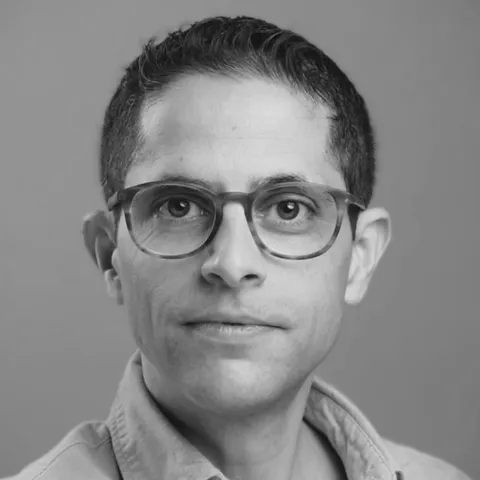
Shlomi Madar runs a biotech in Englewood, New Jersey, whose R&D team includes trained dogs. This is the salient fact. Most companies with a PhD-heavy roster spend their days on assays, panels, and reagents. SpotitEarly does that too, but the assay - the sensor at the front of the pipeline, the thing that reads a patient's breath - is, in part, an animal. The dogs are trained to signal on a small vial of exhaled air. The signal is graded by a deep learning system. The company's pitch is that this arrangement, properly instrumented, is a screening platform.
Madar took over as CEO after a stint as SpotitEarly's VP of business development for North America, which followed a stretch as VP of strategic alliances at OncoHost, an Israeli precision-oncology company. Before that he was in and out of the Weizmann Institute's innovation arm on the East Coast, and before that he was a graduate student at Weizmann itself, doing molecular cell biology under Prof. Varda Rotter. His paper trail on Google Scholar sits under cancer biology. His day job now is a company that mails breath collection kits.
The company describes what it is building as a "bio-AI hybrid" platform. The bio half is canine olfaction - the fact, long known to trainers and increasingly to oncologists, that some tumors emit volatile organic compounds distinctive enough that dogs can pick them out. The AI half is the deep-learning layer that reads the dogs' behavior and reduces it to a probability. The test is meant to screen for four cancers at once: lung, breast, colorectal, prostate. In the company's Rainbow Study, the dogs and the algorithm together landed at 93.9% sensitivity and 94.3% specificity across the four, per the CEO's public interviews.
The right way to think about this, Madar has argued in interviews, is not "cancer-sniffing dogs" but "a scalable canine biosensor system." The dogs are the sensor. The training is the calibration. The neural net is the readout. The kit is the last mile. If any of those pieces breaks, the whole thing breaks. Framed that way, SpotitEarly is less a novelty and more a hardware company whose hardware happens to breathe.
The Weizmann Years
Madar earned his PhD at Weizmann between 2006 and 2012 in the Department of Molecular Cell Biology. His advisor, Prof. Varda Rotter, is a well-known figure in p53 biology - the tumor suppressor gene that sits at the center of much of modern cancer research. Rotter, by Madar's telling, was the sort of advisor who pushed her students onto international conference stages before they felt ready and let them figure out the presentation on the plane. He says he took two things from her: a belief that empowering people beats managing them, and a habit of speaking to audiences bigger than his comfort level.
He also credits a much earlier mentor whose name he tends not to give in public. When that mentor left the company where they both worked, he left Madar a folded piece of paper. On it was a Hebrew proverb: there is a silver lining in every delay. Madar keeps it. It is exactly the sort of talisman that reads as cheesy from a distance and, on the ground, is the reason a founder gets out of bed after a bad quarter.
Knowing the name of something is different from knowing something.
- Feynman, quoted often by Madar
Why Dogs
The obvious question about SpotitEarly is why dogs at all. The company's answer, and Madar's, is that dogs have already done the hard part. Canine olfaction is somewhere between one hundred thousand and one hundred million times more sensitive than the human variety, depending on what you are asking them to smell. In peer-reviewed work over the last decade, trained dogs have picked out cancers from urine, sweat, and breath with unnerving accuracy. What has kept this out of the clinic is not the dogs. It is that dogs are, in engineering terms, an unreliable instrument. They tire. They bond. They have moods. They cost money to train.
SpotitEarly's contribution, at least as Madar describes it, is to treat those problems as engineering problems. The company standardizes the sample collection, standardizes the presentation environment, and grades the dogs' behavior with a computer vision and behavioral analysis pipeline. What comes out the far end is not "the dog thinks so" but a signal-to-noise number the algorithm processes into a probability. If it works, and Madar is careful to say "if" in interviews, it works because the dogs are one component of a diagnostic device whose other components are software.
He is also careful about what he claims. SpotitEarly is not a diagnostic. It is a screen. A screen tells you whether to go to your doctor. It does not tell you that you have cancer. The regulatory posture the company is aiming for - accessible, non-invasive, appropriate for pre-screening at scale - depends on that distinction holding. So does the go-to-market: mailed kits, breath in, envelope out, result in.
The Grandfather
Ask Madar why he does this and the answer, eventually, involves his grandfather. His grandfather started as a paramedic in the French Army and finished his working life as a nurse at one of Israel's largest hospitals, where he assisted, by Madar's telling, in hundreds of surgeries. He knew what he was looking at, in other words. He also, in a story Madar has told in at least one interview, delayed his own prostate cancer screening. He died younger than he needed to.
Madar tells the story without embellishment. It is the kind of story that families in medicine collect and that founders in oncology tend to sit on. It is also - and this is the thing that makes it useful in a room full of investors - a compact statement of the exact problem SpotitEarly is trying to solve. The screening exists. People do not do it. If the screening were a breath sample in an envelope, more people would.