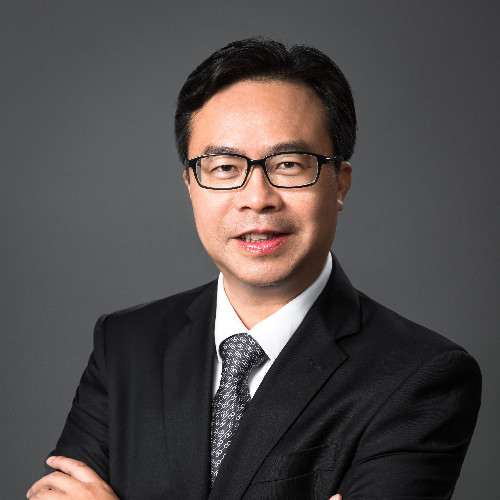
The Story
Six PhDs. Half a Floor. Full Market Disruption.
In 2008, Sheng Liu rented half a floor in Suzhou Science & Technology Park and convinced five other PhD-holding engineers to help him build China's first high-end optical module company. The timing looked terrible - the financial crisis was cracking Western economies, and the optical component market was dominated by American and Japanese manufacturers who had decades of head start. Liu had none of that. What he had was a PhD from Georgia Tech, years inside Lucent's Bell Labs-era research culture, and a specific, boring, technically correct insight: that data center bandwidth demand would keep doubling, that light was the only medium fast enough to carry it, and that nobody in China was making the modules to transmit it.
That company became InnoLight Technology. The name contains its thesis: "Innovation lights our future." By 2012, InnoLight had cleared 160 million yuan in annual sales. By 2014, Google wrote its first-ever China investment check - $38 million in Series B - into InnoLight's optical modules. By 2017, Zhongji Equipment acquired the company and Liu Sheng became Chairman. By 2018, he had produced the world's first 400G optical module. By 2020, 800G modules were rolling off production lines in mass quantities while competitors were still announcing roadmaps.
Innovation lights our future. Technical industries advance or decline - continuous innovation enables lasting development.
- Sheng Liu, InnoLight founder
The 800G story is where Liu's competitive position becomes structural rather than cyclical. InnoLight didn't just ship 800G transceivers first - it captured over half the global market for them. That kind of dominance doesn't emerge from a lucky engineering sprint. It comes from an organization that has been investing 20-plus percent of revenue into R&D every year without exception, building manufacturing processes that competitors can't replicate quickly, and maintaining engineering relationships with the hyperscalers - Google, Meta, Microsoft, Amazon - who ultimately spec what gets built.
Liu Sheng's personal story runs parallel to his company's technical trajectory. Born in 1971 in Daying County, Suining, Sichuan Province - a county so unremarkable that becoming its top science student still required placing second in the 1988 National Chemistry Competition to get bonus points for the Gaokao. He went to Tsinghua University's mechanical engineering and automation programs, completed a master's at the Chinese Academy of Sciences Institute of Automation, earned a PhD at Georgia Tech, and then spent years learning the craft at Agere Systems (the Lucent spinoff that still carried Bell Labs DNA), Pine Photonics Communications, and Opnext.
Liu Sheng's high school teacher remembered: "His grades consistently ranked first in his grade level, and he enjoyed music, singing, and basketball." The kid who liked singing became the man who controls the light moving through AI's arteries.
His former teacher Wang Xingqi described him as someone whose grades "consistently ranked first in his grade level" who also "enjoyed music, singing, and basketball." Liu still donates office equipment - computers, printers, desks - to Tianba Primary School in Daying County, his childhood school. The contrast is quietly absurd: the chairman of a company now worth over one trillion yuan sending printers to a rural elementary school.
TeraHop
What a Sovereign Wealth Fund Buys You in the Age of AI
TeraHop is the vehicle Liu Sheng is now using to take the InnoLight playbook global. It's structured as a Zhongji Innolight subsidiary, but operates as a standalone entity - Singapore headquarters, R&D and sales presence in the US, production bases in Thailand and Taiwan. The geographic spread is intentional: American AI compute infrastructure, Singaporean financial and logistical access, Southeast Asian manufacturing cost structures.
In late 2025, Temasek Holdings - Singapore's sovereign wealth fund - led a $517 million capital raise into TeraHop. Abu Dhabi's ADIA joined. These are not venture bets. Sovereign wealth funds don't take 400-page term sheets to an optical transceiver company based on a hope. They do it when the market position is already established, the engineering moat is real, and the demand curve - in this case, AI data center buildout - is structurally uncapped.
The scale of that demand is clarifying. Zhongji Innolight's Q1 2026 revenue: 194.96 billion yuan, up 192 percent year-over-year. Net profit: 57.35 billion yuan, up 262 percent. This is not cyclical. Every large language model that gets trained, every inference query that gets served, every AI agent that needs memory - they all run on infrastructure that needs optical connectivity at speeds only Liu Sheng's generation of products can provide.
Product Evolution
Generational Leap: From 10G to 12.8T
10G SFP+
40G
100G
400G
800G
1.6T
12.8T
2008
2012
2016
2018 ★
2020 ★
2023 ★
2026 ★
★ = World first or mass production milestone led by InnoLight / TeraHop
Culture & Philosophy
Silicon Valley Rules in Suzhou
Liu Sheng runs his companies with what he describes as Silicon Valley-style culture: flat hierarchy, employee equity, profit-sharing, freedom paired with accountability. This is notably unusual for a Chinese manufacturing company of InnoLight's scale. The typical playbook in Chinese industrial companies involves centralized control, tight information hierarchies, and very limited equity participation below the C-suite level.
Liu's approach may explain why InnoLight was able to attract the caliber of engineers needed to repeatedly beat global competitors on product timelines. When Google invested in 2014, it wasn't just buying modules - it was signaling that InnoLight's engineering organization could be trusted as a strategic supplier. That trust only compounds over time: once a hyperscaler has built InnoLight transceivers into its supply chain specs, switching costs become enormous.
The "innovation lights our future" philosophy isn't just branding - it's an operating constraint. Liu has publicly stated that over 20 percent of annual revenue goes to R&D investment. For a company reporting 194 billion yuan in quarterly revenue, that's a staggering absolute commitment to staying ahead of the physics curve.
Technical industries advance or decline. Continuous innovation enables lasting development.
- Sheng Liu
The awards confirm what the financials suggest. China's National Thousand Talents Program - the country's most prestigious honor for overseas-trained scientists and entrepreneurs who return to contribute domestically - recognized Liu Sheng. The 2023 Forbes China Best CEO list ranked him 36th. The 2025 list included him again. The 2025 Hurun Rich List placed him 411th with 16 billion yuan in personal wealth. The 2026 Hurun Global Rich List: 250 billion yuan, ranked 1,297th globally.
These are not vanity metrics. They're markers of a compounding trajectory that started with half a floor in Suzhou and accelerated every time the world needed faster light.
Career Arc
Every Step Was a Physics Problem
1989
Enrolled at Tsinghua University, Beijing - Mechanical Engineering and Automation. Top science student from Daying County, entered with bonus points from national chemistry competition.
1990s
Master's degree at Institute of Automation, Chinese Academy of Sciences. PhD at Georgia Institute of Technology. Enters American optical communications industry.
1990s-2007
Senior R&D and management roles at Agere Systems (formerly Lucent Technologies / Bell Labs lineage), Pine Photonics Communications, and Opnext Inc. Develops deep expertise in optical transceiver product development and manufacturing.
2008
Returns to China mid-financial crisis. Co-founds Suzhou InnoLight Technology with five other PhDs in Suzhou Science & Technology Park. Patent filed: CN101498820A (10G SFP+ Optical Module).
2012
InnoLight reaches 160 million yuan in annual sales. Wins Suzhou Innovation and Entrepreneurship Mayor Award. Awarded Jiangsu Province Top Ten Overseas Returnees Title.
2013
Suzhou May Day Model Worker honor. Named President of Suzhou Industrial Park Optical Communication Industry Alliance.
2014
Google Capital leads $38 million Series B into InnoLight - Google's first investment in a China company. Global credibility established.
2017
InnoLight acquired by Zhongji Equipment (now Zhongji Innolight, SZ300308). Liu Sheng becomes General Manager, later Chairman.
2018
World's first 400G optical module launched by InnoLight. InnoLight establishes international headquarters in Singapore.
2020
800G optical transceivers reach mass production - an industry first. Company captures 50%+ global market share for 800G.
2023
Forbes China Best CEO list, ranked 36th. World's first 1.6T optical modules released. Named to China's National Thousand Talents Program.
2025
Takes CEO role at TeraHop (Zhongji Innolight subsidiary). Temasek and ADIA invest $517M. Forbes China Best CEO again. Hurun Rich List #411, 16 billion yuan.
2026
TeraHop demonstrates 12.8Tbps XPO transceivers at OFC 2026. Joins XPO MSA. Zhongji Innolight Q1 revenue: 194.96B yuan (+192% YoY). Hurun Global Rich List: 250B yuan, #1,297.