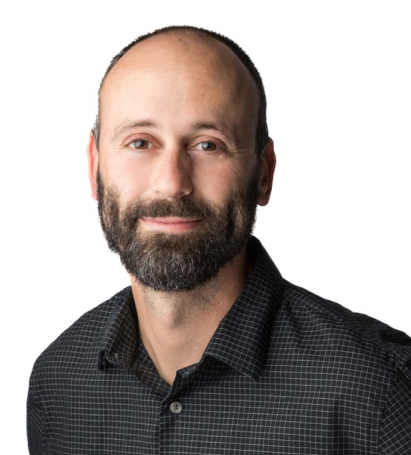
Profile / Biotech / Generative AI
He spent a career teaching biology to behave like an engineering problem. Now he runs the company betting the genome has a grammar - and AI can read it.
Who he is now
In March 2025, Triplebar handed Shawn Manchester the keys. The title changed - Chief Operating Officer became Chief Executive Officer - but the mandate did not. He still wants to make biologic drugs cheap, and he still thinks the way to do it is to stop guessing.
Triplebar sits between Emeryville and Oakland, a roughly eleven-person outfit that talks about building "a predictive model for life itself." That is the kind of sentence that gets you laughed out of most rooms. Manchester says it with a straight face because his platform screens millions of genetic variants inside droplets smaller than a grain of sand, then feeds the results into generative AI genome language models. The droplets are the experiment. The models are the memory.
His pitch is unglamorous and exact: pair ultra-high-throughput phenotypic screening with genome language models, and you can revolutionize how cell lines get developed. Cheaper drugs. Cheaper food proteins. Cells coaxed into making the "hard to make" things that have stumped the industry for years.
He is not the founder. That distinction belongs to Jeremy Agresti, the CTO, who started the company in 2019. Manchester grew into the job the slow way - VP of Product, then COO, then CEO, four years from front door to head of the table.
"I am both honored and humbled to take on the role of CEO at Triplebar."
The bet
Most biotech runs on intuition dressed up as method. A scientist has a hunch, edits a strain, waits, repeats. Manchester's career has been a long argument against that loop.
The Triplebar platform tests massive genetic variation in picoliter microreactors - microfluidic droplets that let the company run experiments at a scale that makes the old plate-by-plate approach look like counting on fingers. Every droplet is a data point. Every data point trains the model.
The payoff he describes is specific. Optimize cell lines for biologics production. Take on a slew of candidates the industry calls "hard to make." Push into cellular meat by improving animal cell line performance, and into microbial protein for food. One platform, several markets, the same underlying idea: combine application-specific data with cutting-edge genome language models and let the grammar of the genome do the talking.
"Our combination of ultra-high throughput phenotypic screening with genome language models holds immense promise to revolutionize how we develop cell lines."
The route there
The anecdote
Years before "AI versus humans" became a tired magazine cover, Manchester was running the experiment for real. At Zymergen he served as lead scientist in the first test pitting machine learning against trained microbial strain engineers - a direct contest to see whether an algorithm could out-engineer the people who'd spent careers doing it by hand.
That is the through-line. He didn't arrive at genome language models because they were fashionable. He arrived because he'd already watched, up close, what happens when you let data argue with intuition. The answer informed everything he's done since.
The texture
Brown for the bachelor's, MIT for the doctorate, both in chemical engineering. He learned to treat biology as a system to be optimized, not a mystery to be admired.
Triplebar's picoliter microreactors run experiments at a scale that turns guesswork into statistics. Millions of variants, screened in volumes you'd need a microscope to find.
At Zymergen he didn't just run the science. As BD lead he turned partner relationships into more than $10M in revenue - the rare scientist who can also sign the deal.
VP of Product to COO to CEO in four years. Venture-backed biotech rarely promotes from within. Triplebar did it twice over with the same person.
The stated goal is a "predictive model for life itself." Cheaper drugs, cheaper proteins, cultivated meat - all downstream of reading the genome's grammar.
Fermentation and machine learning, lab bench and balance sheet. He moves between the two vocabularies without a translator, which is most of why he got the job.
For the record
Find him