NOW Co-founder, Mbodi AI WON ABB Robotics global AI Startup Challenge Y COMBINATOR Spring 2025 DISRUPT 2025 Startup Battlefield Top 20 PAST Core engineer, Google Public DNS (8.8.8.8) UPENN EE · CS · Physics NOW Co-founder, Mbodi AI WON ABB Robotics global AI Startup Challenge Y COMBINATOR Spring 2025 DISRUPT 2025 Startup Battlefield Top 20 PAST Core engineer, Google Public DNS (8.8.8.8) UPENN EE · CS · Physics
Embodied AI · New York

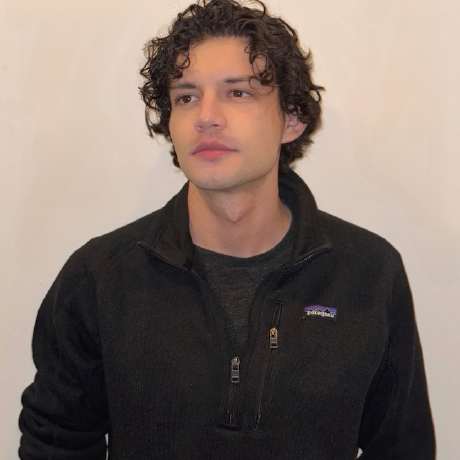
Sebastian Peralta

He teaches factory robots the way you'd onboard a new hire: say what you want, show it once, and let the whole fleet remember.

Sebastian Peralta, co-founder of Mbodi AI
Sebastian Peralta - the roboticist whose bio reads “interested in making humans lazier.”

A robot that needs an engineer every time the job changes isn't automation. It's a very expensive intern.

Talk to the robot. It listens.

On a factory floor somewhere, a robot is being told what to do in plain English. No teach pendant. No re-flashing firmware. No specialist flying in for a week to rewrite motion code. Someone says what they want, demonstrates it once, and the machine gets to work. That is the product Sebastian Peralta co-founded Mbodi AI to build, and it is the kind of thing that sounds obvious only after someone makes it work.

Mbodi runs a cloud-to-edge system that drops into a robot's existing stack. A natural-language prompt goes in; a cluster of AI agents breaks it into subtasks, reasons about the scene, plans, and converts all of it into safe motion in about a second. The framework is hardware-agnostic on purpose. And the part Peralta is most interested in: when one robot learns a skill, every robot on the network inherits it. One lesson, an entire fleet smarter.

The unglamorous truth of industrial robotics is that most robots are brilliant at one rigid task and helpless at anything else. Change the product, change the packaging, change the lighting, and the magic stops. Peralta's pitch is that generative AI and agent orchestration finally make robots that adapt instead of robots that repeat. Mbodi launched in 2024 focused on picking and packaging, the messy, high-variation work that has resisted automation for decades.

The architecture matters here, and Peralta is precise about it. Instead of one giant model trying to do everything, Mbodi runs a cluster of agents that split a request into pieces, each one gathering the information it needs and handing the rest along. Perception, reasoning, planning, and control get coordinated rather than crammed into a single black box. That modularity is also what lets a human step in mid-task to correct a robot, telling it to do a thing a certain way, and have the correction stick. It is the difference between a machine that obeys and a machine that can be taught.
~1s
From a spoken instruction to safe robot motion
3
Undergrad majors at once: EE, CS & Physics
Top 20
Startup Battlefield, TechCrunch Disrupt 2025
Interested in making humans lazier.
- Sebastian Peralta, his entire Y Combinator founder bio

From the internet's plumbing to the factory floor

Before robots, Peralta worked on something almost nobody thinks about and almost everybody uses: Google Public DNS, the service behind 8.8.8.8 that quietly resolves a meaningful slice of the world's internet traffic. It is infrastructure in the truest sense, invisible until it breaks. He was a core engineer there alongside Xavier Chi, who led the project. The two were not working on robotics. They were watching AI accelerate and arriving at the same conclusion: the next frontier was not on a screen, it was in the physical world, and there was no good way to teach a robot anything quickly.

That shared itch became Mbodi. The founding observation was almost a complaint, that robots were stuck inside rigid code and quarter-long deployment cycles while language models were learning to do new things in an afternoon. Why should atoms be so much harder than bits? The honest answer, as Chi has put it, is that the physical world is infinite possibility, you can always invent a task no robot has ever seen, and that is exactly the problem they set out to make tractable.

Peralta did not arrive at robotics from robotics. He came at it from physics. His interest in a theory of everything pulled him not toward higher-energy particles but toward inference itself, and he describes himself as a student of the Jaynes school of information theory, the idea that probability is the logic of incomplete knowledge. It is a tidy origin story for someone now building machines that have to act sensibly with imperfect information about a cluttered, unpredictable room.

His training was almost suspiciously well-suited to the problem. At Penn he stacked three majors that most students take one of, and then went on to graduate work at the GRASP Lab, one of the most established robotics research groups in the country. Electrical engineering taught him the hardware, computer science the systems, physics the math of uncertainty. Robotics is the rare field that punishes anyone who is fluent in only one of those, and rewards the few who are fluent in all three. He picked the unusual path of being all three at once before there was a company that needed exactly that.

A short, fast climb

2021

Finishes a Master of Engineering at UPenn after graduate research in the GRASP Robotics Lab.

2021 - 2024

Engineers at Google, working on Public DNS - the service behind 8.8.8.8.

2024

Co-founds Mbodi AI with Xavier Chi to teach industrial robots through language and demonstration.

2025

Mbodi joins Y Combinator, wins ABB Robotics' global AI Startup Challenge, and reaches the Startup Battlefield Top 20 at TechCrunch Disrupt.

2026

Wider factory deployments planned, following a proof-of-concept with a Fortune 100 consumer-goods company.

He ships code, not just decks

Open Source

embodied-agents

A library for dropping transformer models straight into a robotics stack - Mbodi's bet that the field needs shared tooling, not walled gardens.

GitHub · sebbyjp

robo_transformers & ros2_transformers

Inference servers that bring models like RT-1, RT-X, and Octo into ROS2 - the robotics world's standard nervous system.

86 repos

From grasping to data

Deep-grasp libraries, Contact-GraspNet ports, and the embdata package - the unglamorous scaffolding real robots actually need.

From hundreds of entrants, ABB Robotics picked Mbodi.
Winning ABB's global AI Startup Challenge turned into a joint commercialization deal. ABB was acquired by SoftBank for $5.4B in October 2025.

Infinite possibility, one second to respond

More than 70% of factories report labor shortages. Traditional robots demand week-long reprogramming whenever the line shifts. And hundreds of billions of dollars in automation never happens because the tasks vary too much for a rigid machine to keep up. Peralta and his co-founder framed Mbodi squarely at that gap: not a flashier robot, but a robot that can be re-taught in minutes by someone who has never written a line of code.

The company's stated discipline is refreshingly boring for an AI startup. The goal is not a demo that dazzles and then breaks. It is something that gets deployed and keeps running, reliably, on a real production line. That is the bar a Fortune 100 consumer-goods partner is now holding them to with a proof-of-concept on dynamic, day-to-day packing work.

There is also a quiet philosophy in how he builds. Rather than hoard the tooling, Peralta has put real work into the open. The embodied-agents library lets anyone slot modern transformer models into a robotics stack, and his GitHub is a catalog of the parts that usually never make the keynote: deep-grasp libraries, Contact-GraspNet ports, inference servers that bring models like RT-1, RT-X, and Octo into ROS2. It is a bet that the field grows faster when the plumbing is shared, and a tell about what kind of founder he is, one who would rather the whole ecosystem move than guard a small advantage.

It is a long way from 8.8.8.8, and also not that far at all. Both jobs are about making something enormously complicated feel boringly dependable. One resolves a billion queries you never notice. The other, if Peralta is right, will move a billion boxes the same way. The wager is not that robots will become smarter than people. It is that they will finally become teachable by them, and that the person doing the teaching will not need a degree to do it. For a founder whose stated ambition is to make humans lazier, that is the whole point.

Four things that make him tick

The deadpan bio

His official YC founder line is six words: “Interested in making humans lazier.” A mission statement disguised as a shrug.

Physics first

He chased a theory of everything, found inference instead, and turned probability-as-logic into a way to make robots act under uncertainty.

Three majors

EE, CS, and Physics at once at Penn. The Venn diagram of those three is, more or less, a roboticist.

Peralta's Space

His personal blog mixes notes on utility libraries and class methods with posts on art and “uncanny correspondences.”

See the robots learn

Mbodi's AI-agent robot training, demonstrated live in front of judges and a packed room at TechCrunch Disrupt 2025:

The links

Share this profile