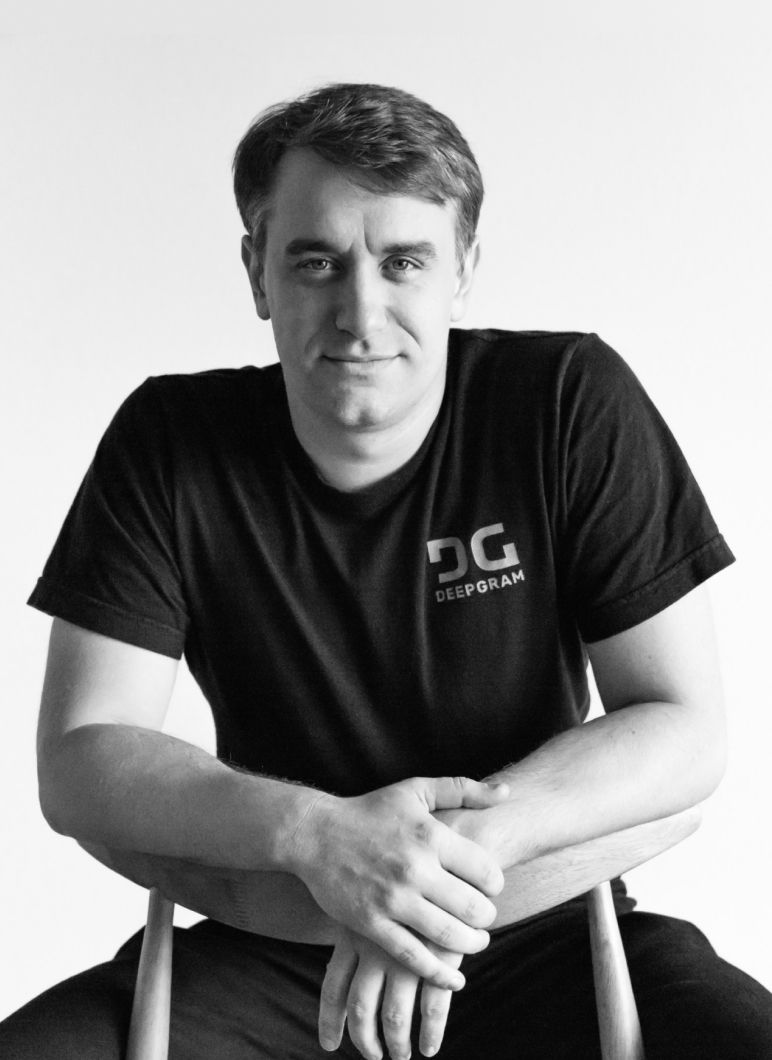
Walk into a Deepgram all-hands and the CEO is the one most likely to start sketching out a loss curve on a whiteboard. Scott Stephenson runs the company the way he ran an experiment - measure first, claim later, and never trust a result you can’t reproduce.
Deepgram is a foundational voice AI company. Speech-to-text. Text-to-speech. Voice agents. The kind of infrastructure that has to be invisible to be any good. More than 500 enterprises sit on top of it, including NASA, Spotify, and Twilio. The pitch is not subtle: build the models from scratch, host the data centers, label the data, generate the synthetic data, and refuse the temptation to wrap somebody else’s API.
Stephenson’s favourite line about all of this is borrowed from his old life. “Speech,” he says, “is the dark matter of enterprise data.” Vast. Mostly invisible. Holding the rest of the universe together if only you could see it. That is the line of a man who has not entirely left the lab.
Because before Deepgram, there was a hole in the ground. Two miles down, in fact. As a particle physics PhD at the University of Michigan, Stephenson helped build a dark matter detector deep underground, where the rock itself shields the instruments from the noise of the sky. Years of staring into the quietest place a human can engineer, listening for an event that may not arrive. It is excellent training for a startup.
The transition from particle physics to voice AI did not happen because he had a vision board. It happened because of an annoying problem. As a grad student, Stephenson and his friend Noah Shutty started life-logging, recording audio of their days for the fun of it. The fun part lasted until they wanted to find a moment again. There was no way to search the tape. So they started building one. Deep learning. End-to-end. The same instinct for picking faint signal out of noise that he had used underground, pointed at a different kind of dark matter.
By 2015 the side project had a name and two more co-founders: Adam Sypniewski and Noah Shutty. By winter 2016 they were a Y Combinator batch. By the time the rest of the world started shouting about voice AI in 2024, Deepgram had already shipped the first end-to-end deep learning speech-to-text models seven years earlier. The receipts are there. Stephenson likes to mention them.
What makes him an unusual founder is not that he is a physicist; it is that he never stopped being one. He talks about training runs the way other CEOs talk about quarters. He treats the company’s in-house data labelling and synthetic data pipelines as instruments to be calibrated. When investors offered $130 million for a Series C, the story he told the press was almost embarrassingly understated: he wasn’t looking. They came to him.
Now he runs a company that ships voice agents capable of holding 100,000 parallel conversations, that competes head-on with OpenAI and Google in a category they helped invent, and that does it from Austin rather than the usual coordinates. The bet is the same one he has been making since graduate school: that the answer is not louder marketing. The answer is a better instrument, pointed at the right faint signal, run long enough that the universe gives something up.
Voice, in Stephenson’s telling, is about to stop being a feature and start being an interface. The keyboard had its century. The screen had its decades. The microphone is up next. He would like to be holding the pen when the spec gets written.
His preferred description of the goal is unfussy: “A world where machines don’t just transcribe words, but truly understand spoken communication.” Read the room. Detect intent. Catch emotion. Respond like a human would, not like a chatbot pretending. The transcription part, the part the industry obsessed over for a decade, is the easy half. The understanding part is where the dark matter lives.
Ask Stephenson where AI is in its arc and he will tell you, with a straight face, that we are “discovering the fundamental laws of intelligence now.” That is a sentence a physicist would say. He says it because he means it.