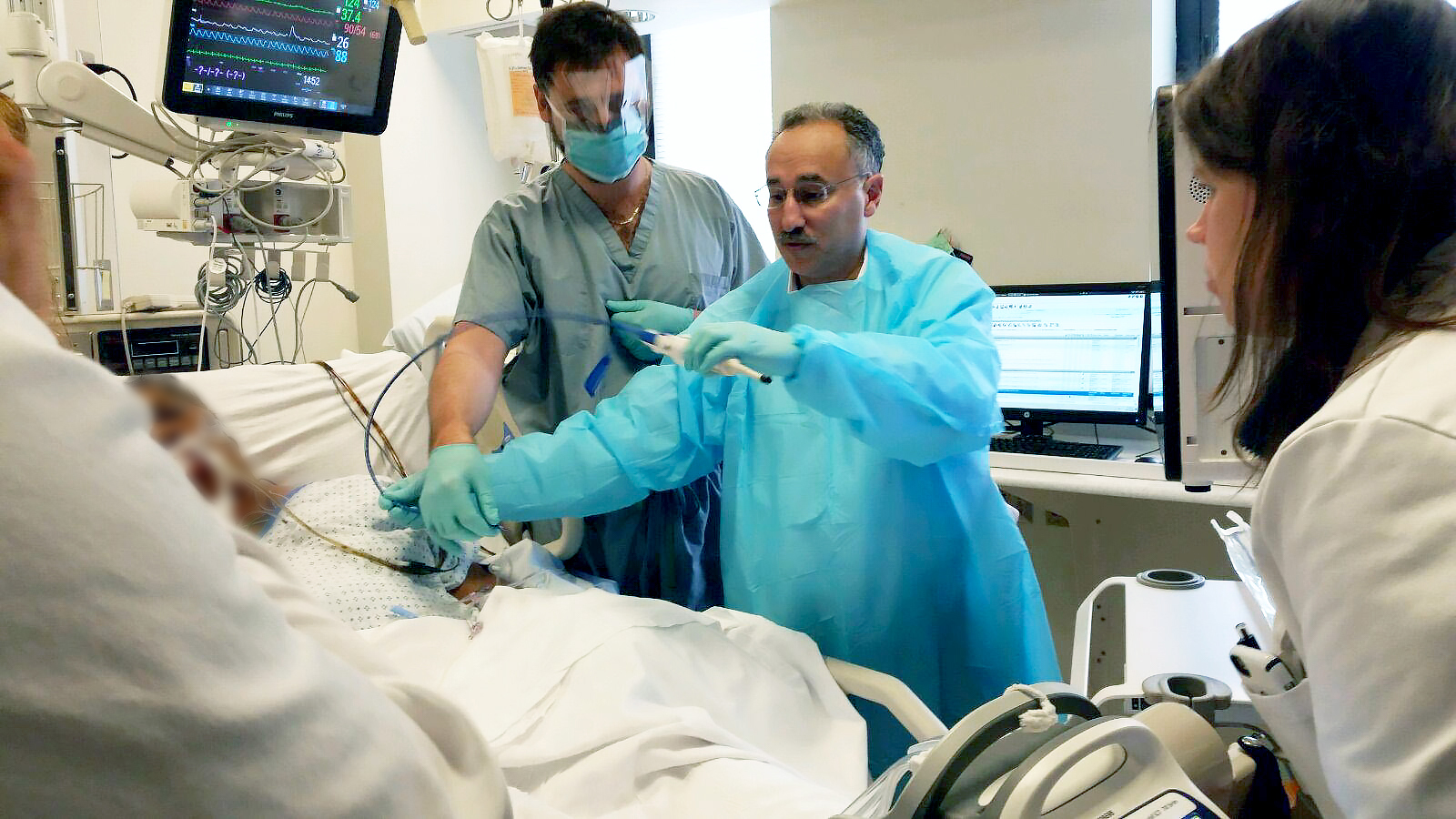
In a critical care unit, the most dangerous number is the one that's already fifteen minutes old. Scott Roth built a company around that specific frustration. As founder and CEO of ImaCor, he made hemodynamic ultrasound - hTEE - a way to point a miniaturized probe at a patient's heart and watch its filling and function change in real time, instead of waiting on a lab to print results that describe a moment that has already passed.
The signature object is small and stubbornly clever: the ClariTEE, a disposable transesophageal probe thin enough to stay indwelling for up to 72 hours. Three days of being able to glance at the heart, episodically, without re-inserting anything. That is the whole pitch, and it is not a small one. It turned an intermittent test into something closer to a monitor.
Roth did not arrive at this from a lab bench. He spent roughly two decades in private practice reading echocardiograms on Long Island, and served as Director of Adult Echocardiography at the Harris Chasanoff Heart Institute at Long Island Jewish Medical Center. He helped start the New York Echocardiography Society as a founding board member. He knew the image, the limits of the image, and exactly when clinicians wished they had one and didn't.
In 2004 he co-founded ImaCor with Steven Evans, MD and Harold Hastings, PhD. The work was slow in the way medical devices are slow - FDA clearance, peer-reviewed evidence, a $5.5M Series A in 2009 - and the company stayed on Jericho Turnpike rather than chasing a coast. The payoff was a category that didn't exist before: continuously available, direct cardiac visualization for the sickest patients in the building.
Then in June 2022, ImaCor and Clarius Mobile Health put that view in a 22-ounce device and called it the Zura Handheld - billed as the world's first handheld TEE system, FDA cleared, running off a phone or tablet. The echo lab, which used to be a room, became something a clinician could carry to the bedside.
The choice of partner says something about how Roth thinks. ImaCor went with Clarius, he explained, "because it delivers the highest image quality for the best patient care" - a clinician's priority, not a procurement spreadsheet's. The handheld runs on the Clarius Ultrasound App across Apple and Android, which means the system Roth spent years building no longer lives on a cart in the corner of the unit. It travels with whoever is on shift.
What's notable is how single-minded the whole arc has been. hTEE is, in Roth's framing, "the first and only critical care solution enabling clinicians to optimize cardiac performance with continuously-available, direct cardiac visualization over time." That is a long sentence describing one idea: look at the heart, keep looking, decide faster. Most of medicine reaches the heart through proxies - pressures, labs, a number on a screen that infers what the muscle is doing. Roth's bet was that direct visualization, made cheap and repeatable, beats the proxy.
The evidence builds slowly, which suits him. ImaCor's case for hTEE leans on peer-reviewed studies and on the unglamorous metric of patients served - more than twenty thousand and counting. In 2023 the company joined the Innovators' Network at the American Heart Association's Center for Health Technology & Innovation, the kind of validation that doesn't trend but does open doors inside hospitals.