Profile · YesPress Editorial
Sandeep Johri
"He has built this thing before. Quietly. From a desk in Palo Alto. Then Vienna. Now Paramus. Same man, different code."
CEO · Checkmarx · Application Security · Silicon Valley → New Jersey
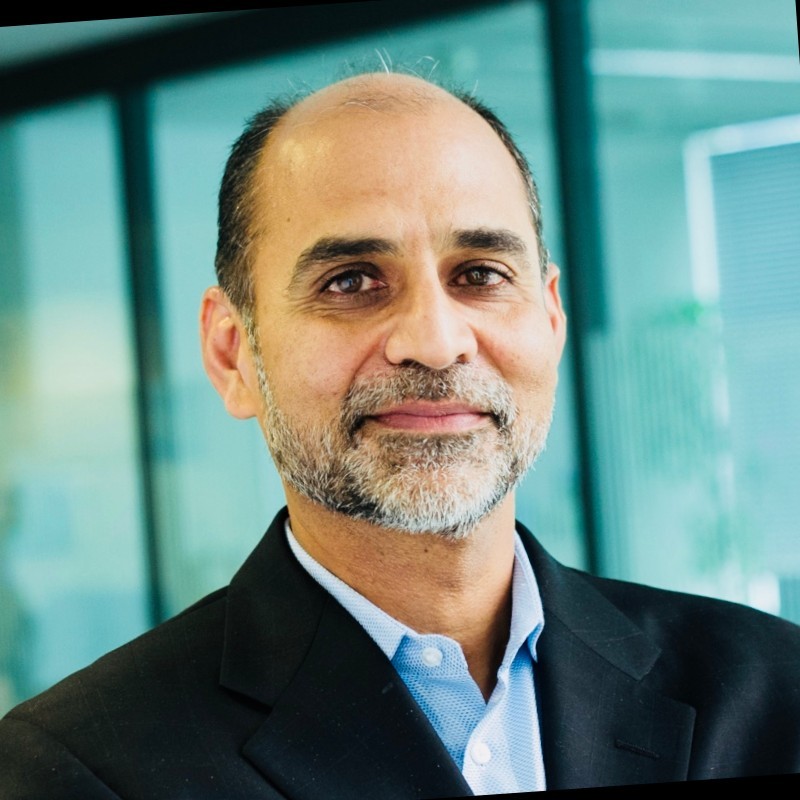
"He has built this thing before. Quietly. From a desk in Palo Alto. Then Vienna. Now Paramus. Same man, different code."
Sandeep Johri runs Checkmarx out of Paramus, New Jersey. He has been in this seat since February 28, 2023. He is not the founder. He rarely is. He is the person you call when the company is good and needs to become unavoidable.
The job at Checkmarx is application security at industrial scale. Static analysis. Software composition analysis. Container security. The kind of work that decides whether a Fortune 500 ships on Friday or rolls back on Monday. Checkmarx has been a Gartner Magic Quadrant Leader for application security testing seven years running, and the last three of those years have his fingerprints on them.
Before Checkmarx there was Tricentis. He took the CEO chair in July 2013, when Tricentis was a small European testing company with maybe five million in ARR. He left in April 2021, with the company at $250M+ ARR, 1,200 employees, offices in three continents. A 30x in ARR. A 100x in enterprise value. The kind of number that gets you a Stanford alumni magazine writeup, except Johri does not do magazine writeups.
Before Tricentis there was HP. Not the printers. The enterprise software arm - then a $600M business that wanted to be a category leader. Johri ran the strategy and the acquisitions, fourteen of them, $7B aggregate, and walked out with HP Software at $3.5B in revenue and a market position that did not need defending. The playbook was simple, the execution was not.
And before HP there was Oblix. His own. Founded in 1996, pivoted multiple times, eventually landed on enterprise identity management - a category that was about to become non-negotiable. Oracle bought it in 2005 for $150 million. Years later he would describe the experience like this: you have to be able to pitch, you'll get a lot of nos, and you've got to keep going. He says it the way other people say good morning.
Think big. But operate very tactically.
— Johri's rule, repeated to anyone who listensHe grew up in Bombay in a middle-class family, in a country whose economy was closed and whose internet did not yet exist. He came to the United States in 1988 on a master's program at Wayne State in Detroit, picked up an industrial engineering degree, took a job at General Motors, and then did what people who watch carefully do - he moved to Silicon Valley. He went to Stanford for the MBA. He spent four years in strategy consulting, advising Apple and telcos and chip companies, learning the shape of the industry from above before stepping into it.
At Silicon Graphics he learned enterprise software at scale. Two years was enough. He founded Oblix on the back of it. The pattern was set then: study the system, build inside it, exit cleanly, repeat at larger scale.
The current chapter is AI. Specifically, AI inside application security. Johri's framing is unusually unromantic: the goal is not to detect faster. The goal is to close the gap between detection and remediation, without hiring more headcount. Checkmarx's bet under his watch has been an AI-powered platform - SAST, SCA, IaC security, API security, secrets detection, container security - that pushes findings toward fixes rather than queues. The pitch is to development leaders, not just security teams, because the people who fix vulnerabilities are the people who wrote them.
The financials around him are loud. Checkmarx has raised roughly $1.24B in total funding, including a merger and acquisition transaction in March 2020 valued at approximately $1.15B. The company is backed by Hellman & Friedman, TPG, and Insight Partners. Johri is the person those investors picked to compound the bet.
What is interesting about Johri is what he is not. He is not loud. He does not run a personal brand. He does not appear on the talking-head circuit between earnings reports. He does not announce his own playbook. He just runs it. The Stanford MBA, the engineering trilogy underneath it - mechanical, industrial, business - reads less like a credentialing project and more like a man assembling a toolkit. Pune for the mechanical fundamentals. Detroit for the industrial systems thinking. Stanford for the financial and strategic vocabulary.
Inside the company he is known for the same thing across every chapter: high-functioning teams. People remember high-functioning teams, he likes to say. They get inspired. They go succeed. The corollary is that bad teams forget themselves. Johri's career has been a deliberate accumulation of teams that did not.
The acquisitions arithmetic from HP is the part that travels with him. Fourteen companies. Seven billion in aggregate value. Not a portfolio - a roll-up. A company built from companies. The discipline required to integrate that many businesses without breaking any of them is rare and underrated, and it is the thing that explains why Tricentis and Checkmarx ever called him in the first place. He has done the integration work. He knows where the seams crack.
The Checkmarx story is still being written. Seven straight Gartner Leader rankings. A platform - Checkmarx One - that has consolidated what used to be a dozen point products. RSAC 2026 in the calendar. A category that grows every time a developer copies a snippet from an AI assistant. The room is large. So is the field. Johri is doing what he has always done: thinking big, operating tactically, and not telling anyone about it until the number prints.
The biographical detail that is easy to miss is the one that explains everything else: he started in a country with no internet and built a career securing the code that runs it. That is not a metaphor. It is a sentence about timing. He arrived in the United States the year Sun Microsystems was selling workstations. He sold Oblix the year Facebook left Harvard. He took Tricentis the year continuous delivery became a phrase. He took Checkmarx the year ChatGPT broke. The companies change. The man's clock is uncannily good.
Pune (mechanical). Wayne State (industrial). Stanford (MBA). The kind of stack that explains why his board meetings sound like systems design reviews.
Founded 1996. Pivoted until identity management clicked. Sold 2005. The starter pistol on the rest of the career.
Grew HP Software from $600M to $3.5B. The arithmetic that turned him into the operator investors call.
Took over in 2013. Walked out in 2021. A small European tester became the global continuous-testing leader on his watch.
First American job was at General Motors in 1988. He worked his way west.
Three operating chapters. Same shape on the chart - in, scale, out.
"You have to be able to pitch. You'll get a lot of nos. And you've got to keep going."
"Think big. But operate very tactically."
"People remember high-functioning teams - inspired to go succeed."
"The goal is not just to detect faster. It is to reduce the gap between detection and remediation in a way that does not depend on hiring more people."
"Technology only succeeds when it is aligned with people, process, and clear business outcomes."
"I have long admired the application security brand and platform that Emmanuel, Maty and the Checkmarx team have created."