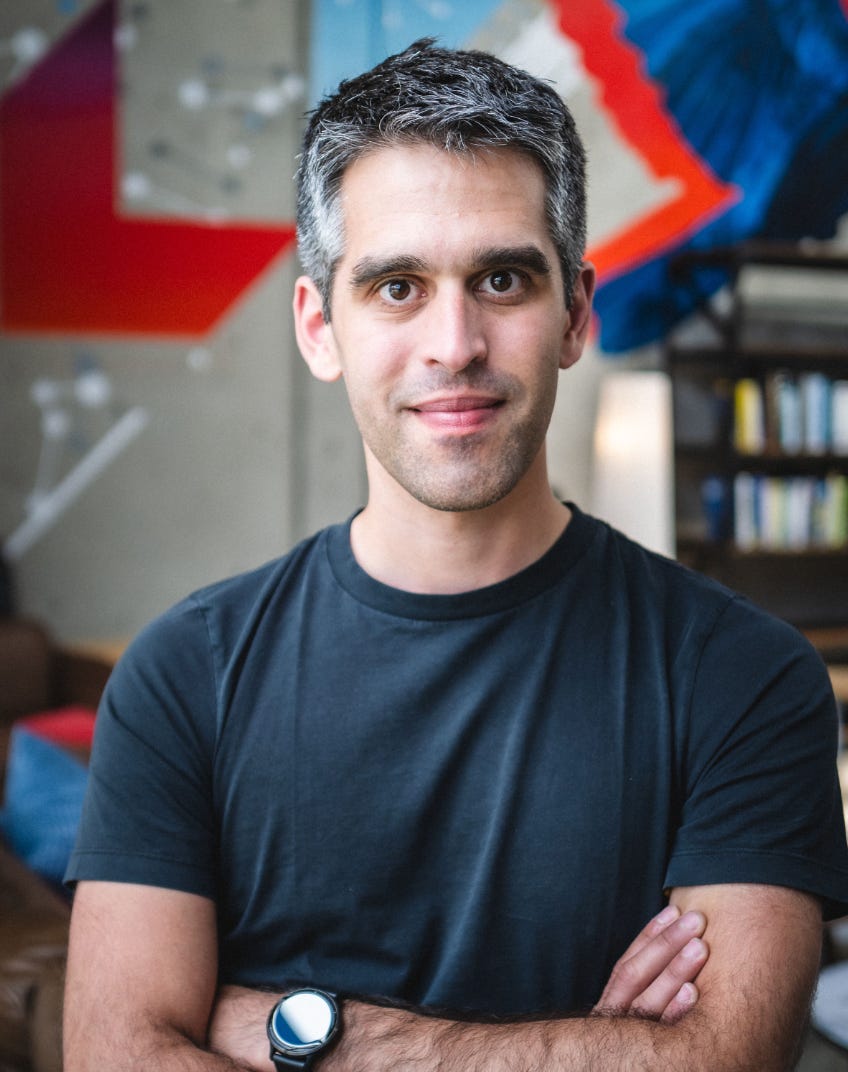
At some point during his PhD at MIT, Samuel Rodriques looked at the remaining unsolved problems in quantum information theory and decided there weren't enough of them. That is not a normal thing for a physicist to decide. It is, however, a very Samuel Rodriques thing to do. He pivoted - hard - into biology, which he describes as having "such a rich supply of great mysteries." That supply has not run out. He is still working through it, now with a team of AI agents.
Rodriques spent his MIT years in Ed Boyden's Synthetic Neurobiology Group, the same lab that invented expansion microscopy - the technique of blowing up biological samples to reveal their nanoscale structure. Rodriques ran it backwards. Together with collaborators, he developed implosion fabrication: a process that shrinks a full three-dimensional structure 1,000-fold to nanoscale dimensions. The potential application that gets cited most often is fitting a million sensors into a brain-monitoring device. He was a graduate student at the time.
His doctoral thesis also included, as a final chapter, a proposal for a new institutional model for science funding. The Focused Research Organization concept - a hybrid between company structure and nonprofit mission - was written in 2019 and dismissed by almost nobody. It has since been adopted by philanthropic funders and governments globally as a model for funding scientific moonshots. Rodriques wrote it as an addendum to a PhD. Governments now use it as policy.
Science is too slow.
- Samuel Rodriques, opening line, Edison Scientific announcementAfter MIT, he joined the Francis Crick Institute in London as a group leader, running the Applied Biotechnology Lab. His research there focused on spatial and temporal transcriptomics, brain mapping, and drug delivery - the kind of translatable work that sits at the crossroads of engineering and medicine. He arrived in 2020, right as COVID was beginning. He left in 2023. On his way out, in a tweet that got noticed, he noted he had always told himself he would only remain in academia if he found something there worth doing.
What he found worth doing instead was FutureHouse - a San Francisco-based nonprofit backed by Eric Schmidt with a single stated objective: build AI systems that can automate scientific discovery in biology. The organization was co-founded with Andrew White, a machine learning researcher and chemistry professor. They started with roughly 22 people. They published papers, built agents, ran evaluations. They built a tool called PaperQA - an open-source AI agent for scientific literature - that the broader community picked up and ran with.
Then in November 2025, they spun out Edison Scientific as the for-profit arm. The same month, they released Kosmos: an AI scientist that, in a single run, reads 1,500 papers, writes 42,000 lines of analytical code, and generates hypotheses, experimental designs, and research reports. Users estimated that one Kosmos run equated to six months of PhD-level work. Sam Altman saw the announcement and called it "exciting," describing it as representative of "one of the most important impacts of AI." The comparison Rodriques offers for what working with Kosmos feels like: "It's like being a professor today - you have a bunch of graduate students working with you. They go do some work, come back, you provide them updates."
In December 2025, Edison Scientific raised $70 million at a $250 million valuation - led by Triatomic Capital and Spark Capital, with additional backing from Pillar VC, Susa Ventures, and others. The announcement post began: "Science is too slow." Three words. No preamble. The tone has been consistent throughout: Rodriques is not particularly interested in celebrating how far science has come. He is more interested in how far it has yet to go. His stated goal is cures for all diseases by mid-century. He does not say this tentatively.
His awards trail him wherever he goes: Hertz Foundation Fellowship, NSF Graduate Research Fellowship, Churchill Scholarship, Barry Goldwater Scholarship, Hertz Thesis Prize, Newman-Galas Entrepreneurial Initiative Award. In 2025, he was named to TIME's 100 Most Influential People in AI. His TED talk on brain interfaces from 2018, titled "What we'll learn about the brain in the next century," still circulates. He gave it as a postdoc. The framing was modest. The ambitions were not.
Asked about the timeline for AI systems generating Nobel Prize-level discoveries, Rodriques does not hedge: "Within 26 years." He says today's AI operates at what he calls "B-level intelligence" - not yet matching a strong graduate student, but not stagnant either. He believes the trajectory is clear: "Within the next two years, AI systems will generate the most novel scientific hypotheses, surpassing humans." Human scientists, in his vision, shift to strategic oversight - "evaluating proposals, allocating resources, and guiding research direction." It is a job description that sounds more like editing than authorship. He seems to think that is fine.
Beyond the lab, Rodriques has described pursuing performing arts as a personal counterweight to rigorous science - a space where he looks for what he calls "beauty within scientific inquiry." A physicist who performs. A founder who wrote institutional policy in a footnote. A bioengineer who thought running microscopy backwards would shrink things to the nanoscale - and was right. The pattern holds: he approaches problems from the direction nobody else is facing.