Samsung Electronics - 2025 Flagship
A 10-inch tablet that fits in your pocket and lived for exactly 90 days.
The Verdict
Let's be honest with each other. The Samsung Galaxy Z TriFold is not a phone for someone who just wants to check Instagram and make calls. It's a phone for the person who reads all of War and Peace on their commute, runs three Slack workspaces, edits video on a train, and still wants to slip the whole operation into a jacket pocket. It is a device for the person who looks at a 6.5-inch smartphone and thinks, "Not enough."
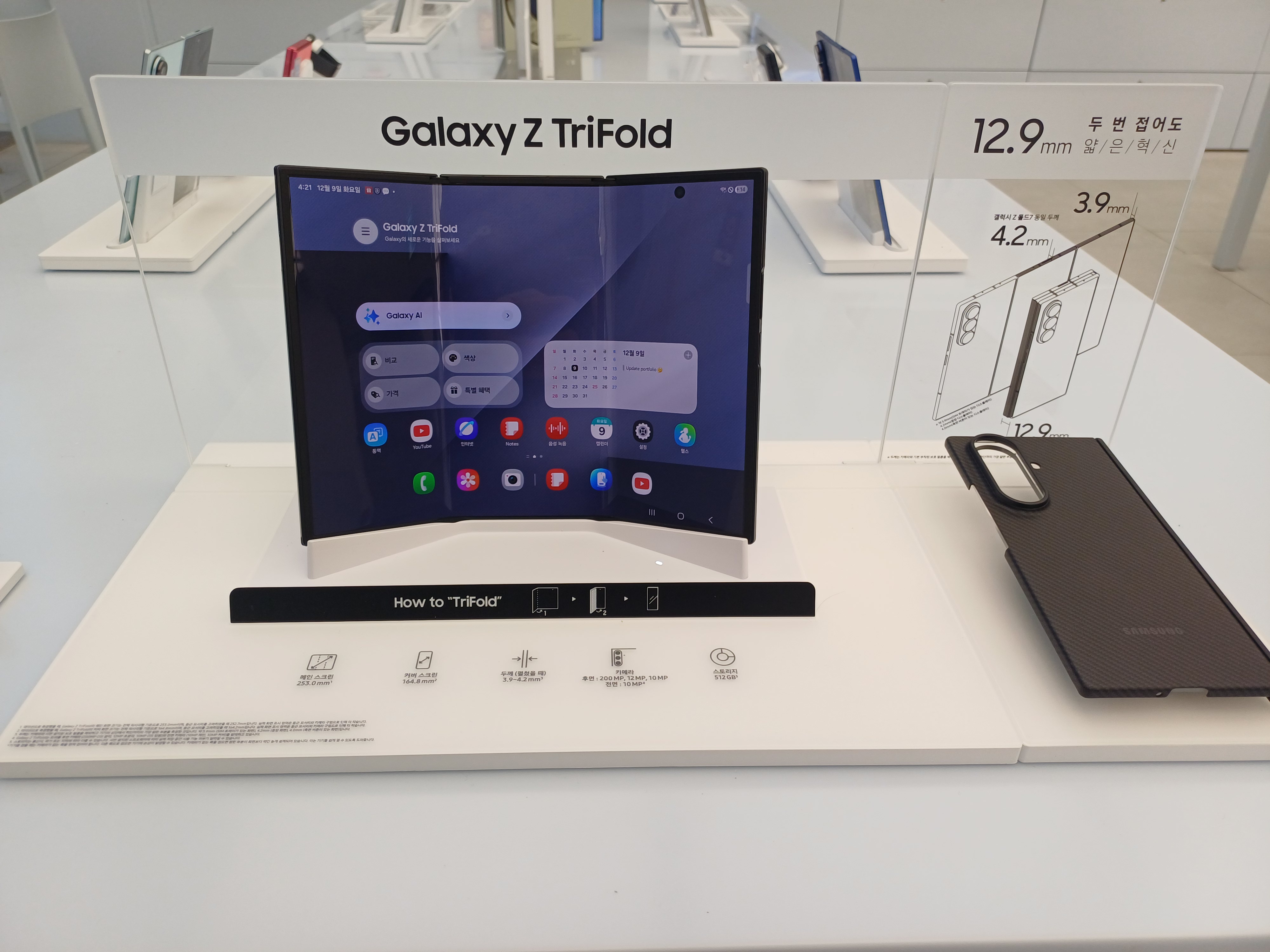
If that is you - and you know who you are - then the Galaxy Z TriFold is the most interesting object Samsung has ever made. Unfold it twice and you're holding a 10-inch tablet. Fold it shut and it disappears into your coat. Nothing else on the market with Google Play services does this. Nothing.
But here's the thing about remarkable objects: they are rarely practical. The Z TriFold weighs 309 grams. It costs $2,899. It was discontinued after 90 days. It is, in every measurable sense, a proof of concept sold as a product. Samsung called it a "technology showcase" - which is corporate speak for "we built this to show the world what we could do, not to retire on the profits."
That honesty is actually refreshing. Samsung didn't pretend this was for everyone. It was for the early adopters willing to pay for bragging rights and a legitimate claim on the future of mobile computing.
"It's oddly addictive - scrolling social media at tablet scale feels like a different medium entirely."
- Early Adopter, Reddit r/GalaxyFold"An amazing product and real statement piece - but separate devices offer better value for most people."
- SamMobile Full ReviewBest For
Not For
Origin Story
The story of the Galaxy Z TriFold begins not with a boardroom decision but with a dare. Samsung had been making bi-fold phones - the Galaxy Z Fold series - since 2019. By 2023, the concept was proven. Foldable phones work. People buy them. But a tri-fold? That's a different order of problem.
Two hinges means twice the engineering challenge. You need the device to fold inward both times - protecting the displays - while still lying perfectly flat when open. The weight distribution shifts with every configuration. And you need it all to survive the punishment of daily use from someone paying nearly three thousand dollars for the privilege.
Samsung's answer was the Armor FlexHinge: two differently-sized hinges using a dual-rail spiral design that manages asymmetric weight distribution across the device. They even built in an auto-alarm system - if you start folding wrong, the phone vibrates and shows an on-screen warning. Preventing damage before it happens.
"The thinnest point when fully unfolded is 3.9mm. Thinner than two credit cards stacked."
- Official Samsung SpecificationsThe result is a device that measures 159.2mm x 214.1mm x 3.9-4.2mm when open, and collapses to just 75mm wide when folded. It is genuinely thin when open. The 10-inch Dynamic AMOLED 2X panel runs at 120Hz with 1,600 nits of brightness. The cover screen - the one you use when the device is folded like a normal phone - is a full 6.5-inch display running at up to 2,600 nits.
Samsung announced it December 1, 2025. South Korea got it December 12. It sold out within minutes. Every subsequent launch - Singapore, UAE, Taiwan, the US on January 30 - followed the same pattern. Minutes. Sold out. The secondary market hit $5,000.
December 1, 2025
Samsung reveals the Galaxy Z TriFold to the world. $2,899, Crafted Black, 512GB or 1TB.
December 12, 2025
iPhone-level launch queues form outside Samsung stores in Seoul.
January 2026
Wins Best Overall and Best Mobile Tech before even launching in the US.
January 30, 2026
Sells out in minutes. Scalpers immediately list units at nearly double retail.
February 2026
Reddit and tech media report dead inner displays in early units. Some fail within 5 days.
March 17, 2026
~90 days after Korean launch. One of the shortest flagship runs in smartphone history.
Mid-2027 (Confirmed)
Targeting ~8.9mm folded thickness, improved internals. The sequel Samsung learned from.
What It Does
Dynamic AMOLED 2X at 1584x2160 resolution, 4:3 aspect ratio, 120Hz adaptive refresh, 1,600 nits. The largest display ever shipped on any Samsung Galaxy device.
Two differently-sized hinges using a dual-rail structure manage asymmetric weight distribution. An auto-alarm system prevents incorrect folding before damage occurs.
Fully functional phone display at 1080x2520 resolution, 120Hz, up to 2,600 nits brightness. Use it folded like any smartphone - no compromises.
Qualcomm's 3nm flagship chip paired with 16GB RAM. The only configuration available - Samsung didn't build a budget version of this device.
Main 200MP f/1.7 sensor with Quad Pixel AF and OIS, 12MP ultra-wide, 10MP 3x optical zoom with up to 30x Space Zoom. Four selfie cameras across two screens.
The largest battery in any Samsung foldable, engineered across three cells to fit the tri-fold form. 45W wired (50% in 30 mins), 15W wireless, 4.5W reverse. Charger included.
Connect to an external display for a full desktop-like experience. The 10-inch screen already enables three simultaneous app windows - DeX extends it further.
Android 16 with One UI 8 and built-in Galaxy AI features: live translation, note summarization, AI photography tools. Seven years of OS and security updates guaranteed.
Latest wireless standards throughout. Faster speeds, lower latency, more efficient power use. Global 5G support gives it a clear advantage over Huawei's Mate XTs.
Rated for splash and rain protection - not submersion. Given the complexity of two hinges and three display sections, achieving any IPX rating here is its own engineering feat.
Technical
| Specification | Detail |
|---|---|
| Model Number | SM-F968B |
| Announced | December 1, 2025 |
| Released | December 12, 2025 (South Korea) |
| Discontinued | March 17, 2026 (~90 days) |
| Price at Launch | $2,899 USD |
| Colors | Crafted Black (only option) |
| Storage Options | 512 GB, 1 TB (no microSD) |
| Dimensions (Unfolded) | 159.2 x 214.1 x 3.9-4.2 mm |
| Dimensions (Folded) | 159.2 x 75 x 12.9 mm |
| Weight | 309 g (10.9 oz) |
| Inner Display | 10.0" Dynamic AMOLED 2X, 1584 x 2160, 4:3, 120Hz, 1,600 nits |
| Cover Display | 6.5" Dynamic AMOLED 2X, 1080 x 2520, 120Hz, 2,600 nits |
| Processor | Qualcomm Snapdragon 8 Elite (3nm) |
| RAM | 16 GB |
| Main Camera | 200 MP, f/1.7, OIS, Quad Pixel AF |
| Ultra-Wide Camera | 12 MP, f/2.2, 120° FOV |
| Telephoto Camera | 10 MP, f/2.4, 3x optical zoom, 30x Space Zoom, OIS |
| Front Cameras | 10 MP (cover), 10 MP (inner) |
| Battery | 5,600 mAh (three-cell) |
| Wired Charging | 45W (charger included) |
| Wireless Charging | 15W |
| Reverse Wireless | 4.5W |
| Battery Life (Claimed) | Up to 17 hours video playback |
| OS at Launch | Android 16, One UI 8 |
| Software Updates | 7 years OS + security updates |
| Water Resistance | IP48 |
| Wi-Fi | Wi-Fi 7 |
| Bluetooth | 5.4 |
| Desktop Mode | Samsung DeX supported |
| Stylus | Not supported |
In Depth
The first time you unfold the Galaxy Z TriFold, you feel like a stage magician who has just discovered a new trick. The cover screen opens to reveal a middle panel. The middle panel opens to reveal the full 10-inch display. Your hands register something that shouldn't fit into a pocket. Your brain hasn't caught up.
That moment is genuinely, authentically remarkable. Not in a marketing-copy way. In a "wait, this is real?" way. Samsung has engineered something that violates intuition. A device this large should not fold this small. Physics should object. It doesn't.
The 10-inch inner panel is the whole point. At 1584x2160 resolution with a 4:3 aspect ratio - essentially the proportions of an iPad - it changes how you experience digital content. Scrolling Twitter on this display feels different than scrolling it on a phone. Reading a PDF feels different. Watching a widescreen film still has letterboxing, but the scale makes it cinema-adjacent rather than smartphone-adjacent.
The three-app split-screen is legitimately useful rather than gimmicky. You can have a document open on the left, a browser in the middle, and a notes app on the right. On a normal phone this is torture. On the Z TriFold it is a recognizable workflow. If you've ever wished you could ditch your iPad and just carry one device, this is the closest anyone has come to making that possible.
309 grams. That's roughly the weight of a can of soup. Your wrist notices this during extended one-handed use. Most people who try the device for more than twenty minutes develop an unconscious technique: support with the left hand, operate with the right. It's workable. It's not a dealbreaker. But it is a constant, low-level negotiation.
The 12.9mm folded thickness is another negotiation. It fits in a jeans pocket but it dominates it. Jacket pockets are more comfortable. The device shapes how you dress, which is either a sign that it takes some getting used to or a sign that it's too big. Your answer to that question tells you whether you're the target audience.
The 5,600 mAh three-cell battery is the most surprising part of the package. Running a 10-inch display should obliterate battery life. Instead, early reviewers and users broadly agreed: the Z TriFold gets through a full day of heavy use. Samsung claims 17 hours of video playback. Real-world usage with the inner display active most of the day typically lands somewhere around 7-9 hours of screen-on time. For a device of this size and complexity, that's a genuine achievement.
The 45W wired charging takes the device to roughly 50% in 30 minutes. Samsung included the charger in the box - a notable choice given the company's recent habit of omitting it. It reads as a gesture of goodwill from a company that knows it's asking you to spend nearly $3,000.
The 200MP main sensor sounds transformative. In practice, it produces excellent shots with good dynamic range and natural color science. It's not the best camera on any Samsung device - the Galaxy S25 Ultra shares the same 200MP sensor and produces comparable results at less than half the price. The telephoto system gives you 3x optical and 30x Space Zoom, which is functional if not cutting-edge.
The real camera story here is the four selfie cameras across two display surfaces. You can use the rear cameras to take self-portraits while seeing yourself on the cover screen. The inner screen's 10MP selfie camera is fine for video calls on that enormous display - and video calls on a 10-inch screen have their own particular absurdity that some people will love and others will find excessive.
In February 2026, reports started surfacing on Reddit and tech forums. Dead inner displays. Black screens appearing after a week of use. Phantom touches. One user reported their inner panel failing completely after just five days. Android Police and Android Headlines covered the issue. Samsung responded - quietly, with warranty service.
Whether this was a systemic flaw or an early production run issue with a complex device is unclear. What is clear: when you spend $2,899 on a phone, you expect it to work for more than five days. The display failures almost certainly contributed to Samsung's decision to discontinue the device and rethink the sequel. The Z TriFold 2's confirmed target of 8.9mm folded thickness suggests Samsung is not only improving performance but rethinking the structural engineering entirely.
Samsung discontinued the Galaxy Z TriFold on March 17, 2026 - roughly 95 days after its South Korean launch. The official framing was "technology showcase." The reality is more complicated.
Samsung reportedly sold the device at or near a loss. The custom dual-hinge system, the large tri-section OLED panel, the three-cell battery configuration, and the limited production run made this one of the most expensive smartphones to manufacture in the company's history. At $2,899, Samsung likely broke even at best. The display reliability issues added warranty exposure on top of thin margins.
But the market response told Samsung something crucial: people will line up for hours and pay $5,000 on the secondary market for a tri-fold phone. The demand is real. The engineering challenge is solvable - just not yet completely solved. The Z TriFold 2 is the solved version. The original is the proof that the market exists.
Awards & Records
Pricing
USD - at launch
DISCONTINUED - No longer available at retail. Last units sold April 10, 2026.
Secondary market peak: ~$5,000. Single color: Crafted Black. Storage: 512GB or 1TB.
Head to Head
The only direct tri-fold competitor is the Huawei Mate XTs. It's a closer race than most expect.
Orange = advantage in category. Both devices have been discontinued or unavailable. Huawei Mate XTs never launched in US.
Press
"A foldable, full-size tablet-phone hybrid that's as functional as it is pocketable. Best Overall at CES 2026."CNET Awards - January 2026
"I liked it a lot more than I thought I would. The 10-inch display changes how multitasking feels on a phone."Tom's Guide, 2026
"An amazing product and real statement piece for enthusiasts - but multiple separate devices will serve most people better."SamMobile Full Review, 2025-2026
"Pricier than other foldables and less polished in execution. The ambition is real - so are the trade-offs."Bloomberg Review, December 30, 2025
"Flexing is believing. The multitasking capabilities are genuine - the 10-inch display elevates everything you do."Engadget CES 2026 Hands-On
"Oddly addictive. Scrolling social media at tablet scale feels like a different medium. The battery lasts longer than I expected."r/GalaxyFold, early adopter, 2026
Trivia
The Z TriFold lasted just ~90 days as a retail product - one of the shortest production runs for a flagship smartphone in recent history.
Samsung reportedly sold the device at or near a loss. The custom dual-hinge system, three-cell battery, and large OLED panel made it extraordinarily expensive to build.
The fully open thickness is 3.9mm at its thinnest point - less than the thickness of two stacked credit cards.
Launch queues in Seoul were directly compared to Apple iPhone launch events by Korean media - a remarkable cultural milestone for Samsung.
A unit purchased for $2,899 at US launch was listed on secondary markets for up to $5,000 - a 72% markup - within hours of the sellout.
One early US owner reported their inner display died after just 5 days of normal use. Samsung honored warranty claims but never publicly acknowledged a systematic defect.
The 5,600 mAh battery matches the Huawei Mate XTs exactly - but charges at 45W versus Huawei's 66W, taking roughly 40% longer from 0 to full.
The confirmed Galaxy Z TriFold 2 targets ~8.9mm folded thickness, down from 12.9mm - a 31% reduction in just one generation. The race to thin is real.
The Galaxy Z TriFold is officially sold out globally as of April 2026. No restocks planned. The sequel - Galaxy Z TriFold 2 - is confirmed for mid-2027 with improved thinness and internals.
Resources
Share This Story