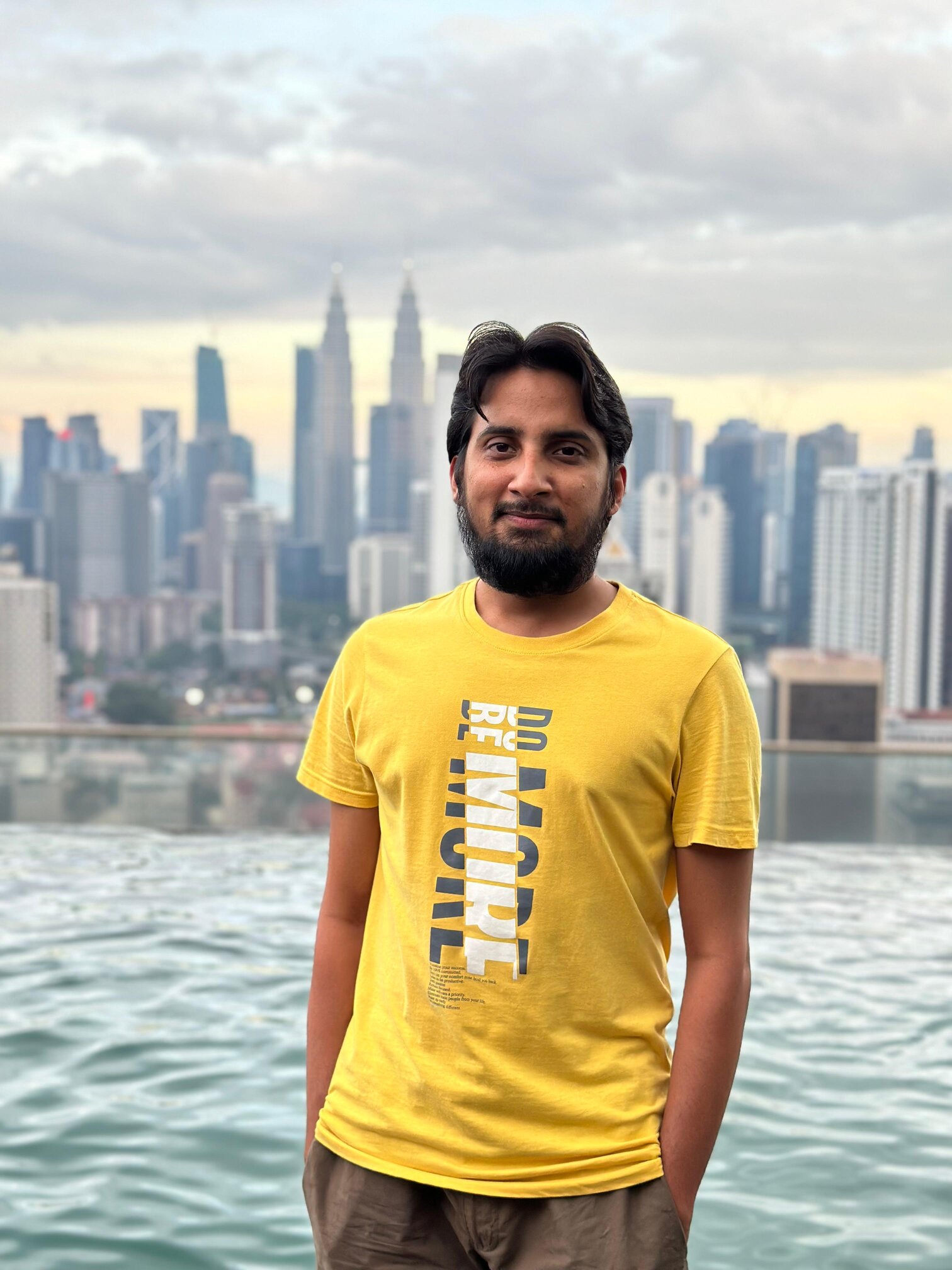
Code first, slogans later
Open Saad Umar's GitHub and the first thing pinned is a UIView subclass that recreates the wiggly graph from Apple's Stocks app. Not a manifesto. Not a landing page. A graph that behaves exactly the way Apple's does, because getting it right was the point.
That instinct - craft over flash - is the whole story. Today he runs Appzay, a mobile app development studio he founded and still engineers for. The pitch on the company's own site is blunt: "We turn funded ideas into stunning mobile apps." Notice the word funded. Appzay does not chase volume or take every brief that lands in the inbox. It takes ideas that are real enough to ship and treats them like they belong to the house.
The model is deliberately strange for an agency. Most shops bill hours and hand over a repository. Saad Umar's pitch is that he and his team show up as technical co-founders - people who care whether the thing succeeds in the store, not just whether the invoice clears. "We're not just developers," reads the Appzay site, "we're your technical co-founders who care deeply about your success." It is the kind of line that sounds like marketing until you notice he has built his entire operation around making it true. Anyone can print "co-founder" on a slide. Far fewer hand over the engineering, the deployment, and the long maintenance tail that follows, and then stick around to answer for all three.
We're not just developers. We're your technical co-founders who care deeply about your success.
Appzay's work spans the whole arc of an app, not just the fun parts. Product strategy and UX at the front. Native engineering in Swift and Kotlin in the middle - no cross-platform shortcuts, because the people who use these apps can feel the difference even if they can't name it. Then the unglamorous machinery: GraphQL and REST plumbing, CI/CD pipelines, App Store optimization, and the long tail of maintenance that decides whether an app survives its first year. One founder, the entire stack.
That refusal to take the easy path has a cost, and Saad Umar seems to have done the math. Cross-platform frameworks promise one codebase for two stores - half the work, half the bill. They also tend to fray at exactly the moments that matter: the scroll that stutters, the animation that lands a frame late, the gesture that feels almost but not quite like the platform underneath it. Choosing Swift for iOS and Kotlin for Android is a vote for the part of an app nobody writes a review about until it's missing. It is slower. It is also the difference between an app people tolerate and one they trust.
The same logic runs through the back end. APIs in GraphQL and REST are not glamorous, but they are where apps quietly die - a slow endpoint here, a brittle contract there, and suddenly the polished front end is waiting on a server that can't keep up. By owning the distributed-systems layer too, Appzay closes the gap between the part users see and the part that decides whether the part users see actually works. CI/CD pipelines mean releases ship on rails instead of by hand. App Store optimization means the work gets found once it ships. None of it photographs well. All of it is the job.
Apps you may have already tapped
The clearest way to understand what a builder believes is to look at what they shipped. Saad Umar's studio has had its hands on products that reach far past the Karachi office where a lot of the work gets written.
A football club with a global fanbase. A driving-rewards app with a multi-million user base. An AI photo tool and an AI meeting companion. The range is the tell: Saad Umar is not a one-trick specialist riding a single template. He is the person founders call when they have money, an idea, and no engineering team to make it real.
Consider what each of those products actually demands. The official app of a club like Inter Miami CF is not a brochure - it is a live surface for hundreds of thousands of fans hitting it at once on match day, the worst possible time for anything to wobble. OnMyWay, with its multi-million user base, has to track driving and hand out rewards reliably enough that people keep it running in the background of their daily commute; an app that drains the battery or misfires on the reward never survives that scrutiny. TagCam leans on on-device intelligence to make photo search feel instant. Bliro rides the current wave of AI meeting tools, where the bar is set by whoever shipped the slickest competitor last week.
Four products, four entirely different failure modes. The thread connecting them is not a category - it's a standard. Each one had to feel native, behave under load, and hold up in public. That is a narrow kind of trust to earn, and founders tend to pay for it precisely because they've been burned by cheaper bets before.
Making an app is a 3 step process.
The long way to lead engineer
Before the agency, there were jobs. Saad Umar studied at the University of Karachi between 2012 and 2016, then moved through the kind of engineering roles that teach you how software actually gets built and broken - stints connected to names like Panacloud and Avanza Solutions, and later a turn as a principal iOS engineer.
By 2022 he was deep enough in the work to be growing teams rather than just joining them. When a colleague signed on, he posted the kind of line that betrays a founder's optimism: "Yes, we are growing. This is the time to join this super rocketship." The exclamation points were doing real work.
The arc is worth pausing on because it explains the agency. Saad Umar did not start as a founder who hired engineers to do the building. He started as an engineer, in the trenches of iOS, learning where apps crack by watching them crack. The principal-engineer years taught him the parts of the job that don't fit on a feature list: how to scope a release so it ships, how to read a crash report at speed, how to tell a founder that the thing they want will quietly ruin the thing they need. Appzay is what happens when that hard-won judgment gets pointed outward - sold not as hours but as the thing those hours produce.
It also explains the geography. Working from Karachi with a globally distributed team, Saad Umar is part of a generation of Pakistani engineers who stopped treating distance from Silicon Valley as a ceiling. The apps don't care where they were written. A graph that behaves correctly behaves correctly in any time zone. He built a studio that competes on craft, and let the craft do the traveling.
What the resume leaves out
Stocks, recreated
One of his pinned projects rebuilds the graph from Apple's Stocks app, pixel by pixel. He shipped it because the detail was worth getting right, not because anyone asked.
Three steps, no more
His LinkedIn article boils the craft down to design, build, deploy. Everything else, in his telling, is noise dressed up as process.
Native or nothing
Swift and Kotlin, written by hand. He resists the cross-platform shortcut that tempts most agencies under deadline.
Funded only
Appzay takes ideas that are real enough to ship. Saying no is part of the product.
The next app, and the one after
The aspiration is not empire. Saad Umar talks about staying close to the work - keeping the co-founder posture, taking on founders he believes in, and shipping things that hold up after launch instead of running a high-volume shop that forgets a client the moment the App Store review goes live.
It is a quieter ambition than most founders advertise, and a harder one to fake. You cannot pretend to care about an app's reviews at two in the morning when a release breaks. Either you wrote the code and you are watching the dashboards, or you are not. Saad Umar, by every public signal, is the one watching.
There's a version of his story that ends with scale - more clients, more headcount, the founder pulled up and out of the codebase until he's signing off on work he no longer touches. Plenty of agencies take that exit, and the apps usually tell on them. Saad Umar's whole positioning is a bet against it. "Founder and lead engineer" is not two titles stapled together for a bio; it's a refusal to drop the second one. The day he stops being the lead engineer is the day Appzay becomes an ordinary agency, and he seems to know it.
So the plan, as far as anyone can read it, is more of the same done well: pick funded founders worth backing, write native code that holds, ship it, and stay close enough to fix it when the store throws a surprise. In an industry addicted to the new framework, the next platform, the shortcut that promises to make building cheap, that is almost a contrarian position. Saad Umar is betting that the boring virtues - it works, it's fast, it lasts - never go out of style. The apps in millions of pockets suggest he's reading the market right.