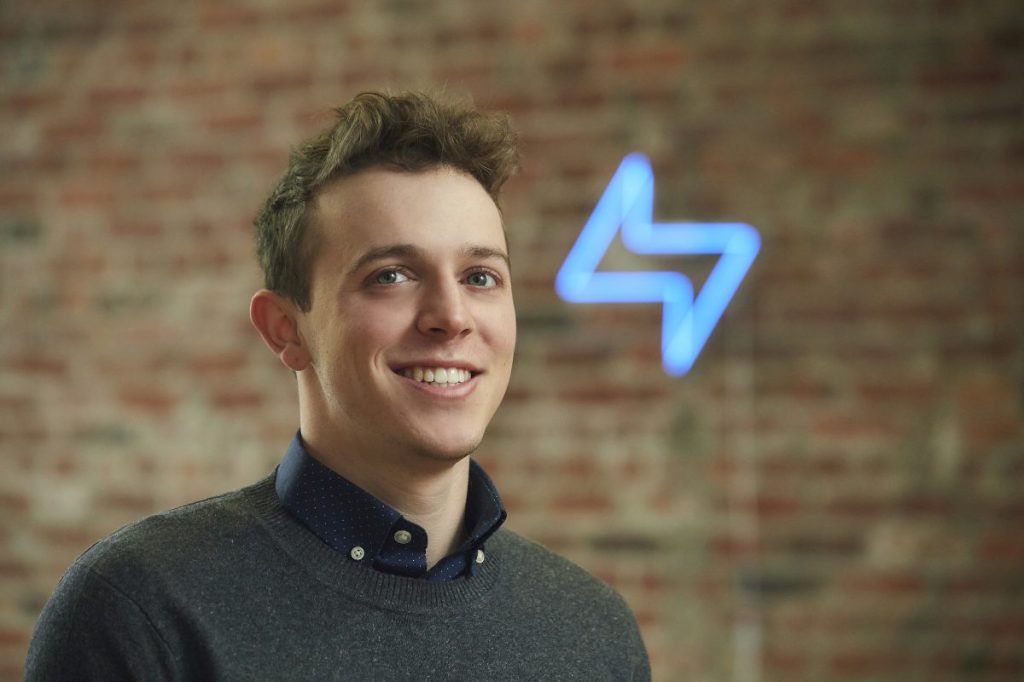
The Story
One Idea, Ten Years, Every Extreme
In 2014, Ryan Breslow left Stanford with a single observation that would define the next decade of his life: Amazon had one-click checkout. No one else did. He decided that gap was a billion-dollar opportunity - and he was right, eventually, though not before experiencing the full range of what Silicon Valley can do to a founder.
He grew up in North Miami Beach, Florida, teaching himself to code from YouTube tutorials in middle school. By high school, he was running an online mattress company while bagging groceries at Publix after school. He designed websites for a luxury shopping center and a LeBron James-backed streetwear brand. The ambition was always there; the address just hadn't caught up yet.
Stanford was the obvious next move, and in 2012 he enrolled as a computer science student. He co-founded the Stanford Bitcoin Group as a freshman - this was 2012, when Bitcoin was still a curiosity for cypherpunks rather than a portfolio hedge. That early crypto instinct would keep recurring throughout his career. But the company that would consume the next decade was the checkout company he started with classmate Eric Feldman after dropping out in 2014. They spent a year in near-total stealth, researching payment regulations and financial compliance before writing a line of product code. Bolt launched in 2016.
One day it hit me like a bolt of lightning. Amazon has offered one-click checkout since 1999 and the rest of the world doesn't.
Ryan Breslow - Forbes, 2022
The insight was obvious in hindsight. Checkout friction was costing merchants billions in abandoned carts. Amazon had solved it behind their own garden wall. The entire rest of the internet was running decades behind. Breslow's bet was that if you built the infrastructure right - a network of shoppers whose details were stored and verified once - you could offer Amazon-grade checkout to any merchant on the planet.
The Rise
From Stealth to $11 Billion
The company grew steadily through 2016-2019, getting the fundamentals right before anyone was paying close attention. Bolt made the Forbes Fintech 50 list in 2019. By 2021, the flywheel was spinning: Bolt ranked #64 on the Inc. 5000, Breslow won Entrepreneur of the Year for Northern California, and the company was implementing a four-day workweek and publishing its "Conscious Culture Playbook" at conscious.org - sharing its internal management philosophy freely with any company that wanted it.
Breslow was operating from a distinctive philosophy: that the rigid, performance-at-all-costs culture of Silicon Valley was both morally wrong and strategically counterproductive. He wrote about mindfulness, yoga, and meditation as essential tools for founders. He founded The Movement, a dance nonprofit. His Instagram handle, @ryantakesoff, attracted half a million followers. He positioned himself as a different kind of tech CEO - one whose success didn't require the traditional sacrifices.
The Conscious Culture Thesis
In 2021, Breslow launched conscious.org to share Bolt's internal culture playbook - freely, with any company. The framework combined mindfulness with high performance standards: challenge people, praise achievement, be honest about underperformance. It attracted significant attention from founders trying to build differently.
The philosophy would be significantly tested in the years that followed.
In January 2022, the Series E closed at $355 million. Bolt's valuation hit $11 billion. By May 2022, based on his equity stake, Breslow had become one of the world's youngest self-made billionaires. The story wrote itself: North Miami Beach kid, Stanford dropout, conscious leader, billionaire at 27. Tech media loved it.
Then, also in January 2022, Breslow posted a Twitter thread calling Y Combinator and Stripe "mob bosses of Silicon Valley." The backlash was immediate and severe. Within days, he stepped down as CEO, with Maju Kuruvilla taking the role. Breslow became executive chairman, then chairman. The company he'd spent eight years building was now running without him.
Bolt Valuation Trajectory (Estimated)
SOURCE: REPORTED VALUATIONS / ESTIMATES. BARS PROPORTIONAL TO REPORTED FIGURES.
The Collapse
97% in Eighteen Months
The $11 billion number had a problem: the market conditions that made it possible evaporated fast. Rising interest rates killed the zero-cost-capital era. Fintech valuations reset everywhere. Bolt's headcount had ballooned - by some accounts north of 800 people - and the spending that came with it. The company had overextended.
In April 2023, Breslow was subpoenaed by the SEC regarding statements made during the Series E fundraising process. Allegations included overstating merchant adoption figures, including unverified or inactive customers in presentations, and inflating revenue forecasts. An investor lawsuit followed, with Brian Reinken of WestCap Management and Arjun Sethi of Tribe Capital challenging the fundraising claims. Breslow proposed settling by returning $37 million worth of shares.
The SEC concluded its investigation in August 2023 without recommending enforcement action - a meaningful distinction. But the investigation period had been difficult, and the company's valuation kept falling. By February 2024, Bolt was valued at approximately $300 million. From $11 billion to $300 million. That's a 97% decline. Breslow was no longer a billionaire.
He'd also been running side ventures during this period - Eco, a crypto savings platform that was later accused of misrepresenting its yield sources (claiming to lend to Goldman Sachs and Fidelity while actually depositing into BlockFi and DeFi protocols), and Love, a cryptocurrency wellness venture. The timing of BlockFi's eventual bankruptcy added another layer of complexity to the Eco story. Breslow maintained his focus on rebuilding Bolt through all of it.
The Return
Wartime CEO
In March 2025, Ryan Breslow returned as CEO of Bolt with unanimous board approval. The company that greeted him was barely a shadow of its peak - fewer than 300 employees, a fraction of the revenue trajectory once projected, and a market that had moved. His self-described mode: wartime.
What followed was methodical and, depending on your perspective, either necessary or brutal. In April 2026, Bolt cut approximately 30% of its remaining workforce. The company's headcount settled around 100 people. Then, on May 20, 2026 - International Human Resources Day, which also happened to be Breslow's 32nd birthday - he eliminated Bolt's entire HR department.
We had an HR team, and that HR team was creating problems that didn't exist. Those problems disappeared when I let them go.
Ryan Breslow - Fortune's Workforce Innovation Summit, May 2026
The reasoning was pointed: in Breslow's analysis, a bureaucratic HR function had become a generator of internal friction rather than a resolver of it. He replaced traditional HR processes with a direct management model and AI-driven tools. The unlimited PTO policy, once a flagship feature of Bolt's progressive culture, was replaced with four weeks of mandatory paid vacation - on the theory that unclear policies cause more burnout than defined ones.
The philosophy has shifted. Breslow now describes the post-turnaround Bolt as a place that challenges people relentlessly. Junior employees working harder and with better energy than their more senior predecessors. He's betting that the combination of a smaller, more committed team and aggressive AI adoption will let 100 people do what 800 couldn't.
We have a team a quarter of the size, who are much more junior, who work a lot harder, who have better energy.
Ryan Breslow - Fortune, May 2026
The Bet
One SuperApp to Rule Them All
The Bolt that Breslow is rebuilding in 2026 is different from the one he originally built. The one-click checkout business is still there - the core insight was always sound. But the vision has expanded: Bolt is positioning itself as a payments SuperApp, offering one-click access to peer-to-peer transfers, cryptocurrency, card products, rewards, and broader financial services under a single roof.
The inspiration runs through two threads: the original Amazon observation (why shouldn't everyone have what Amazon users have?) and a new AI-centric operating model. Breslow has said that building products in 2026 requires a fundamentally different approach - leaner, faster, more reliant on AI to do what previously required large teams. At 100 employees, Bolt's operating model is essentially a test of that thesis at scale.
The SuperApp Stack (2026)
One-Click Checkout - The original product, now serving as the network foundation.
Peer-to-Peer Payments - Extending the one-click experience to personal finance.
Crypto - Back to his Stanford Bitcoin Group roots; integrated into the financial stack.
Rewards - Network-wide loyalty mechanics across merchants.
Cards & Financial Services - Building toward a full consumer financial identity.
The co-founder of the Stanford Bitcoin Group building a crypto-native payments app is, in retrospect, a more coherent arc than it might appear. Breslow was early to crypto as an undergraduate. He was early to one-click checkout as a startup founder. The SuperApp vision is his attempt to fuse both bets into a single platform before competitors get there first.
In His Own Words
The Ryan Breslow Reader
"As a founder, you are the Chief Storyteller. In the very beginning, you have a story that only you believe."
From Fundraising (book)
"Employees want to be challenged and to grow. They want leaders to hold a high bar for them."
Conscious Culture Playbook
"There's a sense of entitlement that had festered across the company - people who felt entitled but weren't actually working hard."
Fortune, May 2026
"Developing products in 2026 is very different than it was in prior years. We need to be leaner and more AI-centric than ever."
Bolt internal memo, 2026
Career Arc
From Publix to $11 Billion to Wartime
~2006-2010
Teaches himself to code from YouTube in middle school. Runs an online mattress company in high school while bagging groceries at Publix.
2012
Enrolls at Stanford Computer Science. Co-founds the Stanford Bitcoin Group - before crypto was a household word.
2013-2014
Begins developing a Bitcoin digital wallet with classmate Eric Feldman. Drops out of Stanford in 2014 to pursue the venture full-time.
2014-2015
Stealth research phase: a year spent studying payment regulations, compliance, and financial infrastructure before pivoting to one-click checkout.
2016
Bolt officially launches. First version developed with a small team; focus on cracking checkout friction for the broader internet.
2019
Bolt named to Forbes Fintech 50. Proof that the market is taking the category seriously.
2021
Inc. 5000 #64. Entrepreneur of Year, Northern California. Launches four-day workweek, conscious.org culture platform. Peak of the progressive-CEO era.
January 2022
Steps down as CEO after Twitter controversy. Series E closes at $355M. Bolt valued at $11B. Becomes executive chairman, then chairman.
2023-2024
SEC investigation (closed without enforcement). Investor lawsuit. Valuation falls to $300M. Breslow no longer a billionaire.
March 2025
Returns as CEO with unanimous board approval. Enters wartime operational mode.
April-May 2026
Cuts 30% of workforce. Eliminates entire HR department on his 32nd birthday (International Human Resources Day). Bolt operates with ~100 employees as AI-first SuperApp.
Track Record
What He's Built and Won
2019
Forbes Fintech 50 - Bolt named among the most innovative fintech companies in the world.
2021
Entrepreneur of the Year, Northern California (Ernst & Young). One of the most recognized startup founder honors in tech.
2021
Bolt ranks #64 on the Inc. 5000 list of fastest-growing private companies in America.
2022
Briefly one of the world's youngest self-made billionaires at 27, based on $11B Bolt valuation.
2022
Forbes Retail and Ecommerce Allstar - recognized for reshaping online purchasing infrastructure.
2021
Launched conscious.org - a freely-shared culture playbook used by companies beyond Bolt.
2025
Returned as CEO with unanimous board support to lead Bolt's comeback. Rare founder second act in progress.
2016+
$853M total funding raised across multiple rounds, including a $355M Series E at $11B valuation.
The Details
Things That Don't Make the Headline
His Instagram handle is @ryantakesoff - 486,000 followers, currently on pause. His LinkedIn is considerably more active. The contrast between the personal brand pivot and the professional rebuild happening simultaneously is one of the more interesting tensions in his current chapter.
He founded The Movement, a dance nonprofit. For someone who describes himself as deeply introverted and who rarely attends social gatherings, founding a dance organization is the kind of detail that reminds you that categories for people are usually wrong.
He wrote a book called Fundraising, which opens with the thesis that founders are above all Chief Storytellers. The story, in his framing, starts as something only you believe - then a small team believes it, then investors, then customers. The sequence matters because the story has to hold through all of it. His own story has been tested at every stage of that chain.
He fired his entire HR department on International Human Resources Day. On his own birthday. Whether that's dark comedy, brilliant trolling, or simply a calendar coincidence he found amusing is a question only Breslow can answer. He hasn't said.
Further Reading
Links & Resources