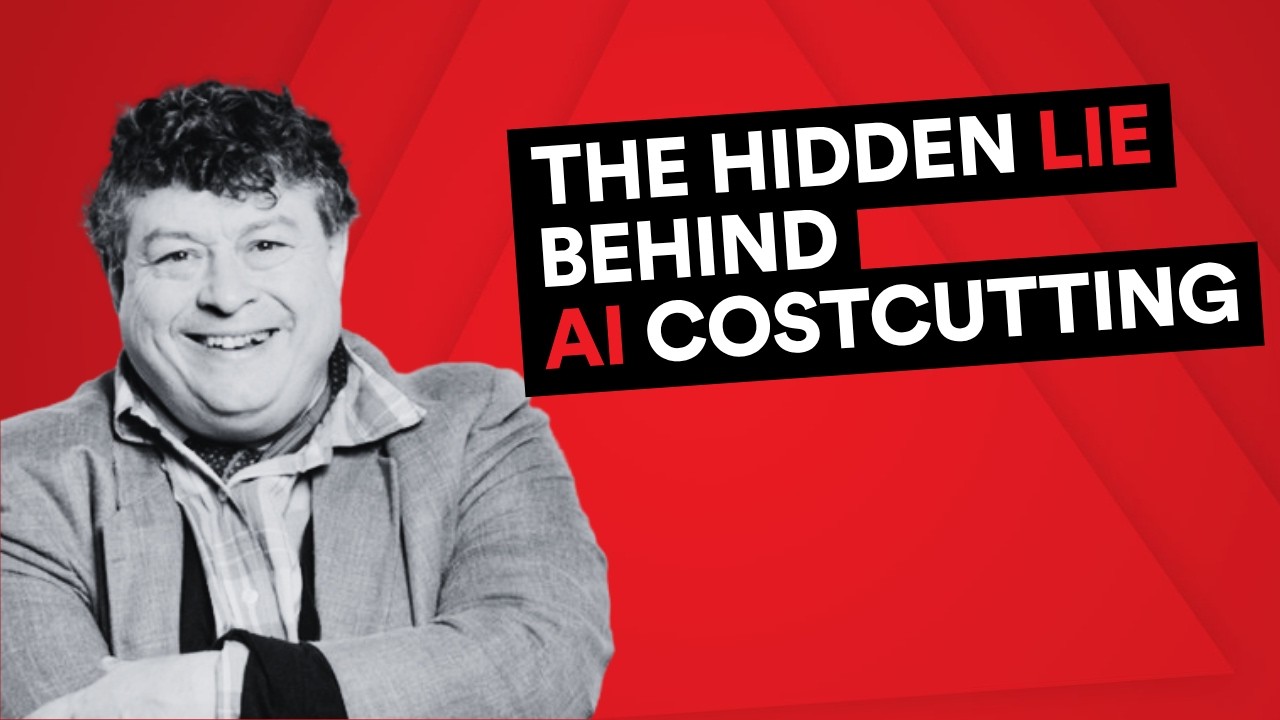
There is a fallacy at the center of modern business. It has no Wikipedia page. It was never written up in the Harvard Business Review. But it has probably destroyed more value than any single act of corporate malfeasance in the last thirty years. Rory Sutherland, Vice Chairman of Ogilvy UK and the closest thing advertising has to a philosopher-king, calls it the Doorman Fallacy — and in a characteristically brilliant and unsettling talk, he deploys it as the lens through which to understand what is about to happen to AI.
The setup is deceptively simple. A consultant walks into a hotel. They ask how much the hotel pays its doorman. They learn it is somewhere in the low six figures. They observe — entirely accurately — that a doorman's stated job is to open a door. They replace the doorman with an automatic revolving mechanism. They claim the cost savings. They walk away. And no one — no one — holds them responsible for what happens next.
You replace the doorman with an automatic door opening mechanism. You lay claim to all the cost savings that result, and you walk away not being held remotely responsible for any of the value destroyed.
— Rory SutherlandWhat happens next, of course, is this: the hotel's rack rate falls. The most regular guests defect. Vagrants sleep in the lobby. The doorman — who was, in reality, a concierge, a security officer, a social buffer, a human face — has been priced at zero because his role was defined as purely mechanical. The door was the function. Everything else was invisible. And what can't be seen can't be saved.
Sutherland is not being nostalgic. He is being precise. Because the same trick, he argues, is about to be played on an almost unimaginable scale.
The AI Bill Is Coming Due
The conceit of Sutherland's 2026 predictions is that the economics of AI have created a structural pressure that will distort how the technology is sold. Vast, almost incomprehensible sums of money have been spent building these systems. At some point, that investment must be recouped. And the easiest way to sell anything to a business, Sutherland notes with evident weariness, is to frame it as cost reduction.
"Most businesses," he says, "only have two principal modes: cost reduction and regulatory paranoia." The result is that tech companies and their consulting firm partners — what Sutherland cheerfully calls "their running dog lackeys" — will sell AI primarily as a headcount reduction tool. It is, after all, the most legible pitch. It fits on a slide. It satisfies a finance team. It clears procurement.
The self-checkout till is his proof of concept. When first introduced, self-checkout was a genuine improvement for a specific use case: a customer in a hurry, with a handful of items, who would rather not queue. An option. A useful option. Then someone in finance noticed that getting the customer to do the work was cheaper than hiring a till operative. And so the option became an obligation. And then the problems arrived.
- Shrinkage exploded: supermarkets were recording more onions sold than purchased, because customers scanned avocados at the onion price
- Large family shops became practically impossible — you need three hands to scan and bag simultaneously
- The "gain share" consultants who recommended the rollout were never held responsible for the shoplifting epidemic that followed
- The finance team booked the cost savings; nobody booked the value destruction
This, Sutherland insists, is the architecture of the problem. People in "gain share agreements" — where consultancies take a percentage of identified cost savings — have every incentive to find cost savings and zero incentive to protect the value those savings eliminate. It is, structurally, a machine for the Doorman Fallacy.
Two Schools, One Spreadsheet, and a Philosophy Problem
To understand why this keeps happening, Sutherland takes us on a brief and decisive detour through the history of economic thought. There are, he argues, two fundamentally incompatible ways of understanding what a business is for.
The first is the Austrian school, associated with thinkers like Ludwig von Mises. In this tradition, value is inherently subjective. The worth of a thing is not in its production cost, but in how it is perceived and experienced. Marketing, under this view, is not a cost centre — it is a value creation engine. The person who sweeps the floor of the restaurant creates value just as much as the person who cooks the food, because they create the conditions under which the food can be fully appreciated.
There is no useful distinction be made in a restaurant between the value created by the man who cooks the food and the value created by the person who sweeps the floor.
— Ludwig von Mises (quoted by Rory Sutherland)The second is the Chicago school, the intellectual engine behind the shareholder value movement. In this model, consumers already know what they want. Their preferences are stable and transitive. They can perfectly price any good. Therefore the only valuable thing a business can do is deliver that good as cheaply as possible. Marketing is not value creation. It is a cost, to be minimized alongside all other costs.
The Chicago school won. Not because it is right — Sutherland finds it obviously absurd — but because it is calculable. It produces mathematical models that can be aggregated, forecast, and put on a spreadsheet. The Austrian school requires you to deal with abstract nouns like "trust" and "experience" and "perception," none of which cooperate with quarterly reporting.
Peter Drucker, long before any of this became fashionable, stated the alternative with uncomfortable clarity: "There are only two functions in business which add value: marketing and innovation. Everything else is a cost." It is a sentence that would be career-ending to utter in most boardrooms today. In Drucker's era, Sutherland notes, it was at least a tenable position. That is the scale of the intellectual retreat.
The Human Who Remembered You Were on Holiday
The Doorman Fallacy is not merely an abstraction. Sutherland's most disarming evidence is the most mundane: the Royal Mail postman.
His friend Alex Batchelor, once the marketing director of Royal Mail, spent significant sums trying to improve operational metrics — on-time delivery, reliability, geographic consistency. None of it moved brand perception. None of it. Researchers dug deeper and found something remarkable: there was no correlation between the reliability of postal service in a given area and how much people said they liked Royal Mail.
What did correlate? Whether people liked their postie.
You could have a pretty crappy service, but if the postie was the kind of guy who went — yeah, I knew you were on holiday, so I left it in the back porch — you thought it was the most brilliant organization in the world. You could have a fantastically efficient postal service. And if your postie was a bit of a bastard, you didn't like it.
— Rory SutherlandThe human is the brand. The human is the product. And yet the human is always, structurally, the most expensive line item and therefore the first to go.
Sutherland extends this to an observation that should be uncomfortable for every digital marketing strategist in the room: an online travel agent's website converts at approximately 0.5%. When someone picks up the phone, conversion jumps to around 30%. The instinct of the efficiency-minded business, naturally, is to drive all customers online and hide the telephone number. The number — the inconvenient, staffing-cost-implying number — disappears from the website. Sixty times more effective, rendered invisible by a logic that can't account for it.
The Three Phases of Every Technology
So where does AI go from here? Sutherland is not a fatalist. He charts a course through three distinct phases, illustrated with a history lesson about the electric motor that is one of the most clarifying things anyone has said about technology adoption in years.
When the electric motor was invented, factories already had their operational logic: a massive steam engine at one end, enormous rotating shafts through the building, everything running off a single power source. The first response was to replace the steam engine with an electric motor. The gains were essentially trivial. Why? Because the architecture was wrong. The electric motor's revolutionary property — that small motors are excellent — was being squandered inside a large-motor infrastructure.
Only when factories were completely rethought from first principles — every machine with its own small motor, turned off when not needed, placed where it actually needed to be — did the technology deliver its full transformation.
Phase One
Same but cheaper. Replace the steam engine with an electric motor. Use AI to cut headcount. Claim the savings. Ignore the value destruction. This is where we are.
Phase Two
Same but better. Use AI to improve customer experience rather than eliminate it. Family-owned businesses and founder-led firms are the most likely to discover this phase first.
Phase Three
Reinvent altogether. When the cost of producing content collapses, does it still make sense to wait for a client brief? Or do you build speculatively and go find the buyer?
His prediction for 2026 is that we are firmly in Phase One, with Phase Two becoming visible at the edges — and that the institutions most likely to reach Phase Two first are those insulated from the tyranny of quarterly reporting. Four of the five 2024 IPA Advertising Effectiveness Award winners, Sutherland notes with pointed emphasis, were family-owned businesses: McCain, Waitrose, Yorkshire Tea, and Specsavers. The fifth was Guinness. Public companies, strangled by EBITDA targets and investor calls, simply cannot play on a timescale that allows real marketing to compound.
The Cannes Trade Fair and the Proactive Agency
Sutherland's most imaginative prediction — the one that might actually terrify agency holding companies if they took it seriously — is about Cannes Lions.
The logic runs like this. When Josiah Wedgwood industrialized pottery, he confronted a question his predecessors had never needed to ask: should we wait for a rich patron to commission a dinner service, or should we produce dinner services speculatively and go out and find buyers? He chose the latter, and invented modern marketing in the process.
The Fabergé model — bespoke, commissioned, one client at a time — was replaced by the Wedgwood model: produce at scale, then find the market. If AI collapses the cost of content production, Sutherland asks, why would ad agencies continue operating on the Fabergé model? Why not produce great creative work speculatively, and then take it to a brand?
Some social media celebrities, he observes, are already there. Creators who approach KFC and say, "We've already made this funny thing; want to buy it?" rather than waiting for a brief, a strategy document, and three rounds of approval. In this world, Cannes Lions becomes not a retrospective awards ceremony but a trade fair — the TV festival model, where formats are bought and sold, not eulogized. "We've got this content. Do you want to buy it?"
Sell How You Think, Not What You Do
Sutherland ends with what he calls a tip, though it functions more as a manifesto. He stumbled upon it accidentally, when forced to speak to audiences outside the marketing world and unable to rely on the familiar lexicon of campaigns and conversions.
The discovery: when you stop selling what marketing does and start selling how marketers think, the market is a hundred times larger and infinitely more lucrative.
The real value of marketers and marketing is how they think. If you don't have a marketer present in the room, engineers — utterly rational people — can make utterly stupid decisions, because they're not looking at it from the consumer's point of view.
— Rory SutherlandHis illustration is the Concorde. An engineering triumph of almost sublime ambition — but built, assembled, and flown by engineers who never once asked a question that a marketer would have asked on day one. The Concorde flying west is one of the great experiences of human travel: you leave London at nine in the morning and arrive in New York before breakfast, moving faster than the Earth rotates. The Concorde flying east is a different proposition entirely: you must stay an extra night in New York, rise early, spend your entire working day in the air, and land in London at six in the evening, exhausted and indignant.
The metrics — speed, fuel efficiency, passenger capacity, range — were all optimized. The human experience of the return journey was never considered. This is what happens, Sutherland argues, in every room where there is no one trained to ask: but what does this feel like to the person experiencing it?
What Sutherland calls Mark Ritson's "180-degree flip" — seeing the problem from an angle that no one else in the organization has thought to adopt — is not a deliverable. It cannot be produced, scoped, or invoiced. It is a way of being in a conversation. And it is, he insists, the most valuable and most undersold thing that marketers possess.
- The doorman's job is not to open the door
- What can't be measured will be cut — and that's exactly what matters most
- Different is better than better
- The human element of any service experience trumps everything else
- Stop selling what you do. Sell how you think.
The Slightly Pessimistic Optimist
What makes Sutherland's talk remarkable — beyond the density of ideas per minute, which rivals almost anyone working in this space — is the structural honesty of his pessimism. He does not predict that the Doorman Fallacy will win forever. He predicts it will win first, as it always does. Cost reduction is the easiest message to sell. It is also the message most likely to be catastrophically wrong in ways that manifest slowly, invisibly, and in someone else's budget cycle.
The hotel discovers, five years on, that it has no guests. The supermarket discovers it has no onions. The airline discovers that no one wants to come home. And the consultants who sold the savings have long since moved on to the next hotel, the next supermarket, the next airline.
The prediction for 2026 is not that AI will destroy value. It is that AI will be sold in a way that destroys value — because that is the only way that fits the reigning philosophy of what a business is for. The Austrian school of economics, with its insistence on subjectivity and human experience and the irreducible importance of the person who sweeps the floor, will lose the first round. It always does. It doesn't fit on a spreadsheet.
But here is what Sutherland knows, and what the spreadsheet cannot capture: the businesses that survive Phase One and reach Phase Two will be the ones that kept a marketer in the room. The ones that asked, not just "is this cheaper?" but "is this better to experience?" The ones that knew, before anyone could measure it, that the most important variable was whether the customer liked the postie.
The doorman has left the building. Whether it comes back — and in what form — is the defining question of 2026. Rory Sutherland is placing his bets on human perception winning, eventually. He just doesn't expect it to win first.
Watch the full video: youtube.com/watch?v=6SXCJhqXubU