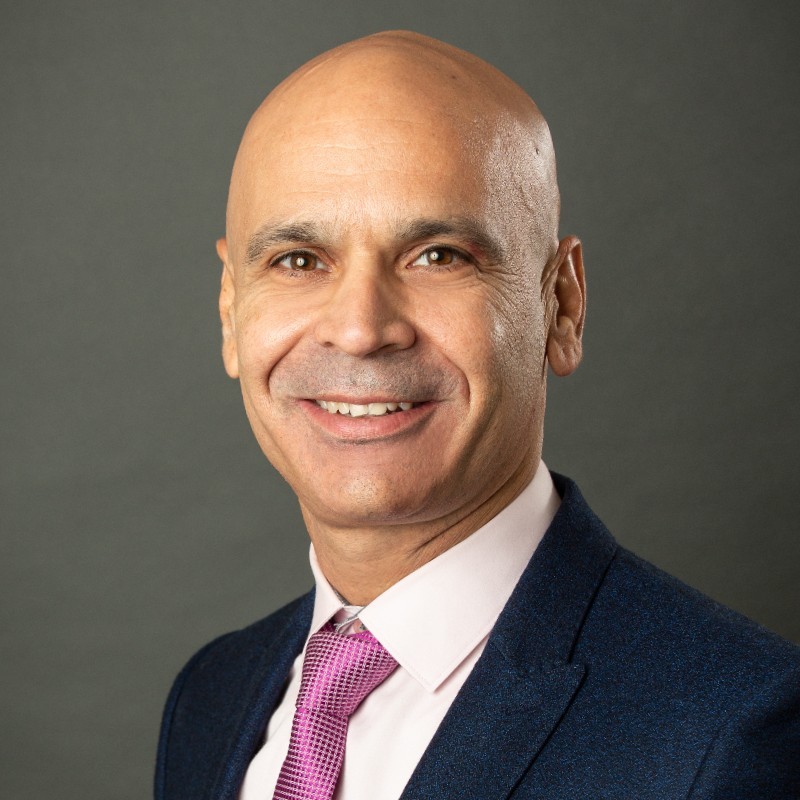
The man selling trust in a medium designed without it
Email, Rom Hendler likes to point out, was never built to be safe. "Email is a problem because of how it was designed originally," he says. "When you send an email, it goes through many different interception points." That single sentence is the foundation of a company. Trustifi, the business he co-founded and now runs as CEO, exists to patch a 50-year-old design flaw that the entire working world still leans on every morning.
The strange part is who chose to fix it. Hendler did not arrive from a packet-sniffing background or a stint at a three-letter agency. He arrived from the casino floor. For most of the 2000s he marketed integrated resorts - VP of Strategic Marketing at The Venetian and The Palazzo, then Chief Marketing Officer at Las Vegas Sands Corp., one of the largest casino operators on the planet. His job was to make millions of people feel something about a building. It turns out that is excellent training for getting people to actually use security software.
Because that is Hendler's real heresy. In an industry that has spent two decades calling the end-user "the weakest link," he says the opposite. "My people are my strength, my people are my greatest asset, I'm there to empower them." He builds for the person clicking the button, not the analyst watching the dashboard. "The more people use the platform, the more secure you are, because people are more engaged." Adoption, in his telling, is not a marketing metric. It is a security control.
"You want to protect everybody in your organization. If you're not going to protect everyone, you're going to be vulnerable."
A resume that reads like a wrong turn that wasn't
Look at the path on paper and it shouldn't work. A B.Sc. in Food & Beverage Management and Nutrition from the Hebrew University of Jerusalem. An MBA in International Hospitality Management from IMHI, the joint Cornell University and ESSEC Business School program. He studied menus before he ever studied malware. Then came the resorts, then a swerve into technology: from 2016 he ran Innovel, an open-innovation center scouting emerging travel tech, a role that rewarded one specific instinct - spotting a technology before the market agrees it matters.
That instinct is the through-line. Hospitality taught him the customer. Innovel taught him the frontier. Trustifi is where the two collide: a frontier technology built with a hospitality obsession for the customer's experience. He didn't abandon the casino career. He smuggled its best lesson into cybersecurity.
Trustifi reflects its founder's geography, too. It is a US company with its research and development team based in Israel - the same US-Israel axis Hendler has worked across his whole career, and the same axis that produced a disproportionate share of the world's security companies.
One vendor, the whole problem
Most email security tools guard the front door and ignore the back. Hendler's argument is that you cannot do half the job. "If you want to look at comprehensive email security, you should start with encryption and securing outbound email," he says - an unusual order of operations in a market obsessed with blocking inbound phishing. Trustifi sells the full stack from a single vendor: inbound threat detection, outbound encryption, data loss prevention, and security awareness training. The pitch to the buyer is blunt - stop stitching four products together.
His read on the threat is equally specific. On the rise of impersonation and business-email-compromise attacks, he reduces it to a single variable: "When you look at impersonation, it's all about timing." The fake invoice that lands the hour before a real one. The CEO request that arrives while the CEO is on a plane. Hendler's answer is machine learning that watches for the moment, not just the message - because, as he puts it, "if you want to combat those really sophisticated attacks, without blocking a lot of legitimate emails," you need AI doing the watching.
"The more people use the platform, the more secure you are, because people are more engaged."
The year the market agreed
In June 2025, Trustifi closed a $25M Series A led by Camber Partners, the New York growth-equity firm that backs B2B SaaS companies hitting their scale-up phase. It pushed the company's total funding to roughly $46M. Hendler's framing of the deal was characteristically about the partnership, not the headline number: "We are eager to partner with Camber for the chapter ahead. This investment reinforces the strength of our technology and the exceptional value we provide our customers and partners." Camber's Justin Johnson put the bet plainly - that Trustifi could "become the leading email security platform for MSPs."
That MSP focus is the quiet strategy. Managed service providers resell security to the small and mid-sized businesses that can't afford their own security teams - exactly the organizations most likely to be hit and least likely to survive it. By winning the channel, Hendler reaches thousands of companies he'll never sell to directly. It's also why his name keeps appearing on CRN's Channel Chiefs list, four consecutive years and counting - an industry award for the executives who make the partner ecosystem work.
What he's actually betting on
Hendler is candid that the problem he's chosen does not have an expiration date. "Email will continue to be a very important and pivotal tool in the day-to-day work environment and, therefore, email attacks will continue." It's a strange thing for a founder to admit - that the threat outlives any one fix - but it's also the most honest sales pitch in security. He isn't promising to end the war. He's building "an extra arm of your security team," one that keeps researching and improving to stay a step ahead.
And as attackers reach for generative AI to write flawless phishing at scale, his thesis hardens: the only thing that fights AI-generated attacks is AI-powered defense, paired with humans who actually want to participate. The casino marketer who learned to make people care about a building now has a harder product to sell - caution - and the same trick for selling it. Make it something people want to use. The whole company is a wager that security works best when it stops treating people as the problem.
In His Own WordsEmail is a problem because of how it was designed originally. When you send an email, it goes through many different interception points.
My people are my strength, my people are my greatest asset, I'm there to empower them.
When you look at impersonation, it's all about timing.
Email will continue to be a very important and pivotal tool... and therefore email attacks will continue.