The first useful thing Risa Heller does in a crisis is ruin the fantasy. The damaging story probably cannot be made to disappear. The reporter cannot be wished into another profession. The internet, having developed an appetite, will not suddenly order the salad. Her clients may arrive hoping for a trapdoor. Heller offers a chair, a set of questions and a demand for the whole truth.
Jeff Zucker learned the method in January 2022, on the eve of his departure as president of CNN. He had not met Heller before she entered his apartment. She put down her coffee, took command of the room and spent much of the next 72 hours in his kitchen. Later, Zucker described her rule: tell her everything, however bad it is, and she will not lie to the press.
That kitchen is a useful place to begin. Crisis communications can sound abstract when described in conference rooms. In practice it is intimate, caffeinated and inconvenient. A stranger arrives just as the walls feel least private. She asks for the facts, explains which questions will come next, and stays while the public version of a life changes outside.
A gossip with a graduate degree
Heller grew up in West Bloomfield, Michigan, outside Detroit. Her father was a lawyer and her mother taught special education. She has supplied the childhood foreshadowing herself: in high school, she said, she was “obviously the class gossip.” There are less sociable ways to become interested in information, but few as efficient.
At the University of Michigan she double majored in psychology and Hebrew and Jewish cultural studies, graduating in 2001. She later earned a master’s degree in communications from Johns Hopkins. The neat academic sequence disguises a bumpier beginning. After Michigan she could not land a job. Then a former roommate happened to sit on an airplane beside the head of the Anti-Defamation League’s Washington office and mentioned Heller’s search. An internship followed. Luck opened the door; appetite kept her moving.
University of Michigan graduate; an airplane introduction leads to an ADL internship in Washington.
Press secretary and communications director in Chuck Schumer’s New York operation.
Global Strategy Group, followed by the communications director role for Governor David Paterson.
Launches Risa Heller Communications before turning 30.
The firm opens in Los Angeles, extending the ambition Heller had discussed a year earlier.
After the ADL came Representative Jane Harman, then Senator Chuck Schumer’s New York press shop. Schumer’s operation was a school conducted at the speed of the morning news cycle. Heller explained the timing in 2007 with the clarity of someone who had missed enough breakfasts: know the plan at 7:30 a.m., have the material ready at 10, and understand that by noon the opportunity may belong to tomorrow.
The larger lesson arrived after she picked a fight with a reporter over a story that mentioned Schumer’s family. Heller reached the office early, told her boss she had already called the writer and unloaded, and expected approval. Schumer told her to call back and apologize. She resisted. He explained the arithmetic: she needed the reporter more than the reporter needed her. Heller made the call.
“It’s never occurred to me that I shouldn’t tell a powerful person that they’re wrong.”Risa Heller
That sentence contains both the privilege and the utility of her education. Schumer was a powerful boss who allowed young aides to shout back. Heller learned that candor could travel upward, and later made a business of bringing it into rooms where very few people feel free to use it.
No trapdoor, no unicorn
At 27, she left Schumer for Global Strategy Group. Soon after, Eliot Spitzer resigned as governor and David Paterson inherited Albany during a ferocious stretch of state politics and the Great Recession. Heller became Paterson’s communications director. She lasted a year, took time away and sampled the idea of corporate work. It seemed boring. She wanted, among other things, to learn how to cook a chicken.
In 2010, before turning 30, she founded her own firm. The following year brought its first defining crisis assignment, advising then-Congressman Anthony Weiner. Friends warned that the association could end her career. He was an old friend, she said, and she would not leave him in the lurch. Whether one admires that loyalty or questions its object, the impulse became central to her public account of the work: people call at their lowest moments, and she listens for whether there is a story that can honestly be told.
Her method is less mystical than the fixer label suggests. Gather the facts quickly. Correct what is wrong. Anticipate what else a reporter may find. Map the likely reactions from employees, investors and other audiences. Explain to the client how journalism works. Then decide whether to apologize, lie low, answer directly or push back.
Clients often ask her to kill a story. Heller compares that outcome to a unicorn. If a report is fundamentally false, perhaps it can be stopped. Usually it cannot. What she can do is add context, supply omitted facts and find the argument that matters to a particular reporter. In one favorite illustration, she points to a clear cup and proposes a debate over whether it is blue. She is game for the argument. Sometimes the exchange is pleasant. Sometimes it is a fight. The cup remains clear.
The boundary she describes is equally plain: she will not lie to journalists. That standard does not settle every ethical question around crisis work, and her roster has repeatedly invited hard questions. Heller has acknowledged that instinct can fail. Asked about an earlier client she would not represent with the benefit of later knowledge, she did not pretend otherwise. A gut can be mostly right and still be wrong when it matters.
The relationship after the argument
Heller’s competitive advantage may be her refusal to treat a disagreement as a permanent divorce. She can press a reporter hard, call an editor, and still remain part of that reporter’s social orbit. Journalists have sought her career advice, brought her newsroom gossip and, in one case, consulted her before putting down a deposit on a wedding dress. The closeness carries obvious tension. It also reveals the old Schumer lesson in adult form: a story ends; the relationship walks into the next news cycle.
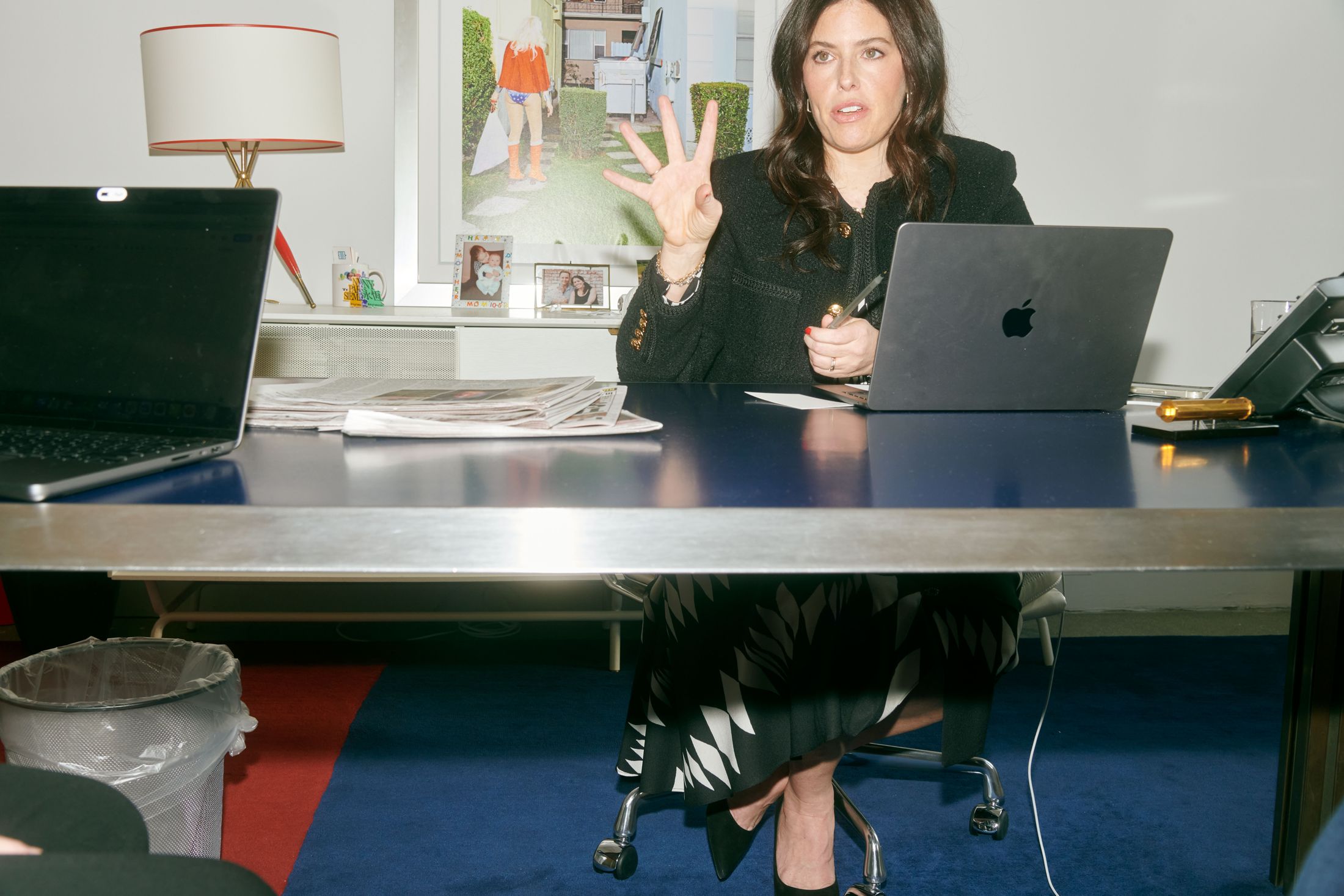
Her office makes the philosophy visible. In the Woolworth Building, she surrounded herself with newspapers, a battered yellow New York Post box and a miniature newsstand filled with tiny scandalous covers. A golden gnome raised its middle finger from a side table. A framed Wonder Woman took out the trash. “It speaks to me,” Heller said of the last image, which may be the least expensive accurate illustration of crisis work ever commissioned.
The scene is combative but also playful. HELLER has staged an annual cookie-baking contest with employees as bakers and figures from media and city politics as judges. Heller hosted a book party for Maggie Haberman and joked in her speech that she had never won even the smallest argument with the reporter. At home, she and her husband, fellow communications executive Ryan Toohey, told an interviewer in perfect unison that she never tries to spin him. They had, however, fought over the correct construction of a tuna melt. Heller pointed to herself when asked who won.
“If a story is knotty, I always want to work on it.”Risa Heller
By 2023, she was saying she wanted more Los Angeles business and hoped to open an office there. In May 2024, the firm did it, hiring former Netflix communications executive Erika Masonhall to lead the operation. HELLER now presents itself across six practices, from crisis and reputation work to litigation, public affairs, corporate communications, real estate and media. Chambers lists Heller in its nationwide litigation communications rankings. The company biography has grown more sober than the office gnome, but the founding taste remains: complex situations, visible stakes, little time.
The easy caricature of a crisis adviser is a dealer in fog. Heller’s more interesting role is translator. The client sees catastrophe, the journalist sees a story, the public sees a headline, and each believes the others understand more than they do. Her job is to make the machinery legible while the gears are turning. She explains why the source will stay anonymous, why the correction matters, why a defense that feels satisfying may sound disastrous, and why authenticity cannot be manufactured between lunch and deadline.
Her career began with chance, matured through argument and became a firm through repetition. Get the facts. Read the room. Tell the powerful person when the powerful person is wrong. Call the reporter back tomorrow. There is no trapdoor. There is only the next call, the next question, and the decision not to leave before the story stops shaking.