YesPress Profile / The Dealmaker
Richard Law
He started by computing the shapes of molecules. Now he negotiates the future of the genome's dark matter.
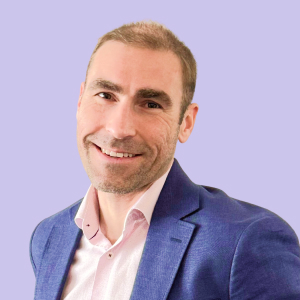
He started by computing the shapes of molecules. Now he negotiates the future of the genome's dark matter.
In March 2025, Richard Law walked away from one of the most talked-about stories in AI drug discovery. He had just helped merge Exscientia with Recursion Pharmaceuticals - a deal that fused two of the field's loudest names. His next move was not to a bigger stage. It was to HAYA Therapeutics, a Swiss-American biotech with roughly 67 employees and a thesis most of the industry had spent decades ignoring: that the so-called "junk" between our genes is where disease actually gets decided.
The protein-coding part of the human genome - the part everyone studies - is about 2%. The rest, long dismissed as filler, is what HAYA calls the regulatory or "dark" genome. Law's bet is that the instructions hidden there can be read, targeted, and rewritten. Weeks after he joined, HAYA closed a $65 million Series A. He has a habit of arriving right before the interesting part.
At HAYA, Law's title is Chief Business Officer. The real job is harder to put on a card: take a platform built on long non-coding RNAs and the dark genome - language that makes most investors blink - and turn it into partnerships, funding, and a path to patients.
It is a translation problem, and Law is unusually equipped for it. Few executives can hold both halves of the conversation at once. He has a PhD in molecular biophysics and a career that began at a lab bench. He also has an MBA and a Rolodex that includes some of the largest pharmaceutical companies on earth. When a scientist explains a regulatory RNA, he understands it. When an investor wants a term sheet, he speaks that too.
HAYA's lead candidate, HTX-001, is a precision therapy aimed at cardiac fibrosis and heart failure - starting with non-obstructive hypertrophic cardiomyopathy. In May 2026, the first cohort was dosed in its Phase 1 trial. Law's work is the connective tissue that keeps capital and collaboration flowing while the science moves toward the clinic.
For years, the genome's non-coding regions were treated as background noise. HAYA treats them as a control panel - regulatory RNAs that tell cells which state to adopt, and which to abandon.
Grey: ~2% protein-coding. Yellow: the regulatory genome HAYA targets with RNA-guided medicines.
Most executives start in business and reach for the science. Law started in the science and reached for the deals.
At Exscientia he opened doors to BMS, Sanofi, Merck Darmstadt, EQRX, and the Gates Foundation. Names that do not return calls from companies they do not trust.
He helped take Exscientia public on Nasdaq in 2021 - one of the era's marquee AI-drug-discovery listings.
In 2024 he led the combination with Recursion Pharmaceuticals, fusing two flagship platforms into one.
More than ten years at Evotec, climbing from computational chemistry into the business development seat - learning both languages.
He oversaw Exscientia's purchase of Allcyte, folding new capability into the platform.
He left the merger headlines to join a 67-person startup - and a $65M round followed within weeks.
Law's education reads like a deliberate plan to become bilingual - fluent in both the chemistry and the capital.
He earned a B.Sc. in Biochemistry and a Ph.D. in Molecular Biophysics from the University of Oxford. That is the bench credential - the part that lets him sit across from a research team and follow the conversation past the first slide.
Then came an MBA from Imperial College London. That is the boardroom credential. Together they explain why he keeps landing in the chief business officer seat at companies whose science is dense enough to scare off generalist dealmakers.
B.Sc. Biochemistry & Ph.D. Molecular Biophysics
MBA
The goal is plain: turn dark-genome science into deals that reach the people who need the medicine. Everything else - the IPOs, the mergers, the term sheets - is just the machinery that gets it there.