YesPress Profile / Agtech
Ricardo
Ricardo
Garcia de Alba
He taught detergent how to smell. Now he is teaching crops how to remember.
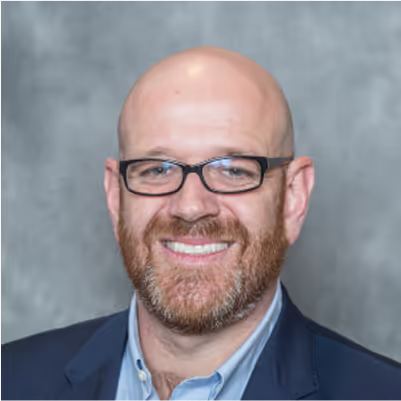 The CEO who edits chromosomes and keeps bees.
He taught detergent how to smell. Now he is teaching crops how to remember.
The CEO who edits chromosomes and keeps bees.
Ricardo Garcia de Alba runs a company that does not insert foreign genes into plants. It convinces plants to reshuffle the genes they already have. Meiogenix, where he became President and CEO in 2024, builds chromosome-editing and targeted-recombination technology that nudges the natural mixing that happens during plant reproduction - the same shuffle that has produced every variety humans have ever eaten, only aimed and accelerated.
The pitch is deceptively simple. Decades of breeding for yield and shelf life quietly discarded traits - flavor, disease resistance, resilience - that still sit, dormant, in a crop's genome and its wild relatives. His job is to put those back on the table for breeders. "Targeted recombination can unlock diversity that would be otherwise unavailable to breeders," he says. The rest is logistics, science, and patience.
"Healthy, natural, nutritious and tasty food - for generations to come."
- Ricardo Garcia de Alba, on what Meiogenix is actually for
Before the merger integrations and the global portfolios, there was a boy from Mexico City spending time on a family ranch in Jalisco, learning how animals are fed and how crops stay healthy. That early, hands-in-the-dirt curiosity is the thread. It pointed him toward chemical engineering at Universidad Iberoamericana, and chemical engineering pointed him, eventually, at everything else.
The everything-else is unusually wide. At Procter & Gamble he climbed to R&D Manager for Latin America, then crossed the Atlantic to lead the global perfume process team from the United Kingdom - the chemistry of how detergent smells. That work threw off scent technology generating more than $20 million a year in patent-related sales. It is not the resume line you expect from an agriculture CEO, which is rather the point.
He also took missionary sabbaticals early on, a detail that explains a lot about the boards he sits on now. The instinct to teach and to serve never left; it just took turns showing up alongside the spreadsheets.
In 2009 he joined DuPont as Pioneer Business Director for Northern Latin America, running the seed business unit. When DowDuPont split into pieces, he helped fuse three separate businesses into what became Corteva Agriscience - and helped develop and launch the Enlist weed-control system, one of the most pivotal technologies the row-crop market has seen. Then, after 15 years, he left to bet on something smaller and stranger.
Conventional breeding is patient and random. GMO is fast but foreign. Meiogenix aims for a third lane: take the genetic shuffle a plant performs naturally during reproduction, and point it where breeders want it to go - in both monocots like rice and dicots.
Flavor, disease resistance and resilience often survive in wild relatives and old varieties, locked beside undesirable genes.
Chromosome-editing tools direct natural recombination to specific spots, separating good traits from the bad they were tangled with.
What once took many seasons of luck becomes a faster, repeatable route to better varieties - more biodiversity, not less.
Illustrative of Meiogenix's stated approach - directional, not laboratory measurements.
He reads the world through molecules and process. Whether the product is a detergent scent or a crop trait, the question is the same: what is the chemistry, and how does it scale?
Mergers, multi-country portfolios, three businesses fused into one. He has spent a career making complicated things work together - useful when your product is biology and your customers are breeders.
Boards at the Children's Museum of Indianapolis and the Indiana Latino Institute; STEM outreach for underrepresented students. The missionary sabbaticals were not a phase.
I am grateful to join an organization with innovation that has such extraordinary potential, having been so successfully developed by a top-performing team.
Targeted recombination can unlock diversity that would be otherwise unavailable to breeders.
We continue unlocking the natural diversity of plants for generations to come, to be able to have access to healthy, natural, nutritious and tasty food.
He is an avid beekeeper. The man who accelerates pollination-built diversity for a living keeps a hive of his own.
Before crops, he sold smell. His perfume-process chemistry earned more than $20 million a year in patent-related sales.
Five countries on the resume: the U.S., Mexico, Brazil, the U.K. and Spain. The accent travels well.
Three degrees, three institutions: Universidad Iberoamericana, Harvard, and MIT. Engineering to economics to an MBA.
The goal is generational: more flavor, more resilience, more biodiversity - put back into the crops we already grow.
- Where he is pointing Meiogenix next
Compiled from public sources. Facts verifiable; the bee is real.