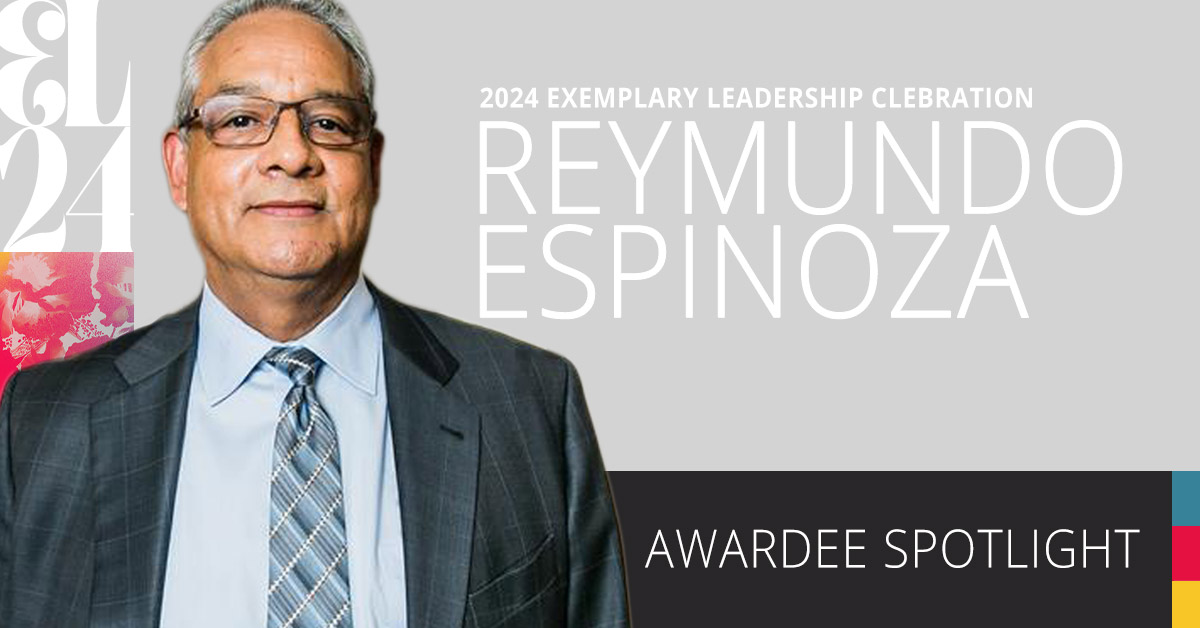
Reymundo C. Espinoza did not disrupt American health care. He showed up for it, every weekday, for thirty-seven years, in a building on East Virginia Street in San Jose. The story of the man is also the story of a clinic, and the clinic is older than half of Silicon Valley. Gardner Health Services was founded in 1967, in the middle of the Civil Rights movement, to serve Mexican farmworkers and cannery workers in the South Bay. When Espinoza walked in as Executive Director in May 1986, it was modest, scrappy, and underfunded. When he walked out as CEO in October 2023, it was operating ten sites, two mobile clinics, a $90 million budget, and a patient roster that had passed 46,000 souls. Ninety percent of them lived at or below 150 percent of the federal poverty line.
His resume reads like a quiet rebuttal to every assumption Silicon Valley likes to make about leadership. Bachelor of Arts in Political Science from Stanford. Master of Public Health, specializing in Hospital Administration, from UC Berkeley, class of 1975. He did not pivot. He did not raise. He did not sell. He picked a problem - access to care for low-income families in one corner of California - and refused to stop working on it for almost half a century.
The roots are in Coachella, the desert farming town outside Palm Springs. He was one of six children raised by a single father who worked the fields. The family had no margin for error and very little for grief. His mother was institutionalized when he was ten. A sister died at twenty. A younger brother at thirty-four. His father at sixty-five. Espinoza tells the story plainly, without ornament. The transformation, he says, took time. "It took me a lot to understand the challenges that I went through, so that I could basically convert that anger into something positive." That is the sentence the entire career rests on.
What he converted it into is infrastructure. Not the kind that ribbon cuts well. The kind that takes a generation to notice. Under his watch Gardner expanded into family medicine, pediatrics, OB-GYN, perinatal care, optometry, podiatry, dental, behavioral health, pharmacy, and homeless health services. Two mobile clinics that drove to people who could not drive to them. Programs for substance use treatment. Programs for unhoused families. WIC nutrition support. A diabetes management program. Telemedicine, eventually, when the world insisted on it. The line on the menu kept getting longer and the people who needed each line kept walking in.
He was also a builder of the scaffolding around the building. Espinoza is a co-founder of the California Primary Care Association, the trade body that represents community health centers across the state. He is a co-founder and board member of the Community Health Partnership of Santa Clara, and a member of the National Association of Community Health Centers. None of these are the kinds of organizations that fund parties. They are the kinds of organizations that fight for line items, negotiate with payers, train workforces, and keep federally qualified health centers from quietly disappearing.
If the public found out about him at all, it was late. In 2023 CBS Bay Area gave him the Jefferson Award Silver Medal, the regional honor for civic contribution. The Silicon Valley Business Journal handed him a Latinx Business Leadership Award the same year. The American Leadership Forum Silicon Valley followed in 2024 with the John W. Gardner Award, named for the LBJ-era cabinet secretary who basically invented the modern American nonprofit sector. None of it changed the cadence of his workday.
In October 2023 the board, chaired by Dr. Noe Lozano, announced that after a year-long search Rafael Vaquerano would succeed him. Espinoza moved into the CEO Emeritus role in January 2024. The handoff was, in his own words, the right one. "I am blessed," he said, "to have enjoyed a career in service to the hundreds of thousands of patients, clients, employees and community partnerships touched by Gardner Health Services." He added that "the conditions are precisely right to pass the baton." That is what a forty-eight-year operator sounds like when he is finally allowed to put the keys down.
The interesting question about Espinoza is not what he built. The numbers tell that. The interesting question is why he stayed. Silicon Valley pulled hard at every kind of executive for four decades, and most of them moved. He did not. The honest answer seems to be that he treated the work itself as the prize. He once described his measure of success this way: "I'm hoping we do that. I'm glad we're giving hope. I wish we could do more." There is no hedge in that sentence. There is also no exit.
Visit a Gardner clinic any weekday and you will see the institution he made. A young mother getting prenatal care in a language she actually speaks. A construction worker getting a tooth pulled before it ruins his week. A senior picking up a prescription she would otherwise ration. None of those moments cost the people inside them much money. All of them cost forty-eight years of someone refusing to look away. That someone, until very recently, was sitting in an office on East Virginia Street.
Espinoza's career also tracks the public health story of the South Bay in three acts. Act one, 1986 to roughly 2000, was triage and survival. Federal funding for community health centers expanded slowly, the state added Medicaid managed care, and Gardner had to grow up administratively just to keep the doors open. Act two, the 2000s and 2010s, was the long climb. New sites. New service lines. New funders. The Affordable Care Act, which finally let community clinics bill at sustainable rates. Act three, the pandemic, was the test. Gardner ran free COVID-19 testing and vaccination programs that reached thousands of low-income families when private systems were rationing slots. By the time the emergency ended, his organization had become a load-bearing pillar of the regional response, not a footnote to it.
The job did not change him much. The temperament is the same one his colleagues describe in his Stanford-era stories: soft-spoken, exacting, allergic to spotlights, generous with credit. He does not write op-eds. He does not appear on the podcast circuit. He spent thirty-seven years showing what one stubborn human can do with one zip code's worth of attention, and then he handed it to the next person.
Healthcare, in his telling, was never the point. "Health care," he likes to say, "is a means to another end, which is keeping people healthy so they can fulfill their dreams." It is the line that explains why a kid from a Coachella farmworker family with a Stanford degree did not go to Washington, or to a hospital board in Manhattan, or to a venture firm three miles up 101. The dreams he was protecting were the ones his own family did not get to fulfill. He spent his career making sure other people's did.