RFLX AI MARKET INTELLIGENCE•
SERIES B $30M LED BY GREYCROFT + IBKR•
FORMERLY TOGGLE AI•
KNOWLEDGE GRAPH BUILT FOR FINANCE•
ZERO-HALLUCINATION AI•
CUSTOMERS: MILLENNIUM, SOROS FUND MGMT•
BACKED BY DRUCKENMILLER & PETERFFY•
HQ: NEW YORK•
RFLX AI MARKET INTELLIGENCE•
SERIES B $30M LED BY GREYCROFT + IBKR•
FORMERLY TOGGLE AI•
KNOWLEDGE GRAPH BUILT FOR FINANCE•
ZERO-HALLUCINATION AI•
CUSTOMERS: MILLENNIUM, SOROS FUND MGMT•
BACKED BY DRUCKENMILLER & PETERFFY•
HQ: NEW YORK•
01Who they are now
A trading desk, minus the panic
It is 6:40 a.m. on a Tuesday in Midtown Manhattan. A portfolio manager has roughly twenty minutes before the market opens and a dozen questions that used to take a junior analyst all morning. Which of my holdings are exposed to that overnight supply-chain headline? What did the 10-K actually say about margins? If rates move 50 basis points, what breaks? Historically, the answer to all of these was the same: coffee, spreadsheets, and hope.
That morning now has a different shape. The questions go into Reflexivity in plain English. The answers come back in seconds, with the underlying filings and data points attached so the manager can check the work. No séance with a chatbot that confidently invents a number. No twelve browser tabs. Reflexivity, the New York fintech that used to be called Toggle AI, has quietly become the thing on the second monitor of people who manage serious money.
“We started Reflexivity to build the market platform I wished I had while managing a $15B global macro book.”
Jan Szilagyi, CEO & Co-Founder
What it does, in one breath: it takes institutional-grade financial data, wires it into a proprietary Knowledge Graph, and lets large language models answer hard investment questions on top of it - without making things up. That last clause is the entire business.
02The problem they saw
AI that lies is worse than no AI at all
Everyone in finance wanted to point a large language model at the market and ask it questions. There was one inconvenient detail: language models hallucinate. They produce a wrong number with the same calm confidence they produce a right one. In most industries that is an annoyance. In investing, where a fabricated figure can move real money, it is disqualifying.
The founders had lived the other side of this problem too. As working portfolio managers, they knew the daily friction was not a shortage of data - it was the opposite. Bloomberg here, a data vendor there, a stack of SEC filings nobody had time to read, and the genuinely useful relationships between all of it living only in an analyst's head. The information existed. Connecting it, in time to act, did not.
The skeptic's objection
- “Isn't this just ChatGPT with a finance logo?” - No. Open models train on the open internet. Reflexivity restricts its AI to curated, verified data sets, and links every answer back to a source.
- “Can I trust the output?” - That is precisely the question the product is designed around. The graph supplies the facts; the model only gets to reason over them.
So the central tension was set, and it has never really changed: give investors the speed of AI without the recklessness of it. Fast and wrong is easy. Fast and right is the whole game.
Open models will tell you a beautiful, confident, completely fictional earnings number. On a trading desk, that is not a feature.
The case for “zero hallucination”
03The founders' bet
Two macro guys and a theory named after Soros
Jan Szilagyi and Giuseppe Sette did not arrive from a coding bootcamp. They ran global macro together as co-Chief Investment Officers at the Swiss private bank Lombard Odier. Before that, Szilagyi managed money at Fortress Investment Group and - this is the detail people repeat at dinner parties - reportedly finished a Harvard Economics PhD in about two and a half years, under Ken Rogoff, which is said to be the fastest on record. Sette did time at Brevan Howard and Davidson Kempner, topped his class at Bain Italy, and picked up a Wharton MBA along the way.
CEO & Co-Founder
Jan Szilagyi
Former co-CIO of global macro at Lombard Odier and PM at Fortress. Holder of a famously fast Harvard Economics PhD. The guy who wanted the platform he never had.
President & Co-Founder
Giuseppe Sette
Co-CIO of global macro at Lombard Odier; alumnus of Brevan Howard, Davidson Kempner and Bain. Wharton MBA. The product's institutional conscience.
Their bet had two parts. First, that the people best placed to build investment AI were investors, not outsiders guessing at the workflow. Second, that the company should be named for an idea, not a gadget. They picked reflexivity - George Soros's notion that investors' perceptions of a market feed back into the market itself. It is a fitting flag for a company arguing that the tools you use to see the market quietly change how you move in it.
The rebrand from Toggle AI was not cosmetic. The original product had drifted toward retail investors; the new name marked a return to the institutions the founders came from, and to the harder, more lucrative problem of serving them.
The name nods to George Soros: what you believe about a market can change the market. So can the tools you use to read it.
On why “Reflexivity,” not “Toggle”
05The product
Six tools, one trustworthy spine
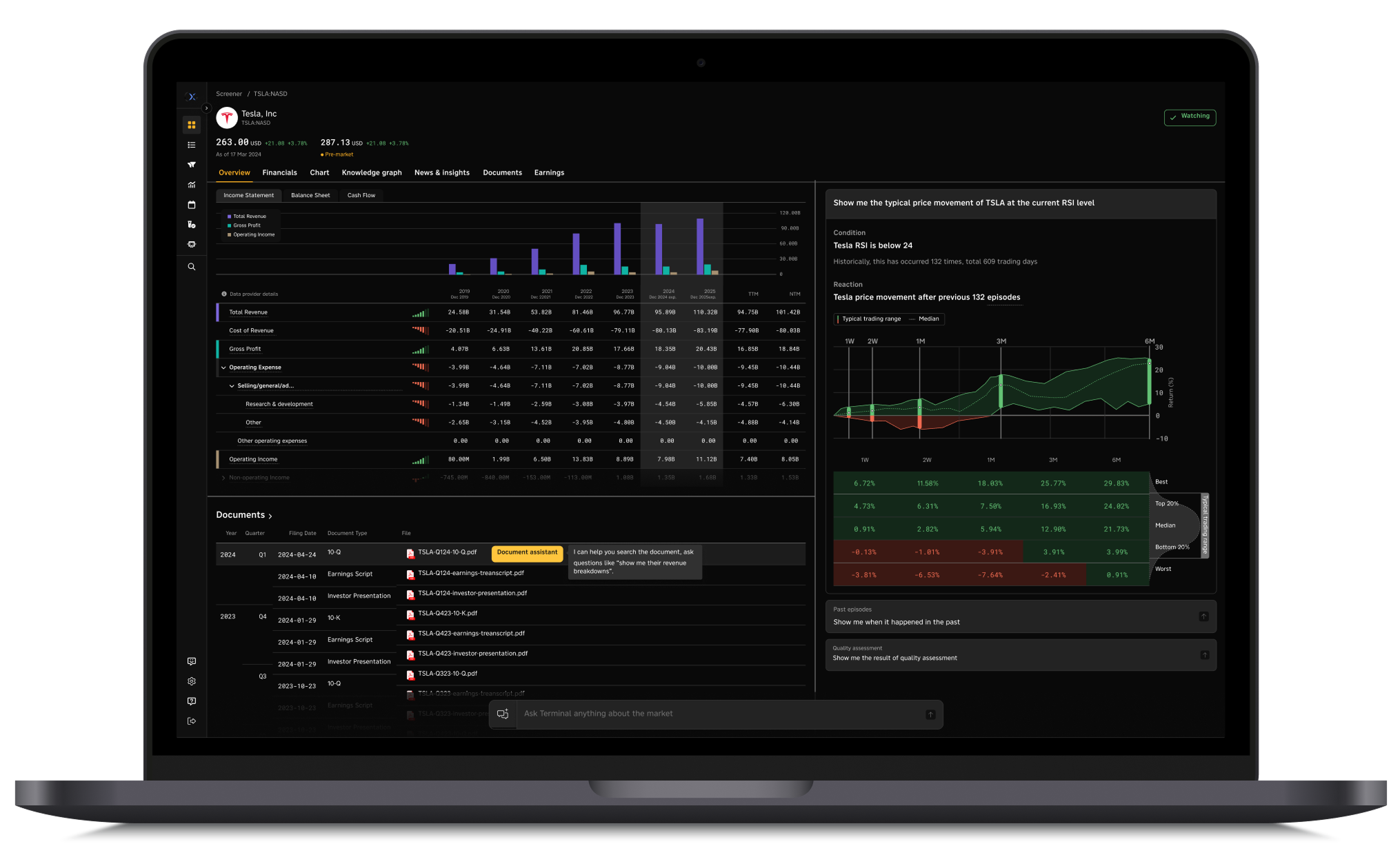
Underneath everything sits the Knowledge Graph: a map, built from the ground up for institutional finance, of how the market's pieces connect. Peers, suppliers, customers, partners, geographic exposure, thematic exposure - the relationships an experienced analyst carries in their head, made machine-readable and kept current as new SEC filings and earnings calls land. Reflexivity argues it is the only such graph built specifically for this job. The language model is not allowed to freelance; it reasons over the graph's verified facts.
Deep Research
Autonomous AI agents produce full financial analyses in minutes, not days.
Knowledge Graph
Maps hidden relationships between companies, themes and macro drivers in real time.
Portfolio Insights
Live performance attribution and risk metrics across a book.
Scenario Analysis
AI-powered simulations and stress tests for macro and idiosyncratic shocks.
Document Intelligence
Pulls and summarizes insight from filings and earnings transcripts.
Smart Screening
AI-driven discovery of opportunities across the market.
The data underneath is institutional by default - integrations with S&P Global, LSEG Datastream, Cboe and Nasdaq - which means customers do not have to assemble a wall of separate data contracts before they can ask a single question. For technology teams there is an API, so the same intelligence can flow into systems a firm already runs.
The analyst's instinct - this supplier matters to that stock - is no longer trapped in one person's notebook. It is in the graph, and it updates overnight.
What the Knowledge Graph really sells
06The proof
The receipts
A trust-first pitch is easy to make and hard to back. Reflexivity's evidence is its cap table and its customer list, which overlap in a way that is hard to fake. The October 2024 Series B - $30 million, led by Greycroft and Interactive Brokers - drew checks from Stanley Druckenmiller, Greg Coffey, Thomas Peterffy, General Catalyst and SoftBank's LatAm fund. These are people who evaluate market tools for a living, and they were buying.
The customers tell the same story. Reflexivity counts Millennium and Soros Fund Management among its users - firms that do not adopt research tools for the novelty. And the Interactive Brokers investment is also a distribution deal: IBKR has signaled it will weave Reflexivity's AI into its electronic trading platform, putting the tools where traders already research, monitor and execute.
The capital ramp
Disclosed funding by round (USD millions)
Druckenmiller, Coffey and Peterffy do not invest in vibes. They invest in tools they would put on their own desks.
On the cap table as a credential
07The mission
Trust, at the speed of the market
Strip away the funding and the famous backers and the mission is unglamorous in the best way: give the people who move markets AI they can rely on. Fast, explainable, grounded in verified data rather than guesswork. The team's worldview is that in finance, an answer you cannot check is not an answer - it is a liability with good grammar.
There is a larger ambition underneath. Szilagyi has argued publicly, including on CNBC, that AI will reshape and in places replace parts of the financial advisory role. Read generously, that is the company's real bet: that reliable market intelligence should not be a privilege reserved for the desks that can afford a small army of analysts. Start with the institutions, prove the trust, then let it spread - eventually, through a partner like Interactive Brokers, toward the individual investor too.
Faster Insights. Better Analysis. Greater Confidence.
Reflexivity, in four words
08Why it matters tomorrow
Back to 6:40 a.m.
Return to that Midtown morning. The market still opens at 9:30, the headlines still arrive overnight, and the questions are no smaller. What changed is the gap between question and action. The manager who once spent the morning assembling context now spends it deciding what to do with context already assembled - and, crucially, can click straight through to the filing that backs each claim.
That is the quiet shift Reflexivity is betting on. Not AI that thinks for you, but AI that does the gathering and the connecting, then shows its work so you can think faster. If they are right, "I'll have the analyst look into it" stops being a sentence anyone says before lunch. The coffee is still there. The panic, increasingly, is optional.