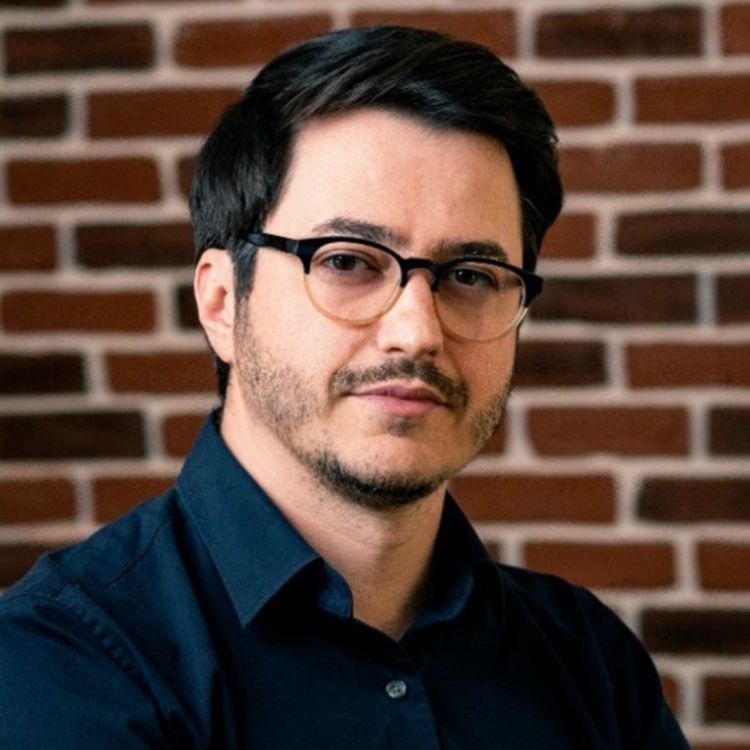
A company that recognizes you by the way you type
Press three keys on a login form and TypingDNA already has an opinion about whether you are who you say you are. The dwell time on each key. The flight between them. The micro-hesitations you have never noticed and could not fake if you tried. Raul Popa took that invisible rhythm and turned it into an authentication API now used by banks, insurers, and online-exam proctors who need to know a human, the right human, is on the other end of the keyboard.
The pitch sounds like a parlor trick. The math is not. TypingDNA's engine claims better than 99% accuracy, climbing to 99.9% once it has watched you type enough to learn your habits. In 2018 the European Banking Authority blessed keystroke dynamics as a legitimate factor for Strong Customer Authentication under PSD2 - which is the regulatory way of saying your typing counts as something you are, right alongside a face or a fingerprint.
Popa is the unlikely figure behind it: a sociology graduate who taught himself to code in middle school, a National Philosophy Olympiad kid who slipped into university without an entrance exam, and a data scientist who treats statistics the way other founders treat a deck. He likes to say the best CEOs do one thing well - prioritize - and he has spent a decade prioritizing one strange bet about the keyboard.
Your typing is more unique than you think
No new hardware. No sensor. Behavioral biometrics watch what you already do a thousand times a day and find the pattern. Popa's wager is that the keyboard, not the face scanner, is the security channel of the future - because millennials and the generation behind them would rather type than talk, and they do it constantly.
The company stretched the idea past the login box. ActiveLock watches continuously and can lock a machine the moment someone who isn't you starts typing - the seed of a zero-trust, verify-all-the-time posture. And TypingDNA Focus took the same signal somewhere stranger: a free app that reads your mood from your keystrokes and tells you when you focus best and when you're burning out.
If you can't understand how children use technology today, you're too old to be a founder.— Raul Popa
Figures as stated by TypingDNA and the European Banking Authority. Accuracy rises as the system builds a longer profile of how you type.
The sabbatical that lasted three days
He meant to rest. He planned a clean break between ventures - a little time to do nothing. The nothing lasted seventy-two hours.
By day four of 2016 he was building TypingDNA, and he was building it alone. That detail matters more than it looks. Popa had spent years as head of product at Snacktools and Bannersnack and Jumpeye Components, shipping components used by millions, even by Adobe. He had co-founded two companies before this one. He knew how to manage tens of people. And he chose to start over with a team of exactly one, because the idea was too odd to delegate and too early to sell.
When he told family and friends what he was building - a company that identifies you by your typing - they thought it was foolish. Popa took the doubt as a compass. The reaction, he has said, was a clear indication he should keep going. Months in, once the technology actually worked, he made the call he now describes as the most important a founder makes: he picked his co-founders. Cristian Tamas, who ran his own quiet market research before saying yes. Adrian Gheara, who was willing to put his own money in. He chose them because they were the first to believe.
Choosing the right co-founders is critical. What you want is a shared vision and the ability to function together.— Raul Popa
TypingDNA was born in Romania - Oradea, then Cluj energy, then the world. A $1.5M seed in early 2019. A 2019 Made in Romania award. Then the leap: a $7M Series A in January 2020 led by Gradient Ventures, Google's AI fund, and a move to New York, landing in Brooklyn just before COVID rearranged everything. The startup that critics called foolish had become one of Romania's most promising tech exports, written up by TechCrunch, Forbes, and the Financial Times.
The timeline
Head of product at Snacktools/Bannersnack and Jumpeye Components; co-founds Elastic Ad Inc and Mitix.com. Builds software components used by millions, including Adobe.
Plans a sabbatical. Quits it after three days. Founds TypingDNA in Romania as a solo founder.
Proves the typing-biometrics engine works, then recruits co-founders Cristian Tamas and Adrian Gheara.
Raises a $1.5M seed round. Extends typing biometrics to mobile. Wins a Made in Romania award.
Closes a $7M Series A led by Google's Gradient Ventures. Moves the company to New York, just ahead of the pandemic.
Launches TypingDNA Focus, a free app that predicts mood and focus from typing patterns.
Three ideas, one signal
TypingDNA Verify
The core engine. A passive layer of 2FA and fraud prevention that recognizes a user by how they type - no extra hardware, deployed in banking, finance, insurance, and online education.
ActiveLock
Watches the keyboard after login and locks the machine when the typing stops matching you. A practical step toward zero-trust, verify-all-the-time endpoint protection.
TypingDNA Focus
The playful cousin. A free app that reads mood from keystroke timing and maps when you focus, when you stress, and when it's time to step away from the desk.
- + Raised roughly $8.8M across four rounds, including a $7M Series A led by Google's Gradient Ventures.
- + Helped make keystroke dynamics a recognized factor for Strong Customer Authentication under Europe's PSD2.
- + Early hardware: Best Newcomer, Best Startup, Best Fintech Startup, Disrupt100, EUTop50.
- + Techstars alumnus; featured in TechCrunch, Forbes, Financial Times, and ProductHunt.
The scrapbook of advice
A sociologist running a deep-tech AI company
Look at the credentials sideways and they stop making sense - which is exactly why they work. A BSc in Sociology from Babes-Bolyai University in Cluj-Napoca, heavy on statistics, data analysis, and quantitative methods. A master's in Media Studies and Communication from Malmo University in Sweden. Certified machine-learning courses from Stanford, taken online. Three countries, three disciplines, one habit: counting things other people overlook.
He calls time more valuable than money. He prefers a short video to a long pitch deck. He thinks humility is the team virtue that matters most, and he is suspicious of founders who can't see how kids actually use technology. Sixteen years into building software, the through-line is not a single product. It is a willingness to take a small, weird signal seriously enough to bet a decade on it.