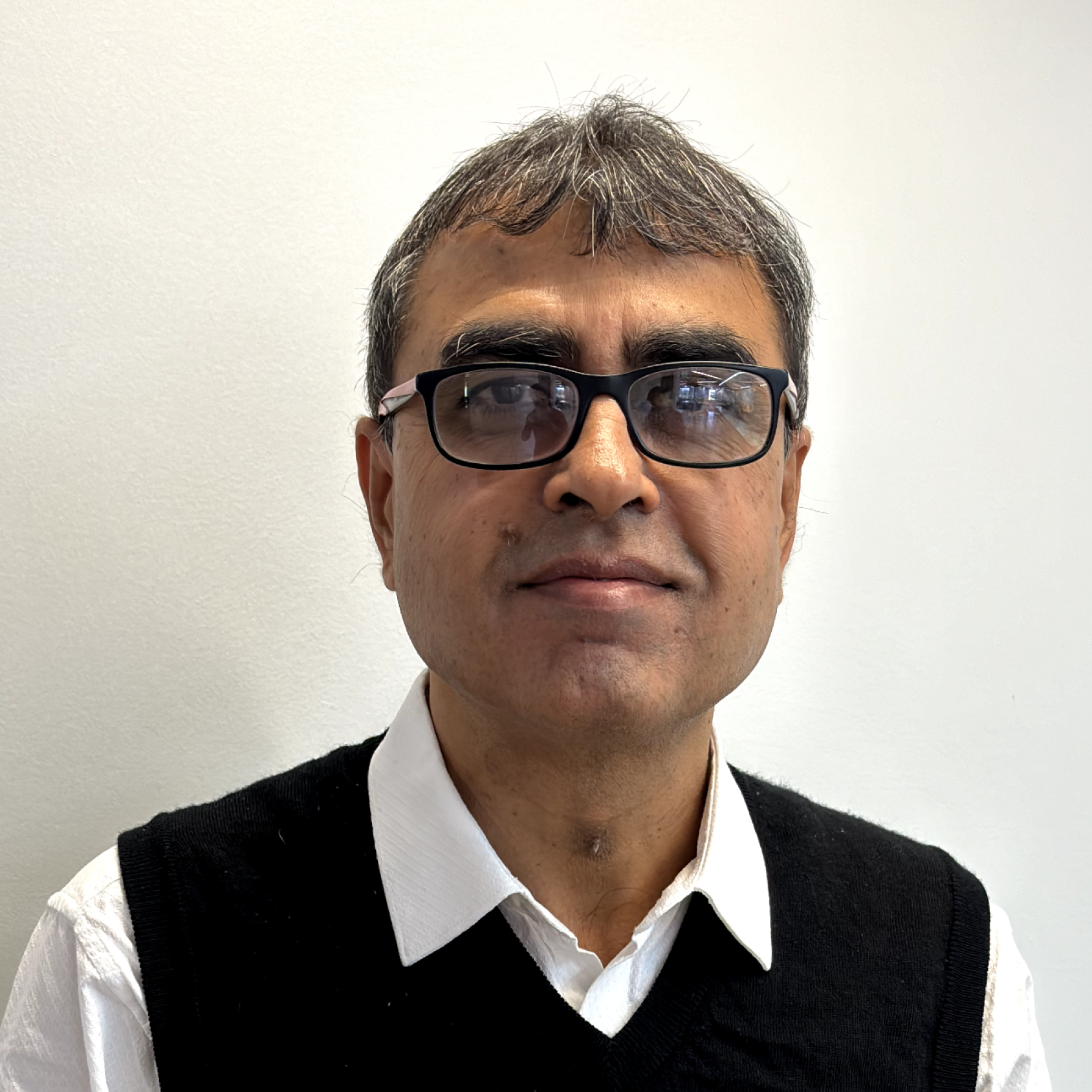
The origin story is not a garage or a whiteboard. It is a spreadsheet with a mismatched vendor code, a bank of unmatched invoices, and a quarterly close that would not, no matter how hard anyone tried, get any faster. Rajeev Pathak was running funtoot, an adaptive-learning company he had founded in 2011, and the part he could not stand was the finance and accounting part. He was good at building AI. He was less good at reconciling ledgers. This turns out to be the sort of asymmetry that produces a company.
Pathak co-founded Hyperbots Inc. in April 2023 with Niyati Chhaya and Ram Jayaraman. Hyperbots is headquartered in Dover, Delaware, engineered out of Bengaluru, and pitched at the corporate CFO. It sells agentic AI co-pilots that automate procure-to-pay, order-to-cash, expense management, analytics and reporting. Two years in, the company has about 110 employees and $8.5M in cumulative venture funding, including a $6.5M Series A that closed in May 2025 and was co-led by Arkam Ventures and Athera Venture Partners with participation from JSW Ventures, Kalaari Capital, Sunicon Ventures and Darashaw & Company. It is training its own finance-specific language model, HyperLM. It has not, so far, tried to do anything except finance.
The interesting thing about Hyperbots is that it is Pathak's second AI company. The first, funtoot, was founded in 2011 to build adaptive-learning software for K-12 students in India. In December 2019, funtoot was acquired by Embibe, the Reliance-owned edtech platform, at a reported price of around $10.1M. Pathak stayed on as Senior Vice President at Embibe through March 2023, running content, media, learning science and delivery. He then left to build Hyperbots. He has not returned to education. Adaptive learning for children and agentic workflows for controllers are, on the surface, unrelated. Both, on closer inspection, involve teaching software to handle ambiguity without asking a human for permission every three seconds. This turns out to be the recurring interest.
Before funtoot, Pathak spent about thirteen years at Wipro Technologies, joining in 1997 and rising to General Manager and Vertical Head. In that role he ran a technology business north of $100M in revenue. Before Wipro, in 1994 to 1996, he was an engineer at the ISRO Satellite Centre in Bengaluru, where he worked on the INSAT-2C, 2D and 2E communications satellites. The distance from satellite firmware to enterprise finance software is longer than it looks, but the underlying skill - convincing very expensive systems to behave predictably when a human is not watching - is not entirely different. He holds a PGSM from IIM Bangalore (1999-2002), which he completed while at Wipro.
Why finance, and why now
The bet at Hyperbots is straightforward, at least on paper. Traditional automation of finance workflows relied on RPA, which is a fancy way of saying scripts that break every time an invoice PDF is laid out slightly differently. Large language models can, in principle, read anything. The problem is that CFOs are not paid to trust things that guess, and general-purpose LLMs guess. Hyperbots' argument is that if you train the models on domain data - chart-of-accounts logic, vendor taxonomies, reconciliation heuristics - and wrap them in an agentic workflow engine that knows the shape of the finance office, you get something a controller will actually sign off on.
Pathak's own summary, delivered when the Series A was announced, put it like this: "We are entering a new era of finance-and-accounting transformation in the U.S. With our proprietary, domain-trained AI models and agentic workflow engine, we can finally automate the heavy, error-prone work that's been holding finance teams back." One notices the word "proprietary." Hyperbots is building HyperLM in-house rather than layering prompts on top of somebody else's frontier model. In a market where every startup insists they are a wrapper by day and a model company by night, this is at least a specific claim.
The go-to-market is the other tell. Hyperbots' senior team spends a striking amount of time in front of CFOs at events like the CFO Leadership series and Finance Leaders Connect in Dallas, where in 2025 the company hosted 47 CFOs and finance leaders in one room to argue about ROI. This is not a self-serve product motion. Pathak's public thesis is that trust is the moat, and moats are built at dinners.