She gave herself a deadline to find a problem worth a decade. The clock ran out on the gender health gap - and she started building.
Priyanka Jain // the founder who reads the data twice
Priyanka Jain runs Evvy from New York, and she runs it like someone who has read the spreadsheet you are about to send her. Evvy is a precision women's health company, and its quiet ambition is enormous: build the single largest dataset on a corner of biology that medicine spent a century waving past. Jain is the co-founder and chief executive. She is also the person who, by her own telling, sat with a frustration long enough to turn it into a category.
The headline version is tidy. Forbes 30 Under 30. Inc.'s Female Founders 500. Worth Magazine's WORTHY 100. A Series A she closed in a fundraising market that was, to put it generously, allergic to first-time consumer-health bets. The lists are real, and she keeps landing on them. But the lists are also the least interesting thing about her, which is exactly the kind of sentence she would push back on with a chart.
What she actually does, day to day, is translate. She takes the messy, stigmatized, under-studied middle of human biology and turns it into something a person can read on a phone and a clinician can act on. She built the machinery so that a single swab returns a map of more than 700 microbes, then wraps that map in language a human being can use. The product is the translation. The translation is the company.
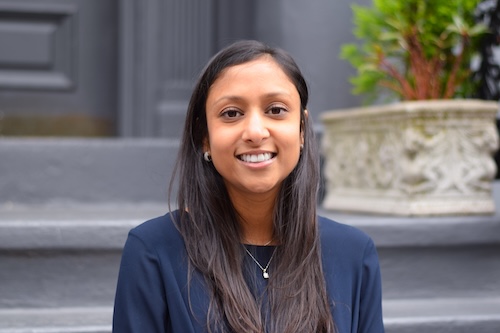
I've spent my career at the intersection of data, product, and equity.- Priyanka Jain
Before Evvy, Jain spent roughly four years as Head of Product at pymetrics, a New York startup that used behavioral science and AI to make hiring less of a coin flip and more of a measurement. The work was about fairness at scale: build algorithms that judged people on what they could do rather than where they went to school. She hired and led a tech team of more than 70 across product, design, data science, and engineering, and helped take the company from pre-revenue to six product lines and over 100 global enterprise clients.
That is the resume line. The throughline matters more. At pymetrics she learned a specific trade - how to point rigorous data science at a problem everyone assumed was unsolvable, and how to ship it as a product real organizations would pay for. When she left, she did not leave the method behind. She just went looking for a problem that was bigger, stranger, and far more neglected.
So she gave herself a deadline. During an exploration period she set a timer on her own curiosity: find a market worth the next ten years, or move on. The search did not end in software. It ended in biology - specifically, in the realization that an entire field of women's health had been running on thin data for decades. The tests were not asking the right questions. The dataset to ask better ones did not exist yet. That gap became Evvy.
I couldn't get answers. I realized we weren't running the right tests.- Priyanka Jain, on the spark behind Evvy
Evvy launched in 2021 with co-founders Laine Bruzek and Pita Navarro. The first product was the first of its kind: an at-home, metagenomic test, CLIA/CAP/CLEP-certified, that reads more than 700 microbes from a single sample and returns personalized insight instead of a shrug. The certification alphabet soup is not decoration. It is the difference between a wellness gimmick and a result a doctor can stand on. Jain insisted on the hard version.
Moving from Head of Product to CEO is a promotion on paper and a personality transplant in practice. A product leader optimizes; a founder-CEO has to decide, raise, hire, and absorb the days when nothing works. Jain has been candid that the jump was its own project. The instincts that made her good at product - read the data, find the real user need, ship the smallest honest version - turned out to be portable. The rest she built on the job.
The fundraising story is the cleanest evidence. Evvy's $14M Series A landed when capital had gone cold on consumer health, when generalist investors had decided the category was too hard and too slow. Total funding now sits near $19M. Closing a round like that, in a climate like that, for a product in a space many investors still found awkward to say out loud, is not luck. It is a founder who can make a skeptic look at the data and change their mind.
The neat narrative says Jain discovered her mission in her late twenties. The truer one says she has been circling it since high school. As a teenager she helped launch the UN Foundation's Girl Up campaign. At Stanford she was a Mayfield Fellow and President of Stanford Women in Business. She chaired the Acumen Fund's Junior Council and joined the XPRIZE Foundation's Innovation Board. None of these are line items she collected for a bio. They are the same commitment, expressed at different scales, for over a decade.
Read that way, Evvy is not a pivot at all. It is the moment her two obsessions - data and women's standing in the world - finally fused into one object she could build. The girl who organized for women's issues and the operator who shipped fair-hiring algorithms are the same person, and Evvy is what happens when she stops splitting her attention.
Our goal is to transform how we define and diagnose the female body. The first product is just the beginning.- Priyanka Jain
Her recognition tracks the ambition. She has served on the Steering Committee for the Innovation Equity Forum, a joint effort of the Gates Foundation and the National Institutes of Health. In 2026 she and her co-founders made Inc.'s Female Founders 500. In 2025 she was named to Worth's WORTHY 100. The awards are a lagging indicator. What they measure is that a category very few people took seriously now has a face, and the face keeps showing up prepared.
Ask what keeps her building and the answer is not the trophies. It is the inbox. She has said the thing that lands hardest is the messages from users - the ones who tell her, in their own words, that the company changed the course of their lives. That feedback loop is the engine. It is also a useful reminder that behind the dataset, every row is a person who finally got an answer.
Most companies sell a product and hope a moat forms later. Jain ran it backwards. The thesis behind Evvy is that the bottleneck in women's health was never ambition or capital - it was data. The field had been making decisions on too few measurements for too long. So the first job was not to sell anything. It was to build the largest dataset in the category, swab by swab, and let that asset compound into everything else: better insight today, better discovery tomorrow.
That ordering shows up in how she describes the work - data, then product, then equity, in that sequence and on purpose. The certification standards she chose are part of the same discipline. It would have been faster and cheaper to ship a lifestyle product with friendly copy and no clinical backing. She chose the regulated, defensible path because the dataset is only worth as much as the rigor behind each row. The slow road was the strategy.
It also explains why she keeps expanding the platform rather than resting on a single hero product. Evvy has grown from a test into something closer to a system - integrating the measurement, the interpretation, and the connection to care into one experience. Each new layer feeds the others. For a founder who spent years building algorithms that got smarter with every data point, this is familiar territory wearing new clothes.
I've spent my career at the intersection of data, product, and equity.
I realized we weren't running the right tests.
There's nothing like reading the messages from people who say the company changed their life.
The first product is just the beginning of how we define and diagnose the female body.