The Quanta File · Profile No. 01
Perry Nisen
A pediatric oncologist who kept getting promoted until he was the one deciding which cancers to chase next.
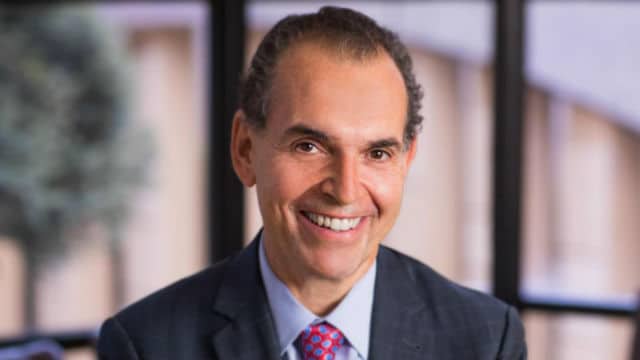
Nisen, mid-stride: the look of a man who has read the resistance data.
A pediatric oncologist who kept getting promoted until he was the one deciding which cancers to chase next.
In a 36-person building in South San Francisco, Perry Nisen is betting the back half of a remarkable career on a three-letter villain: RAS.
For decades, RAS was the white whale of cancer biology. It sits at the center of the signaling that tells a cell to keep dividing, and when it mutates - which it does in roughly a quarter of all human cancers - it jams the throttle open. Pharmacologists circled it for thirty years and mostly walked away. The protein's surface was too smooth, too featureless. They had a name for that: undruggable.
Nisen runs Quanta Therapeutics, a clinical-stage biotech built on the idea that "undruggable" was a failure of imagination, not chemistry. Instead of trying to plug RAS head-on, Quanta uses allosteric modulation - reaching the protein sideways, locking it into shapes it cannot use. The platform leans on a technology with a name that sounds borrowed from a physics lab: Second Harmonic Generation, used to watch proteins change conformation in real time. The company name is a tell. Quanta. Quantitative. The shape of things.
The two programs are QTX3034, a multi-KRAS inhibitor, and QTX3046, tuned to the G12D mutation that haunts pancreatic and colorectal tumors. First-generation KRAS drugs cracked one variant, G12C, and then ran into a wall of resistance and modest results. Quanta's pitch is the next wall over: the mutations the early winners could not touch, taken orally, designed to last.
That is the work now. But the reason to take Nisen seriously is the road behind him, because he has stood at nearly every station of the drug-discovery railway.
Nisen started as a pediatric hematologist-oncologist - the doctor in the room when a child has leukemia. Before that he was the Lowe Foundation Professor of Neuro-Oncology at the University of Texas Southwestern Medical Center, studying the molecular genetics of human cancers. His scientific pedigree is unusual: he trained under Stanley Norman Cohen, a co-inventor of recombinant DNA, and the developmental biologist Lucy Shapiro. Both names belong in textbooks. He earned his MD and PhD at the Albert Einstein College of Medicine after a BS at Stanford, then did his residency at Columbia.
From academia he crossed into industry, running Cancer Research and then Oncology Clinical Development at Abbott Laboratories. Then came GlaxoSmithKline, where he stacked titles - Oncology Therapy Area Head, interim Chief Medical Officer, Senior Vice President of Science and Innovation. As head of oncology he was accountable for the portfolio from target to market. That division was later acquired by Novartis for more than $16 billion. Whatever else you make of a number that large, the drugs passed through his hands first.
In 2014 he took an unexpected turn: CEO of the Sanford Burnham Prebys Medical Discovery Institute, a nonprofit research powerhouse, where he held the Donald Bren Chief Executive Chair and was responsible for strategy, operations, and performance across the whole organization. He stepped down in 2017. By most measures that is where a career ends - on the top floor of an institute, retired.
Instead he joined Sofinnova Investments in 2018 as an Executive Partner, became the founding Executive Chairman of Quanta during its formation, and in June 2021 took the CEO seat outright. The retirement lasted about as long as a good idea takes to get funded. He also sits on the board of Teva Pharmaceuticals and chairs its Science and Technology Committee, which means that on any given week he is both running a startup and helping steer one of the largest generic-drug makers on earth.
RAS sits at the heart of the MAPK pathway. Pancreatic, colorectal and lung tumors lean on it hardest.
Quanta's clinical thesis is narrow and deliberate: oral, selective, built to outlast resistance.
There is a pattern in the resume that says more than any single title. Nisen keeps choosing the harder problem, and he keeps switching seats to do it - clinician to professor, professor to executive, executive to nonprofit chief, chief to investor to founder. His research curiosity has roamed from the molecular genetics of cancer to X-recessive disorders in females, and his honors stack up quietly: Alpha Omega Alpha, the Macintosh Fellowship at Columbia, a Basil O'Connor Research Award from the March of Dimes, a Woodward Visiting Scholar appointment at Harvard.
What he is building at Quanta is the through-line of all of it - the bedside urgency of a pediatric oncologist, the portfolio discipline of a pharma executive, and the patience of someone who has watched "undruggable" turn into "not yet." The chips below are the temperament that holds it together.