The Profile / Enterprise Networking
Pavel
Bykov
He calls his product a building safety inspector. It looks for the rusted rebar you cannot see, in a network you thought you understood.
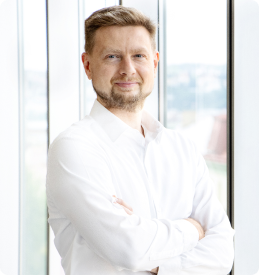
He calls his product a building safety inspector. It looks for the rusted rebar you cannot see, in a network you thought you understood.
Pavel Bykov spent fifteen years inside Fortune 500 networks before he decided the honest thing to do was build the tool he had been wishing existed. That tool is IP Fabric, which he co-founded in 2016 and still runs as chief executive. It is a network assurance platform, which is an industry phrase that mostly means: you point it at your enterprise network and it builds a live model of what is actually there - devices, links, routes, ACLs, policies, forwarding paths - so that when someone in operations asks a question, they can get an answer from software rather than from memory.
The elevator pitch comes from Bykov himself, delivered in an alumni interview with the University of New York in Prague, where he earned his MBA in 2011. "Our product is akin to a building safety inspector," he said, "ensuring that the whole building does not collapse in on itself because of some rusted rebar." It is a founder-friendly analogy. It is also the kind of thing an engineer says when he has watched a lot of buildings almost collapse.
IP Fabric's customer roster is the argument for its existence. Red Hat runs on it. Major League Baseball runs on it. Air France runs on it. These are organizations whose networks are complicated enough that no single human being can hold the topology in their head, and whose downtime is expensive enough that discovering a misconfiguration through an incident is not a viable operations model. What Bykov sells them, put bluntly, is the ability to look at their own network and be sure of what they are seeing.
There is a version of this story where the founder pivots into the AI narrative and the pitch deck starts talking about agents and copilots. Bykov does not entirely resist this - IP Fabric's marketing does invoke AI, digital twin, zero-trust validation, all the necessary category words - but the underlying argument he keeps returning to is that automation only works when the map matches the territory. If your automation is running against a stale CMDB, or a Visio diagram someone drew in 2019, or a spreadsheet a network engineer maintains under duress, the automation will confidently do the wrong thing at scale. That is Bykov's core operator instinct: get the ground truth first, then automate.
"Before jumping into the AI deep end, it's vital to understand how infrastructure really fits together."Pavel Bykov, Forbes Technology Council
Bykov's founder biography is unusually linear for the genre. It does not include a Stanford dorm room, a viral side project, or a widely retweeted resignation letter. It includes Yakima Valley College, in Washington State, where he earned an AAS in information technology. It includes a stint at Verizon between 2011 and 2015 as a lead consulting engineer and then principal engineer - the kind of jobs where you spend your days inside the routing tables of very large customers and mostly stay out of the pitch decks. And it includes an MBA from the University of New York in Prague, which he took because he already knew he wanted to build something and thought he ought to understand the accounting side first.
The accounting matters, apparently. In the same UNYP alumni interview, Bykov mentioned that investors had praised IP Fabric's "pristine financial accounting from a company at such an early stage." He credited the classes, not the CFO. This is a very engineer thing to say. It is also probably true.
After Verizon he spent a year as an independent consultant on complex IT projects. In 2016 IP Fabric was founded. In June 2023 the company closed a $25M Series B, bringing total disclosed funding to somewhere around $30.7M. The company keeps its engineering center of gravity in Prague and its commercial center of gravity in Boston, where it operates from a Beacon Hill address on N Washington Street. It reports around 150 employees. Bykov himself sits on the Forbes Technology Council, contributing occasional essays on AI, network digital twins, and the eternal gap between security teams and IT operations.
Reduced to its structural work: IP Fabric ingests, normalizes and models a customer's live network state, from campus and data center gear to public-cloud fabrics, and then lets engineers query, visualize, validate policy against, simulate change on, and audit that model. The pitch words - digital twin, network assurance, continuous compliance - describe the same underlying object.
Walks the network to build a topology, not a guess. Cloud and on-prem. Firewalls included.
A queryable, normalized representation of what is actually running - not what the diagram claims.
Rules that ask: is the network doing what you meant it to do? End-to-end path validation, security posture, drift.
API-first surface for NetDevOps pipelines, ticketing, and change-impact analysis before rollout.
Total disclosed funding is approximately $30.7M across rounds. The Series B, in June 2023, is the load-bearing raise. The rest is context.
"Our product is akin to a building safety inspector, ensuring that the whole building does not collapse in on itself because of some rusted rebar."
"AI can deliver benefits, but quick, broad deployment regardless of context will likely result in slop."
"Before jumping into the AI deep end, it's vital to understand how infrastructure really fits together."
"Network modernization must become proactive and strategic before operations degrade."
Bykov's Forbes Technology Council profile lists his personal interests as nuclear engineering, racquet sports and travel. Two of those are ordinary. Nuclear engineering is not the answer most software CEOs give when asked what they do for fun.
He held CCIE and CCSI certifications - the Cisco engineer and instructor credentials - which put him in the small population of network people who have both operated production infrastructure and taught it to other engineers. This is unusually load-bearing for a founder in this category, because the customer base is other CCIEs, and they can tell.
IP Fabric's headquarters is Prague. The U.S. office is Boston, on N Washington Street. The company's stack, by outside estimation, leans Python, TypeScript, Go, PostgreSQL, Kubernetes - which is roughly the toolkit any modern infrastructure-software company would list if you asked, and probably means the answer is honest.
His path into founding included community college in Washington State and an MBA in the Czech Republic, which is not the usual routing for a founder of a company selling into Fortune 500 network teams. When he says his investors flagged how clean the books were, it reads less like a boast and more like an engineer noticing that a well-executed control plane is worth mentioning.
He appears occasionally on video - a 2021 IP Fabric Vision interview on YouTube, a Tech Field Day product demo, various customer conference talks. He is not a founder who lives on social. His public writing is on the IP Fabric blog and Forbes Tech Council. Both read like engineer writing, not marketing writing.
He keeps a connection to UNYP, participating in classes and speaking with students who are trying to work out how to become the next thing. His advice, distilled from interviews, is roughly: learn the accounting.
Co-founder and CEO of IP Fabric, a network assurance platform founded in 2016. Headquartered in Prague with a U.S. office in Boston.
It builds an automated model - a digital twin - of an enterprise network, so operators can discover, visualize, query and validate what is actually running across on-premises and cloud infrastructure.
Publicly referenced customers include Red Hat, Major League Baseball and Air France.
Around $30.7M total, including a $25M Series B in June 2023.
AAS in IT from Yakima Valley College, MBA in IT from the University of New York in Prague (2011), then Verizon lead and principal engineering roles, then independent consulting, then IP Fabric.