YesPress Profile / Person / Executive
Paul
Schiefer.
He started on the canning line in high school. Two decades later, the family that founded Amy's Kitchen handed him the company.
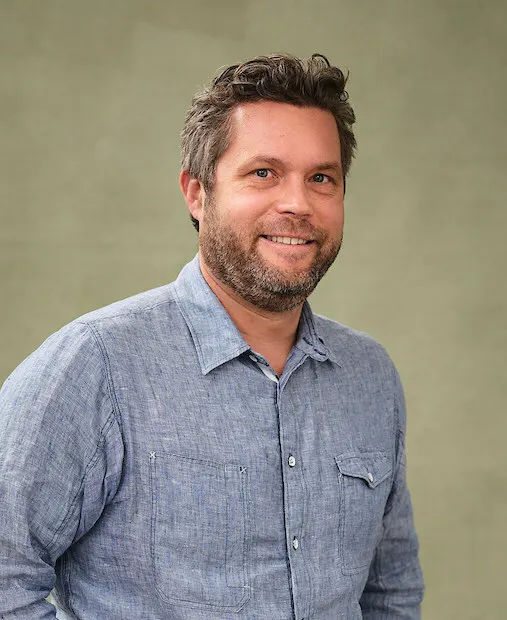
Schiefer / olive backdrop / 2026
He started on the canning line in high school. Two decades later, the family that founded Amy's Kitchen handed him the company.
In April 2026, Andy Berliner - who built Amy's Kitchen around his wife and his daughter and the soup that started everything - stepped sideways into the chairman's seat. The chair he left behind went to a guy who first showed up to work the canning line as a teenager.
Paul Schiefer is the kind of executive promotion that reads like a parable: high-school kid clocks in to label cans of organic vegetable soup in Petaluma, comes back after college, and proceeds to spend two decades quietly inheriting almost every job in the building. IT. ERP. International. Sustainability. Government affairs. Chief of staff. President. Then, on April 22, 2026, CEO. The cans on the shelf are the same cans. The desk is different.
Schiefer grew up in the Bay Area and studied business economics at UC Santa Barbara from 1999 to 2003. He left Amy's for a stint as a project manager at the tech firm Agilysys and picked up a project-management certificate from Villanova along the way. In 2009 he came back. The company he returned to was smaller, scrappier, and a little stranger - a family-run organic frozen food maker betting on a market that the rest of grocery still treated as a niche. He stayed because the bet was working, and because someone needed to wire up the back office while the founders kept inventing burritos.
For most of the 2010s, Schiefer's job description was «whatever the company is trying to do next.» That meant standing up ERP systems, which is not glamorous. It meant translating an American organic brand into European and Asian retail channels, which is harder than it sounds. It meant arguing for sustainability targets when sustainability was still a marketing problem. And it meant doing chief-of-staff work for a founder-led leadership team - the unsung craft of making the trains run on time when the trains have strong opinions.
Two stretches stand out. He led Amy's Drive Thru - the company's first and only fast-food restaurant in Rohnert Park, opened to prove an organic, vegetarian drive-thru could actually work at a price a teenager could afford. And he championed the company's B Corporation certification, which is the kind of certification that sounds like paperwork and turns out to be a multi-year audit of how you treat every supplier, employee and watershed in the business.
Between Amy's chapters there was a small detour. From 2012 to 2014, Schiefer co-founded a startup called Eatsense and was its CEO. The startup didn't take. Amy's did.
Schiefer was promoted to president in 2023, part of a new generation of leadership the Berliners installed to take the company past its founder era without losing the recipe. The mandate was unglamorous in the way that good mandates are: tighten the operation. By the time the CEO announcement landed in April 2026, the company's communications were claiming the strongest gross margin performance in a decade and a 60 percent improvement in profitability over his time as president. Whether you trust press-release math or not, the throughline is consistent - he is an operator running a mission-driven company, and the operating part finally got attention.
What he says he is going to do next is three lines on a slide: keep Amy's at the front of food culture, double down on sustainability and responsible business, and run the place better every quarter. The reason it's interesting is that those three lines have, historically, fought each other in the food industry. Innovation eats margin. Sustainability eats margin. Running a tighter ship can quietly eat the values that make a brand worth buying. The job is to do all three without flinching.
Amy's Kitchen has spent forty-plus years as a strange American business - a family-owned, fully privately held, organic-only manufacturer with national distribution and a soup-can aesthetic that hasn't changed in a generation. It became a default in the freezer aisle because the food worked and because the company refused to dilute the values that made the food work. Founder-led companies tend to wobble in their first non-family transition. Schiefer was hired to make sure this one doesn't.
He has the long resume to do it. He has worked every functional seat at the company. He has the trust of the Berliners, who are still in the building. And he has the unusual credential of having literally packed the product into cans. That is a useful credential when the conversation in the room turns to what the product can and cannot afford to be.
Schiefer's stated worldview is short, and he repeats it: doing the right thing for the food, the people who make it, and the planet it comes from. In a category that has spent the last decade chasing protein fads and ingredient theatrics, that's a quieter pitch than most. His public talks - on podcasts like Brands for a Better World, From Intern to President, and Mark Bittman's food show - circle the same themes: organic agriculture as climate strategy, regenerative supply chains as a hedge against everything, employee ownership of the mission, and the idea that convenience food can stop being a moral compromise.
He sits on the board of the Organic Trade Association, which is the industry body that argues for organic farming in front of the USDA. It is policy work, not photo-op work, and it is consistent with how he describes the company's job in the world.
Three things. First, whether Amy's pushes harder into regenerative agriculture sourcing - the next stage past organic, and the one Schiefer talks about most. Second, whether the Drive Thru concept comes back from its hiatus in a new form. Third, what the company does on the international side, which Schiefer himself built and which is the easiest lever for a privately held food company that wants to keep growing without taking on outside capital. The last reported funding round on Amy's was logged in February 2024 as «Other,» with an amount listed as zero, which is private-company shorthand for «we are still ours.»
Mostly, watch the cans. The cans are the thing. Schiefer's whole career has been about the cans staying good while everything around them grew up.
Amy's has always been about doing the right thing - for our food, our people, and our planet.
Stay in front of food culture. For a forty-year-old organic brand, that means evolving the freezer aisle without losing the regulars who buy on autopilot.
Push past organic into regenerative sourcing and climate-friendly agriculture. Keep the B Corp commitments. Hold the supplier relationships that took years to build.
The unsexy part. Margin discipline, supply chain, ERP. The work that bought Schiefer the credibility to be named CEO in the first place.